Spanish learning apps vs lessons with a teacher
1on1Spanish gives you one-on-one Spanish lessons with qualified native teachers, online across the United States. So we have an obvious interest here — which is exactly why this page starts with what Spanish learning apps do better than we do.
The useful question is not which one is better. It is which one is holding you back right now.
Take your free level test
Spanish learning apps are better than their critics admit
A self-study app is the reason a great many adults in the United States have any Spanish at all, and dismissing that is both rude and wrong. Apps solved the hardest problem in language learning for a beginner, which is starting at all.
They ask nothing of your calendar, they cost a fraction of anything with a human in it, and they let you be bad at Spanish in private, which matters more than most methods admit. If you have kept a daily streak going for months, you have already done the part most people never manage.
So this page is not an argument that you should delete your app. It is an argument about the specific point at which an app can no longer teach you the thing you are now stuck on.
Four things an app does better than a teacher
These are real advantages, not consolation prizes. On each of them, a lesson loses.
-
Daily habit
An app is available in the four minutes you spend waiting for coffee, and it will nag you. Nothing with a scheduled human in it can compete with that, and frequency is genuinely one of the two things that decide whether anyone learns a language.
-
Early vocabulary
Building your first several hundred words is a memory problem, and spaced repetition on a phone is an excellent solution to a memory problem. Paying a teacher to drill flashcards with you would be a waste of both of you.
-
Starting without fear
Nobody hears you get it wrong. For an adult who has not been a beginner at anything in twenty years, that privacy is often the difference between starting and not starting.
-
Price
A few dollars a month against the cost of a person's time is not a close comparison, and pretending otherwise would insult your arithmetic. What a lesson has to justify is the difference, not the total.
The wall is always the same, and it is not vocabulary
People rarely leave an app because they ran out of words. They leave because of a specific, repeatable experience: they understand the lessons perfectly, then a real person says something at real speed and nothing comes out.
That gap is the difference between recognizing Spanish and producing it. An app trains recognition beautifully — you pick the right option, you tap the right word — and production is a different skill that only improves under pressure from another person.
Below is where that shows up, in the order people usually hit it.
Three things a self-study app cannot do for you
Not because the software is bad. Because each of these needs a second person in the room.
-
Hear you and correct you
An app can check whether you chose the right answer. It cannot hear you hesitate, cannot tell you that what you just said was grammatically perfect and socially strange, and cannot answer the question you have while you still care about the answer.
-
Talk at the speed of a real person
Recorded audio is slowed down, cleanly pronounced and free of interruptions. A person in a kitchen in Texas is none of those. Understanding a real speaker at real speed is a trainable skill, and it is trained by being spoken to, not by listening to a recording.
-
Teach you register
Spanish marks respect, distance and warmth in places English does not. Getting it wrong reads as rudeness rather than as a mistake, and no self-study app will ever tell you that the sentence you just built was correct but landed badly.
What a lesson buys that software cannot
A lesson here is 25 minutes, one-on-one, with a qualified native teacher who has read your file before you arrive. You speak for most of it and you are interrupted while the sentence is still warm.
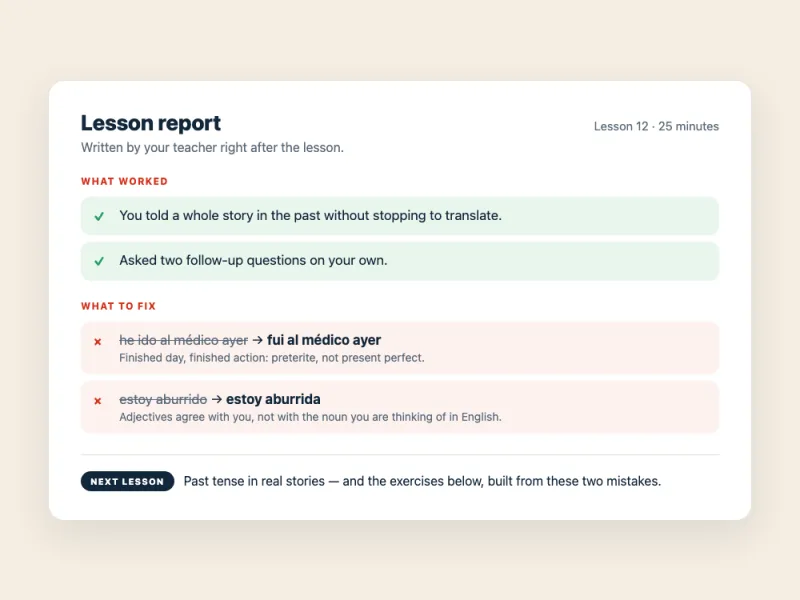
Afterwards you get a written report with your corrections and exercises generated from the mistakes you made in that lesson — not the next chapter of a syllabus, because you are not the average learner the syllabus was written for.
That is the whole difference, and it is narrow: someone is professionally obliged to notice what you get wrong and interrupt you about it. You can read how the method works in full before deciding whether that is worth paying for.
How to use both without wasting either
Most people who get somewhere with Spanish end up running both at once. The mistake is asking each one to do the other one's job.
- Keep the app for the memory work Vocabulary, spaced repetition, the four spare minutes in a queue. This is the part where software wins outright and a lesson would be an expensive way to do the same thing worse.
- Spend live time speaking, not reviewing If you spend a lesson going over material you could have read, you paid for the wrong thing. Lesson time is for producing Spanish under pressure and being corrected on the spot.
- Let your errors choose the grammar One grammar point a week, taken from what you actually got wrong rather than from whatever comes next. Our free Spanish grammar guides are there for that, and they cost nothing.
- Practise out loud on the days between Every plan includes unlimited AI practice with our conversation partner, which handles the repetition that needs volume rather than judgement. Silent review does not count: the point is producing sound.
Which one you need depends on where you are stuck
If you cannot get yourself to do anything most days, your problem is habit and an app is the better tool. Buying lessons to solve a motivation problem usually ends with a plan you stop showing up to, which is worse than a streak you keep.
If you understand far more than you can say, your problem is production and no amount of tapping will fix it, because the thing you are avoiding is the thing you need to do.
If you are not sure which of the two you are, that is what the level test is for. It is a real conversation with a teacher rather than a quiz, and ten minutes of speaking will tell you more about your Spanish than another month of guessing.
If the wall you have hit is the speaking one, that is the whole reason this school exists. You can learn Spanish online with a real teacher and keep the app for the vocabulary it is genuinely good at.
What lessons cost next to an app subscription
Plans run from $84 a month for one lesson a week up to $264 a month for four. Every plan is one-on-one, 25 minutes, with a qualified native teacher. Book any teacher, any available slot. No weekly caps.
An app costs less, and it should — nobody's time is in it. What you are deciding is whether the specific things a person adds are worth the difference to you right now, and for a lot of people the honest answer is not yet.
There is no contract either way, so the decision is reversible in a month.
Every plan includes unlimited AI practice with our conversation partner, for the days between lessons.
Your first month is $1 — on any plan.
Questions people ask before switching
Are Spanish learning apps enough on their own?
They are enough to build a habit, a first few hundred words and a solid grasp of how the language is put together. They are not enough to make you able to hold a conversation, because they cannot hear you speak or correct you in the moment. Most people who only use an app understand a lot of Spanish and freeze when someone answers them.
Should I finish my app before starting lessons?
No, and waiting is the most common expensive mistake here. There is no level at which you become ready to speak; you become able to speak by speaking badly for a while first. Starting lessons early also makes the app more useful, because your errors start telling you which words are actually worth learning.
I have a long daily streak. Am I wasting my time?
Not at all. A streak is evidence that you can do the hard part, which is showing up on days you do not feel like it. Keep it. The question is only whether the thing you practise every day is still the thing you most need, and after several months of an app that is usually speaking rather than vocabulary.
Can an app teach me to have a conversation?
It can teach you the raw material for one. What it cannot supply is an unpredictable person who talks at full speed, misunderstands you, and reacts to how you said something rather than to what you selected. Conversation is a skill practised against other people, and that is true whether the other person is a teacher, a friend or a stranger.
How do I know if I am ready for lessons with a teacher?
If you can say a few sentences about yourself, you are ready, and if you cannot, a teacher is the fastest way to get there. Take the free level test and find out where you actually are: it is a real conversation, no card required, and you leave with an honest read on your level whether or not you book anything.
Find out what your Spanish sounds like out loud
A short conversation with a qualified native teacher, online, no card. It will tell you in ten minutes what another month of tapping will not: whether your problem is words, or saying them.
Take your free level test