
Medical Spanish for the shift you are working tonight
1on1Spanish gives you private Spanish lessons with qualified native teachers, online across the United States. Lessons built around your service, your patients and the conversations that come up between the ones an interpreter is called for.
The goal is not to replace the interpreter. It is to be useful in the twenty minutes before one arrives.
Take your free level test
The interpreter is not always in the room
Every clinician who works with Spanish-speaking patients knows the gap: the line is busy, the tablet is charging, the family member offering to translate is eleven years old, or the exchange is too small to justify the call and too important to skip.
That gap is where language stops being a nicety. A patient who cannot describe where it hurts gets a slower workup, and a patient who nods without understanding the discharge instructions comes back.
Nothing on this page will close that gap completely. What private lessons do is make it narrower, and make you better at recognizing when you have reached its edge.
Where clinical Spanish breaks down
Rarely in the vocabulary. Almost always in one of these three.
-
Taking the history
You can ask ¿dónde le duele? The problem is the answer: a description of pain that uses words no glossary lists, delivered fast, by someone frightened. Understanding is the harder half and the one that gets practiced least.
-
Being understood back
Explaining a plan in Spanish is a different skill from naming things in Spanish. Register matters here — usted, softeners, how you deliver bad news — and getting it wrong reads as coldness rather than as a language mistake.
-
The family in the hallway
The daughter who wants to know what is happening, the husband who has a question he did not ask inside. These conversations are not clinical documentation, and they are the ones patients remember.
Medical Spanish vocabulary is not the hard part, but here is where it starts
A short sample of the everyday clinical phrasing lessons work on, in Latin American Spanish. Knowing these does not qualify anybody to run a consultation in Spanish; it is the floor, not the ceiling.
| Español | English |
|---|---|
| ¿Dónde le duele exactamente? | Where exactly does it hurt? |
| ¿Desde cuándo se siente así? | How long have you felt like this? |
| ¿El dolor es punzante, ardiente o como presión? | Is the pain sharp, burning, or like pressure? |
| ¿Es alérgico a algún medicamento? | Are you allergic to any medication? |
| ¿Qué medicamentos toma actualmente? | What medications are you currently taking? |
| Voy a tomarle la presión. | I am going to take your blood pressure. |
| Tome esta pastilla dos veces al día con comida. | Take this pill twice a day with food. |
| Si empeora, regrese a emergencias de inmediato. | If it gets worse, come back to the emergency room right away. |
| Voy a llamar a un intérprete para explicarle esto bien. | I am going to call an interpreter so this is explained properly. |
That last one is on the list on purpose. Knowing how to hand the conversation over is part of doing this well.
Medical Spanish classes built around your service, not a glossary
The Spanish an emergency nurse needs and the Spanish a pediatric dietitian needs overlap by very little, so there is no shared word list here. You bring the real material: the intake questions you ask forty times a week, the discharge sheet you hand over, the conversation that went badly on Thursday.
Your teacher works from that. Because every lesson is one-on-one, the twenty-five minutes go on your service and nobody else's.
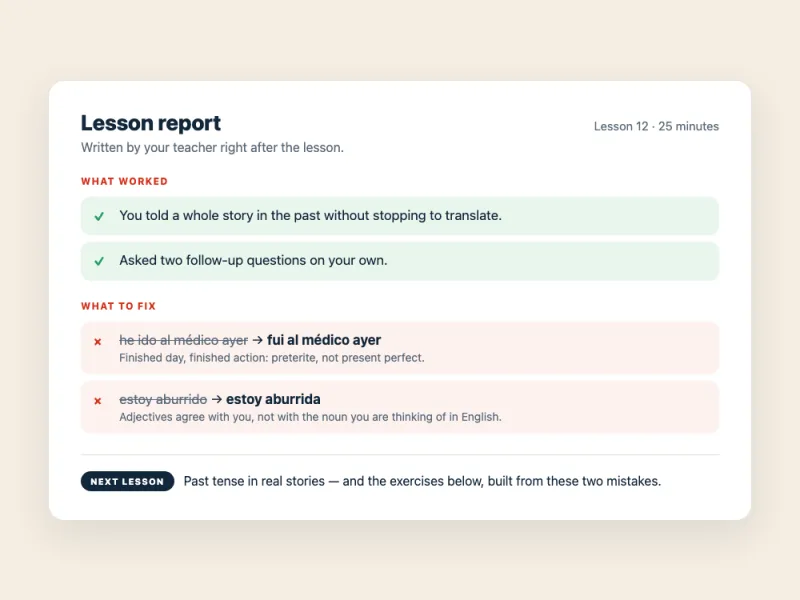
After each lesson you get exercises generated from the mistakes you made in it, and every plan includes unlimited AI practice for the repetition — running the same intake ten times at midnight, which is exactly what repetition is for and exactly what a teacher should not be spending your money on.
What these lessons are not
They are not clinical training, they carry no certification, and they do not qualify anyone to work in Spanish. We are a language school; we do not accredit medical competence and we would not know how.
They also do not replace a professional interpreter. Consent, complex diagnoses, anything with legal weight and anything you would not be comfortable defending in a chart still goes through the interpreter service your institution provides. Any provider telling you that a few months of lessons changes that is selling something you should not buy.
What lessons do change is the daily texture of your work: understanding what a patient volunteers, being able to reassure someone while you wait, catching the detail that gets lost in a rushed translation, and knowing precisely where your Spanish stops.
Spanish for nurses and healthcare professionals who work shifts
A 25-minute lesson fits into a break or the hour before a night shift, and that is the entire argument for the length. Teachers are available early, late and across time zones, so a rotating schedule is a booking problem rather than a reason not to start.
You book the slots you want and move them when the rota moves. Plans are monthly, with no contract and no minimum term, which matters when your next three months are not the same as your last three.
Everything runs in a browser, like the rest of our online Spanish classes — nothing to install on a hospital machine you have no rights to install anything on.
The Spanish underneath all of this is ordinary Spanish; what changes is the vocabulary and the situations you rehearse. If your reasons reach past the ward, you can learn Spanish online with the same teachers and the same 25-minute lessons.
What medical Spanish classes cost
Plans run from $84 a month for one lesson a week up to $264 a month for four. Every plan is one-on-one, 25 minutes, with a qualified native teacher. Book any teacher, any available slot. No weekly caps.
Same teachers and same monthly plans as everyone else; there is no clinical tier and no minimum term. Many people expense it through professional development, and the invoice shows the plan and the month.
Every plan includes unlimited AI practice with our conversation partner, for the days between lessons.
Your first month is $1 — on any plan.
Questions healthcare professionals ask before they start
Will medical Spanish lessons let me stop using an interpreter?
No, and we would not want them to. Consent, complex diagnoses and anything with legal weight go through your institution's interpreter service regardless of how good your Spanish gets. What lessons change is the ordinary ground in between: history taking, reassurance, follow-up questions, and knowing exactly when to stop and call.
Do you offer a certification in medical Spanish?
We do not. We are a language school with qualified native teachers, and we have no standing to certify clinical language competence. If your employer requires a formal credential, that comes from an accrediting body, not from us. Lessons here are practice and instruction, and we describe them that way on purpose.
I know medical Spanish vocabulary already. What would lessons add?
Usually listening and register rather than words. Most clinicians who study terminology can produce a question and then lose the answer, because patients do not describe symptoms in textbook language. Time with a teacher goes on comprehension at real speed and on sounding warm rather than clipped.
Which variety of Spanish will I be taught?
Latin American Spanish by default, since most Spanish-speaking patients in the United States have roots there, and we match to a specific country when your patient population and the schedule allow. Our teachers come from across Latin America and from Spain. Mention your setting in the level test.
How long until I can take a patient history in Spanish?
It depends on where you start and how often you speak, and anybody quoting you a number without asking both is guessing. What we can say is that narrow, repeatable exchanges like an intake improve well before general conversation does, because that is precisely what one-on-one practice is good at.
Find out where your clinical Spanish actually is
A short conversation with a qualified teacher, online, no card. Tell them what your service is and what keeps going wrong, and they will tell you honestly what is realistic and where to start.
Take your free level test