Spanish classes for adults who got nowhere the first time
1on1Spanish gives you private Spanish lessons with qualified native teachers, online across the United States. Two years of high school Spanish left you with the numbers and the colors. This is the other thing.
You are not bad at languages. You were taught in a room with twenty-nine other people.
Take your free level test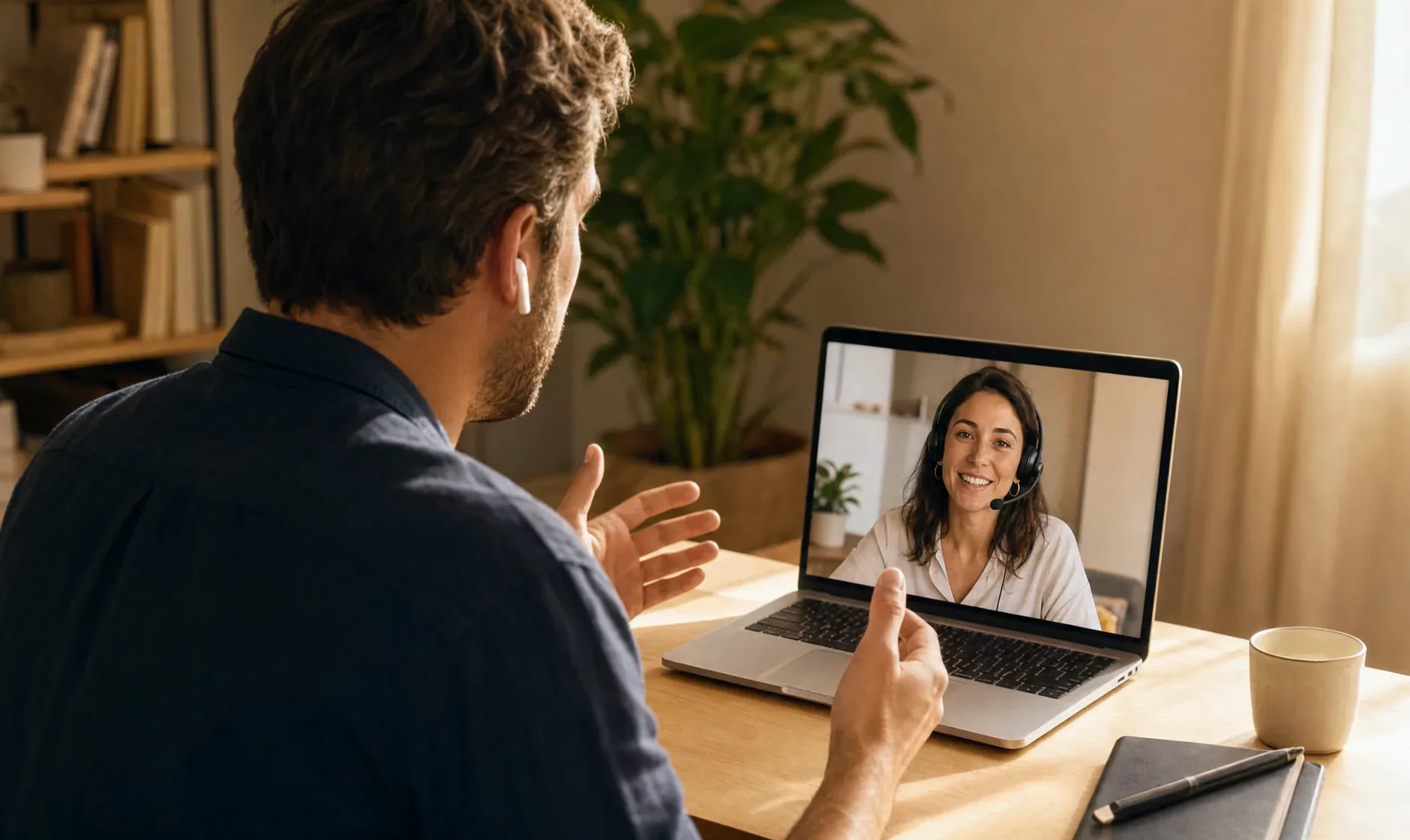
Learning Spanish as an adult is different, not worse
Adults memorize vocabulary more slowly than teenagers do and understand structure far faster. A fifteen-year-old absorbs a verb table without asking what it is for; you will ask, and once somebody answers you properly, you will use it correctly for good.
That trade is in your favor more often than not. What it means in practice is that lists are the wrong tool for you and explanation is the right one — and explanation is exactly what a classroom never has time for.
The other adult advantage is that you know why you are here. Nobody is making you.
What actually stopped you last time
In our experience it is almost never the grammar. It is one of these three, and each of them has a specific fix.
-
The room
In a group class you speak for about ninety seconds an hour and spend the rest listening to other people be wrong. Speaking is the only part that transfers, and group format is structurally bad at it.
-
The clock
An hour of Spanish plus travel is a two-hour commitment, so it becomes the thing you cancel first. Anything that only works on a good week does not work.
-
The fear
Most adults have not been bad at something in public for twenty years, and being a beginner again in front of witnesses is genuinely unpleasant. This is the real reason people quit, and almost nobody says it out loud.
One-on-one means nobody watches you get it wrong
There is no class to hold up, nobody ahead of you and nobody sighing behind you. You can ask the same question three times, you can be slow on a Tuesday, and the only person who sees any of it is a professional who has watched a thousand adults do exactly the same thing.
Teachers here are trained to teach, not just to speak Spanish. That distinction shows up in how they correct: you get told what you said, why it came out that way, and what to do instead — rather than being handed the right sentence and moved along.
After every lesson you get exercises built from the mistakes you personally made in it. Not a generic worksheet. The list of things that tripped you up that day.
What your first lesson actually looks like
Written out in full because the fear of this is the main reason adults never book one.
- You click a link It opens in your browser. Nothing to install, no account for your family to see, no camera required if you would rather keep it off the first time.
- Your teacher already knows something about you They have read what you put in the level test. You do not have to explain from scratch that you did two years in high school and remember almost none of it.
- You talk more than you expect to Badly, at first. That is the point of the lesson and not a sign it is going wrong. A trained teacher steers rather than lectures.
- You get corrected out loud On the spot, on the things that matter, and not on every single article. Being corrected feels worse in your head than it does in the room.
- It ends after twenty-five minutes Before you are tired, which is deliberate. You finish still able to think in it, and you get your exercises the same day.
Adult Spanish classes that survive a bad week
A 25-minute lesson fits in a lunch break, before the school run, or after the house goes quiet. That is the whole reason it is short: an hour is a better lesson and a much worse habit, and habit is what decides this.
You book the slots you want and move them when life moves. Teachers are available early, late and across time zones, so the plan does not depend on your Wednesday behaving.
Everything runs in a browser, like the rest of our online Spanish classes, and between lessons every plan includes unlimited AI practice for the repetition part — the drilling a person should not be spending your money on.
None of this is an adults-only arrangement, incidentally. It is how the school works: everyone who signs up to learn Spanish online with us gets the same 25 minutes, the same qualified teachers and the same freedom to move a lesson.
The best way to learn Spanish as an adult is to speak badly, on purpose, to someone qualified
Every method that works has that in common, and every method that fails avoids it. Apps avoid it because software cannot judge whether you were understood. Group classes avoid it by arithmetic. Watching television avoids it entirely.
What a private teacher does that none of those do is answer you — at real speed, in a real accent, with a real face reacting to what you just said.
You can read how we choose our Spanish teachers before you book anything, including where they are from and what they are qualified in.
What adult Spanish classes cost
Plans run from $84 a month for one lesson a week up to $264 a month for four. Every plan is one-on-one, 25 minutes, with a qualified native teacher. Book any teacher, any available slot. No weekly caps.
There is no adult track and no separate price: everybody here is an adult. Two lessons a week is the cadence most people settle on once they have tried one, and you can move up or down each month.
Every plan includes unlimited AI practice with our conversation partner, for the days between lessons.
Your first month is $1 — on any plan.
Questions adults ask before they start
I studied Spanish in high school and remember nothing. Where do I start?
Further along than you think, and the level test is how we find out where. Most people in your position have passive knowledge they cannot reach under pressure, which is a different problem from being a beginner and needs different lessons. Starting in the wrong place is the main reason adults quit a second time.
Am I too old to learn Spanish?
No, and the research on this is less flattering to teenagers than people assume. Adults acquire vocabulary more slowly and grammar considerably faster, and they stick with things for better reasons. What genuinely changes with age is accent, which matters far less than being understood.
What is the best way to learn Spanish for adults?
Speaking regularly with someone qualified to correct you, in short sessions you can actually keep up. Everything else — apps, shows, podcasts, grammar books — supports that or replaces nothing. If you only change one thing about how you tried last time, make it the amount of time you spend talking.
I am embarrassed about how bad my Spanish is. Is one-on-one worse for that?
It is the opposite, and it surprises people. In a group your mistakes have an audience; alone with a teacher they have a professional, and professionals are unimpressed by beginner errors because they see them all day. Most students say the awkwardness is gone by the second lesson.
How often should I take lessons as a working adult?
Twice a week is the point where most people stop feeling like they restart every session, and once a week still works if you use the AI practice between lessons. Four times a week moves faster but is harder to sustain past month two. Start at two and adjust.
Find out where your Spanish actually is
A short conversation with a qualified teacher, online, no card. Tell them what you tried before and what went wrong, and they will tell you where to start and what a realistic month looks like.
Take your free level test