The Spanish teaching method behind every lesson
1on1Spanish gives you one-on-one Spanish lessons with qualified native teachers, online across the United States. This page explains how those lessons are built, and why each part of them is the way it is.
You should be able to tell whether a method works before you pay for it. Here is ours, in full.
Take your free level testThe method in one paragraph
Our Spanish teaching method is a 25-minute private lesson with a qualified native teacher, repeated often enough that you speak on several separate days a week. Before the lesson your teacher reads your file. During it you speak for most of the time and get corrected while the sentence is still warm. After it you get a written report and a set of exercises built from the mistakes you actually made.
Everything below is an explanation of why each of those four pieces is there. If a piece cannot justify itself, it should not be in a method.
What happens around a single lesson
A lesson is not an isolated event. It is the middle of a four-part cycle that repeats every time you book.
- Your teacher opens your file first Before the lesson starts, the teacher reads what you did last time, what you got wrong, and what you said you wanted to work on. Nobody asks you to explain yourself again, and no lesson starts from a blank page.
- You speak for most of the 25 minutes The teacher is not there to lecture you. The teacher is there to make you produce Spanish out loud and to interrupt you when it goes wrong, which is the one thing you cannot do for yourself.
- You get a written report After every lesson you receive the corrections in writing: what you said, what it should have been, and the pattern behind the mistake rather than just the sentence.
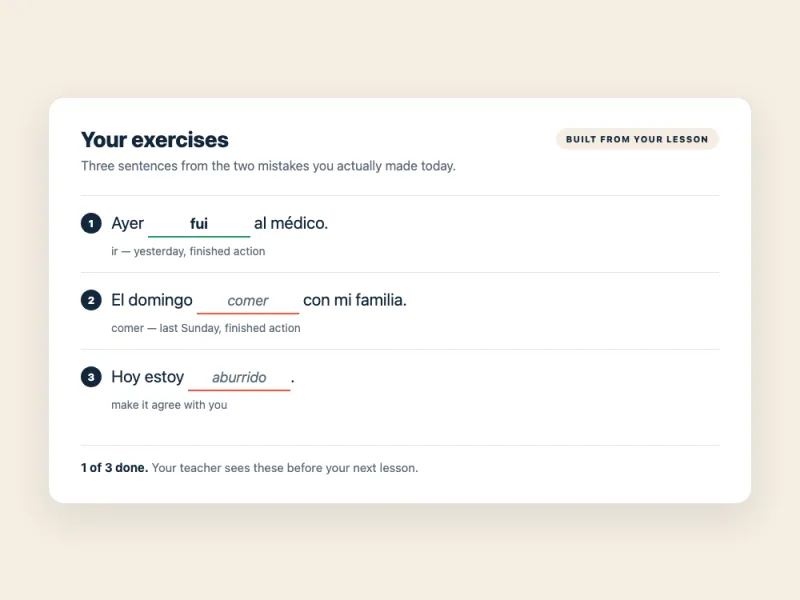
- Your exercises are generated from that lesson The practice you get afterwards is built from the errors you made that day. It is not the next chapter of anything, because you are not the same learner as the person who booked before you.
Why lessons are 25 minutes and not an hour
A 25-minute lesson is short enough that you can hold full attention for all of it, and short enough that it survives a bad week.
An hour sounds more serious and behaves worse. Attention drops after the first stretch, the teacher fills the gap by talking, and the lesson quietly turns into a lecture you attend. The long session is also the one you cancel when work runs over, and a cancelled hour is a whole week without Spanish.
Three short conversations put you in Spanish on three separate days, which means three times your brain has to find the language cold. That is the part that moves people forward, and it is a scheduling decision more than a teaching one.
25 min
one-on-one, with a qualified native teacher, as often as your week allows
There is no assigned teacher, and that is deliberate
You do not get one fixed teacher here. You book whoever is available at the time you want, and every teacher opens your file before the lesson so they know where you are and what you have been getting wrong.
The honest trade-off: a fixed teacher gets to know you as a person faster. What you get instead is a calendar that does not depend on one human being having a free Tuesday, and several trained ears on the same Spanish rather than one — which catches habits a single teacher stops hearing after a month.
Continuity is carried by the file, not by the person. If that sounds like a downgrade, it is worth testing before deciding: most people find that the second teacher already knows more about their Spanish than they expected.
The three things the method refuses to skip
Everything else is negotiable. These are not.
-
Correction in the moment
Feedback the next day is information. Feedback in the same breath is learning, because you still remember what you were trying to say and the fix attaches to the intention rather than to a note you reread once.
-
Speaking before you feel ready
Waiting until your Spanish is good enough to speak is the most common way adults stall for years. You speak in the first lesson, badly, and that is the point of the first lesson.
-
Practice built from your errors
Generic exercises drill what an average learner gets wrong. Yours drill what you got wrong on Tuesday, which is a much shorter and much more useful list.
Who teaches, and what qualified means here
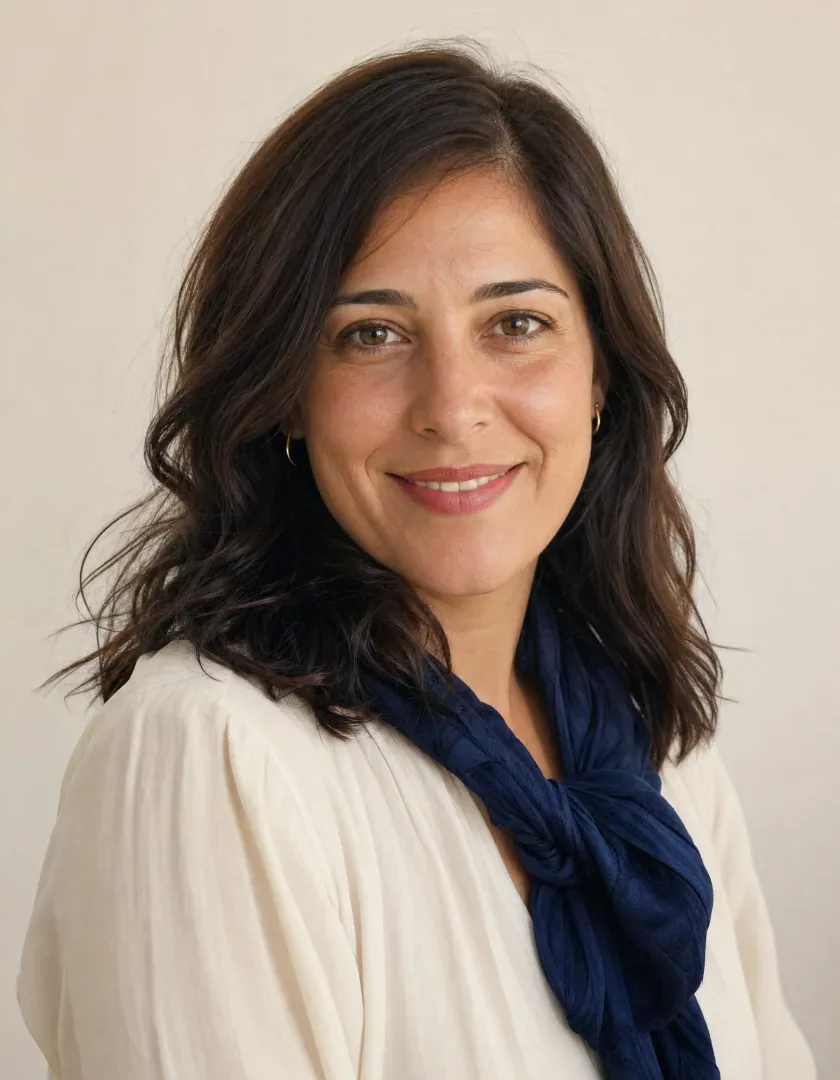
Every teacher is a native speaker from Spain or Latin America and trained to teach, which are two separate things. Speaking a language natively tells you what sounds right; being trained to teach tells you why your student keeps getting it wrong and what to do about it.
That distinction shows up in the first ten minutes. A native speaker who is not a teacher corrects the sentence in front of them. A trained teacher hears the same mistake three times, names the pattern, and fixes the cause.
You can read how we choose our Spanish teachers before you book anything.
What happens between lessons
The lesson is where mistakes get caught and the plan gets set. It is not where the repetitions happen, because nobody learns a language in twenty-five minutes a day.
Every plan includes unlimited AI practice with our conversation partner, so you can keep speaking on the days you do not have a lesson without needing another person to be free. It does not replace the teacher: it holds the repetition, and the teacher handles everything a machine cannot judge.
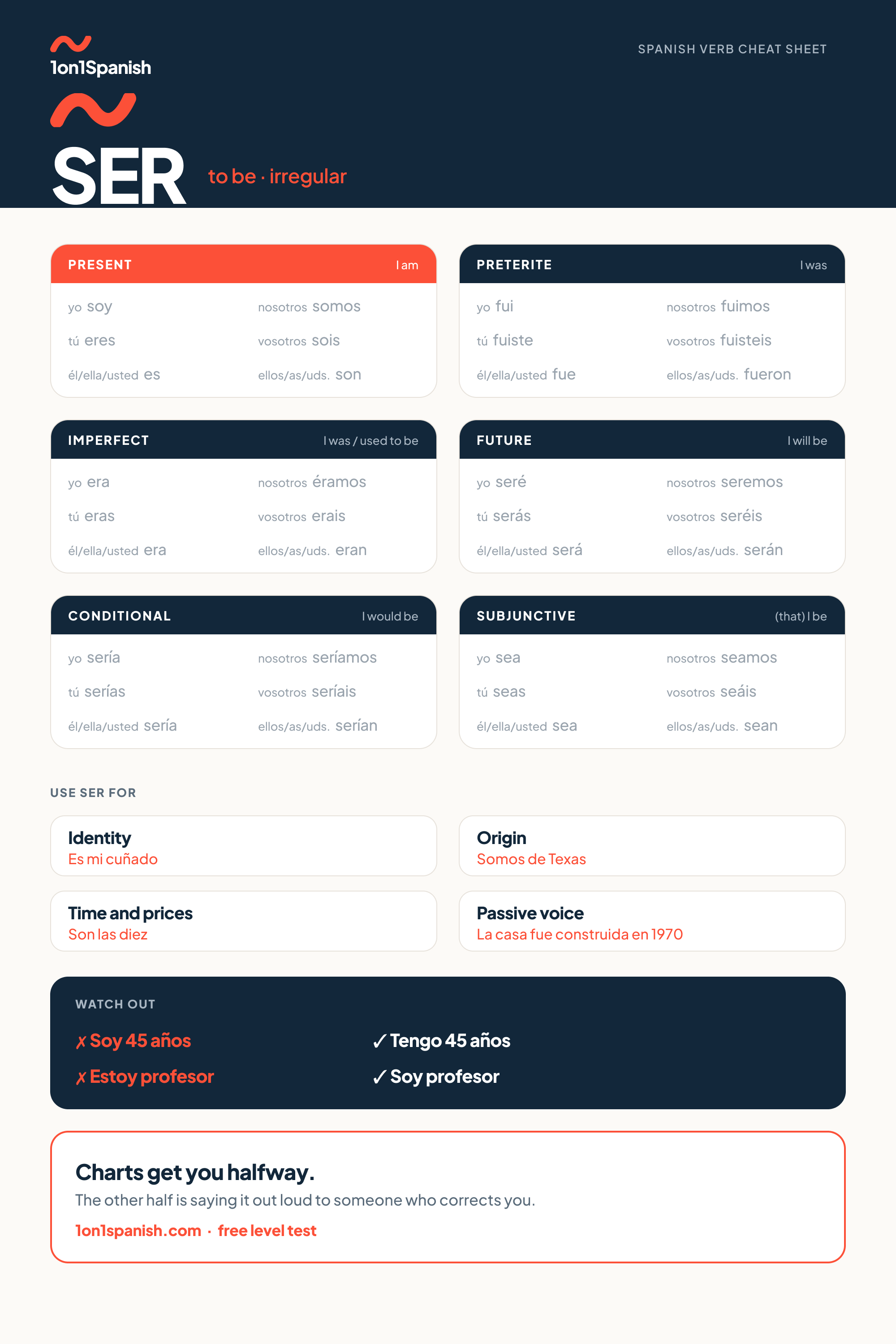
Alongside it you get the exercises from your last lesson and our free Spanish grammar guides, which exist so that the one grammar point a week comes from your own mistakes rather than from a syllabus.
Where the method comes from
This is not a method we invented for a new brand. 1on1Spanish was created by RingTeacher, a Spanish school that has been teaching English to Spanish speakers since 2017 with the same structure: short private lessons, a report after each one, and practice built from the student's own errors.
Built on RingTeacher's method — 700,000+ classes delivered since 2017.
What is new is the direction. The students are in the United States and the language being taught is Spanish, and the parts of the method that were specific to teaching English were rebuilt rather than translated.
How to check the method before you pay for it
Everything on this page is visible in the first lesson, which is why the level test is free and does not ask for a card. It is a real conversation with a teacher, not a multiple-choice quiz.
You come out of it with your level and a concrete idea of what to work on next, and that is yours whether or not you ever book anything. Take the free level test and judge the method on what happens in it.
Everything on this page is how we teach everyone, not a programme reserved for one kind of student. It is the same method whether you are here to pass an exam, to travel, or simply to learn Spanish online because you always meant to.
What lessons with this method cost
Plans run from $84 a month for one lesson a week up to $264 a month for four. Every plan is one-on-one, 25 minutes, with a qualified native teacher. Book any teacher, any available slot. No weekly caps.
There is no premium tier of the method and no cut-down version of it. The report, the personalized exercises and the AI practice come with every plan, and the only difference between plans is how often you speak.
Every plan includes unlimited AI practice with our conversation partner, for the days between lessons.
Your first month is $1 — on any plan.
Questions people ask about the method
What Spanish teaching method do you use?
Short private lessons built around speaking, with correction happening in the moment rather than afterwards. Each lesson is twenty-five minutes with a qualified native teacher who has read your file first, and each one produces a written report and a set of exercises generated from the mistakes you made in that lesson. Between lessons you keep practising with an AI conversation partner.
Why are lessons only 25 minutes long?
Because attention and consistency both fall off a cliff after that, and because a short lesson survives a busy week. Speaking on three separate days beats one long session on a single day, since each new day forces you to retrieve the language cold. Twenty-five minutes is also long enough that you speak for most of it instead of being lectured.
Do I get the same teacher every time?
No. You book whichever qualified teacher is available at the time you want, and every teacher opens your file before the lesson, so they arrive knowing your level, your last lesson and your recurring mistakes. The advantage is a calendar that does not depend on one person being free, plus several trained ears on the same habits.
What do I actually get after each lesson?
A written report with your corrections, and exercises generated from the specific errors you made in that lesson. The report names the pattern rather than only the sentence, so you can see the same mistake repeating across weeks. The exercises change every time, because they are built from your lesson rather than from a fixed syllabus.
Does the AI practice replace the teacher?
No, and it is not meant to. The AI partner handles repetition on the days you do not have a lesson, which is the part that needs volume rather than judgement. What it cannot do is tell you that a sentence was grammatically correct and socially strange, or hear why you keep making the same mistake. That stays with the teacher.
See the method in a real conversation
A short lesson with a qualified native teacher, online, no card. You will find out your level, and you will see exactly how a lesson here is run before you decide anything.
Take your free level test