DELE preparation, one-on-one with a native teacher
1on1Spanish gives you private Spanish lessons with qualified native teachers, online across the United States. The DELE is the official Spanish diploma, and preparing for it is what we do — we are not an exam center and we do not register candidates.
The written parts you can study alone. The oral is the reason to work with a person.
Take your free level test
What the DELE is, and who issues it
The DELE is the Diploma de Español como Lengua Extranjera, awarded by the Instituto Cervantes on behalf of the Spanish government. It is an official state qualification, which is why it carries weight with universities, employers and immigration processes.
Two things make it different from every other exam on this list. It does not expire, so you sit it once and hold it for life. And you register for one specific level from A1 to C2, on one of a set number of fixed dates each year, rather than being placed on a scale afterwards.
Which means the decision that matters is made before you ever open a book: choosing the level you register for. Dates, fees and centers are published by the Instituto Cervantes, and that is the only place to take them from.
What the DELE asks you to do
The exam is built from four skills, and every level tests all four. The tasks get harder; the shape stays the same.
-
Reading comprehension
Texts you have to work through against the clock, answering questions that reward precision rather than gist. The trap is speed: most people can understand the text and run out of time doing it.
-
Listening comprehension
Recordings played at natural speed, with accents from across the Spanish-speaking world. This is the section where people who learned Spanish only from written material find out how much they were missing.
-
Written expression and interaction
You produce real texts to a brief — a letter, a report, an argument — with the register the task asks for. Correct grammar in the wrong register still loses marks.
-
Oral expression and interaction
You speak to an examiner: a prepared task, a conversation and a reaction to something you are shown. Preparation time is short and the examiner will follow up on what you say.
Where candidates lose the DELE: the oral
People fail the DELE at a level they clearly have, and it is almost always the same story. They prepared alone, they read well, they wrote well, and then they sat in front of an examiner and produced short, careful, safe sentences that did not show what they could do.
The oral is an interaction. You are expected to develop an idea, disagree, ask something back and keep going when the examiner pushes. Nobody does that for the first time in an exam room and does it well.
So that is what your lessons are for. Your teacher plays the examiner, times you the way the exam times you, interrupts, and afterwards tells you what actually came out — not what you meant to say.
How DELE preparation works here
Nothing about this is a package. It is your normal one-on-one plan, pointed at a date.
- You take the free level test A conversation with a teacher who tells you which DELE level you are realistically at today, and which one is worth registering for. This is the whole ballgame.
- You register yourself with the Instituto Cervantes We do not do it for you and we cannot. You choose the level, the date and the center, and then we work backwards from it.
- Your lessons go where the marks are Mostly oral, because it is the part you cannot rehearse alone, plus the written task types that keep costing you points.
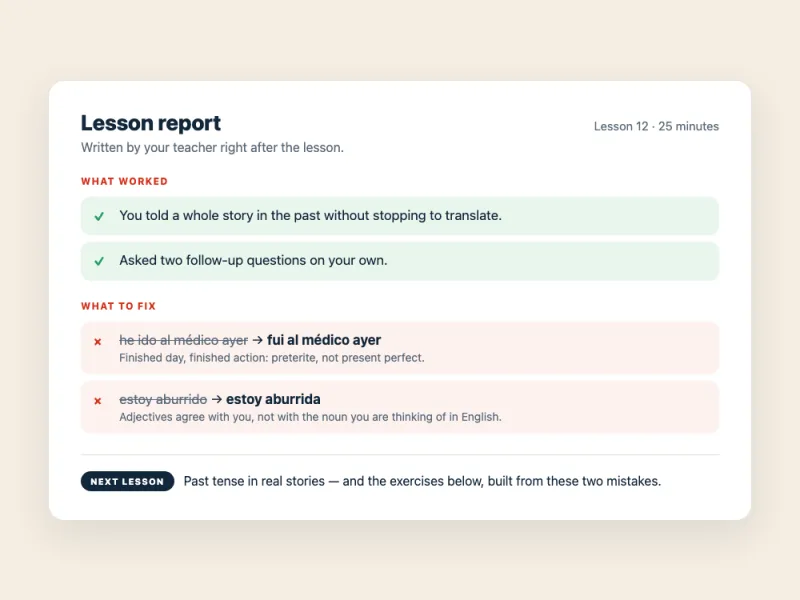
- You get corrections you can reuse After each lesson, a report and exercises built from the mistakes you actually made — which, close to an exam, is the fastest study material there is.
- You practice on the days between Every plan includes unlimited AI practice, so the repetition happens between lessons and the lesson time goes on judgement.
Choosing your DELE level is the decision that costs money
You register for one level and you either reach it or you do not, so registering a level above where you are is an expensive way to find out where you are. Registering a level below is a wasted year of a diploma you will want anyway.
A teacher can hear the difference in one conversation. That is the point of starting with the free level test rather than with a self-assessment table.
If you are not sure the DELE is the right exam for your situation, the overview of Spanish proficiency tests compares it with the alternatives.
The certificate has an expiry in your head, not on paper: most candidates keep speaking afterwards. The same lessons carry on once the exam is behind you, which is simply what it looks like to learn Spanish online here.
What DELE preparation costs
Plans run from $84 a month for one lesson a week up to $264 a month for four. Every plan is one-on-one, 25 minutes, with a qualified native teacher. Book any teacher, any available slot. No weekly caps.
There is no exam-preparation surcharge. Same teachers, same monthly plans, and the exam fee is paid to the Instituto Cervantes, never to us.
Every plan includes unlimited AI practice with our conversation partner, for the days between lessons.
Your first month is $1 — on any plan.
Questions people ask about the DELE
What is the DELE and who awards it?
The DELE is the Diploma de Español como Lengua Extranjera, awarded by the Instituto Cervantes on behalf of the Spanish government. It is an official qualification recognized internationally by universities, employers and public bodies. Unlike most language certificates it has no expiry date, so once you hold a level you hold it permanently.
Which DELE level should I register for?
The one you can already reach on a bad day, not the one you hope to reach by the exam date. Each level is a separate exam with a separate registration, and there is no partial credit for falling short. Take the free level test first: a teacher can place you in one conversation, which a self-assessment table cannot do.
How long does it take to prepare for the DELE?
It depends on the gap between your level now and the level you registered for, and on how often you speak. Somebody already comfortable at the target level may need a few weeks on exam format alone. Somebody reaching up a full level usually needs months of regular speaking, and no honest answer skips those two questions.
Can 1on1Spanish register me for the exam?
No. We are not an exam center, we do not enroll candidates and we do not issue diplomas. Registration, fees, dates and locations are handled by the Instituto Cervantes and its authorized centers. What we do is prepare you, with one-on-one lessons focused on the sections you cannot practice alone.
Is the DELE oral exam really that hard?
It is the section that surprises people most, because it is the only one you cannot rehearse by yourself. You are asked to develop ideas, react to an examiner and keep talking under time pressure. Candidates who prepared alone tend to produce short, safe answers that score below the Spanish they actually have.
Find out which DELE level you are ready for
A short conversation with a qualified native teacher, online, no card. Tell them the date you are considering and they will tell you what is realistic between now and then.
Take your free level test