
Spanish prepositions: the full list and the verbs that trip you up
Spanish prepositions are a short, closed list — a, de, en, con, por, para, sobre, desde, hasta, entre, and a handful more — and memorizing their basic meaning is the easy part. The real difficulty is that certain verbs demand a specific preposition in Spanish that has nothing to do with the preposition, or lack of one, that the same verb takes in English. At 1on1Spanish we work through both the list and the verb pairings in 25-minute one-on-one lessons with qualified native teachers, online across the United States.
Learn the core meanings first and the verb exceptions second: the list is finite, and once a preposition is attached to a verb in your memory, it rarely moves.
Reviewed by María Jiménez — Licenciada en Filología Hispánica (BA in Hispanic Philology) · Updated Sep 2026
The core set: a, de, en, con
A marks direction, a specific time, or a person receiving the action: Voy a Chicago, a las tres, Llamé a mi hermano. De marks origin, possession or material: Soy de Texas, el carro de mi papá, una mesa de madera. En marks location or a means of transport: Vivo en Dallas, viajamos en avión. Con marks accompaniment or an instrument: Voy con mi esposa, Corté el pan con un cuchillo. These four cover most of daily conversation and rarely surprise an English speaker, because their closest English equivalents — to, of/from, in/on, with — line up fairly well. The exceptions live with specific verbs, not with the basic sense of the preposition itself.
Por and para: the pair with its own page
Por and para both translate as “for” in English, and Spanish tells them apart by looking back at the cause versus forward to the goal. This distinction is dense enough that it has its own full breakdown, with the minimal pairs and the practice, at por vs para — this page won’t repeat it.
Sobre, desde, hasta, entre
Sobre marks “on” or “about”: El libro está sobre la mesa, Hablamos sobre el contrato. Desde marks a starting point in time or space: Trabajo aquí desde 2019, Caminé desde el centro. Hasta marks an endpoint: Abierto hasta las nueve, Corrí hasta el parque. Entre marks “between” or “among”: Entre tú y yo, Entre las cinco opciones. All four behave close enough to their English counterparts that the meaning rarely gets lost — the trouble starts with the verbs below.
Reference chart
| Preposition | Core meaning | Example | English |
|---|---|---|---|
| a | direction, time, person | Llegamos a las ocho. | We arrived at eight. |
| de | origin, possession, material | Es de California. | She’s from California. |
| en | location, means | Trabajo en casa. | I work from home. |
| con | accompaniment, instrument | Fui con mi hijo. | I went with my son. |
| sobre | on, about | Hablamos sobre el precio. | We talked about the price. |
| desde | starting point | Vivo aquí desde marzo. | I’ve lived here since March. |
| hasta | endpoint | Trabajo hasta las seis. | I work until six. |
| entre | between, among | Entre semana estoy ocupado. | On weekdays I’m busy. |
Verbs that don’t match English
This is where an otherwise solid English speaker keeps producing sentences that sound foreign, and it runs in two opposite directions.
Some verbs need a preposition Spanish assigns on its own, unrelated to what English does: soñar con (to dream about, not “of”), pensar en (to think about, not “on”), casarse con (to marry, literally “to marry with”), depender de (to depend on, not “of”). None of these follow the English preposition; each has to be learned as a fixed pair with its verb.
Other verbs Spanish uses with no preposition at all, even though the English verb needs one: buscar (to look for), escuchar (to listen to), esperar (to wait for), pedir (to ask for). Adding por or a after any of these, out of habit from English, is the single most common preposition error an English speaker makes in Spanish. The fix is the same for all four: treat the preposition as already built into the meaning of the Spanish verb, so nothing extra follows it.
| Spanish verb | Takes | Example | Not |
|---|---|---|---|
| soñar con | con | Sueño con vivir en México. | soñar de |
| pensar en | en | Pienso en mi familia. | pensar sobre/de |
| casarse con | con | Se casó con su novio. | casarse a |
| depender de | de | Depende de ti. | depender en |
| buscar | nothing | Busco trabajo. | buscar por trabajo |
| escuchar | nothing | Escucho música. | escuchar a música |
| esperar | nothing | Espero el autobús. | esperar por el autobús |
| pedir | nothing | Pedí ayuda. | pedir por ayuda |
Common mistakes English speakers make
Buscar already means “to look for” — adding por is a direct calque of the English “for” that Spanish doesn’t need.
Esperar means “to wait for” on its own. When the thing waited for is a specific person, a marks that person, not “for” translated as por.
Soñar pairs with con, never de, no matter how naturally “dream of” comes out in English.
Depender always takes de. En here is a straight, understandable, and wrong guess based on “depend on”.
Pensar en is the fixed pair for “to think about”. Sobre isn’t wrong Spanish, but it changes the meaning toward “to think over” a decision, not “to have on your mind”.
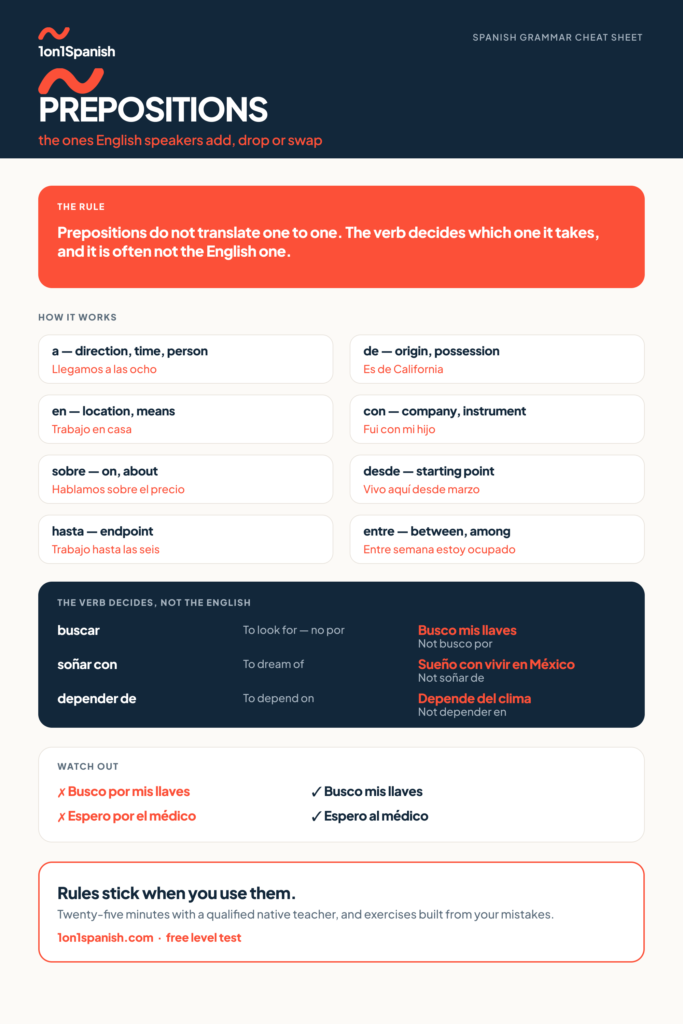
Take the chart with you
The chart is free to view and share. Drop your email and we’ll send the print-ready US Letter PDF — the version you stick on the fridge.
Practice
Practice Spanish prepositions with a real teacher
Charts get you halfway. The other half is saying it out loud to someone who corrects you on the spot. At 1on1Spanish you get 25-minute private lessons with a qualified native teacher, exercises built from the mistakes you make in class, and AI practice between lessons.
First month $1. No contracts, cancel anytime.
You can go further with someone listening: Learn Spanish with 1on1Spanish, 25 minutes at a time.
Take your free level testBuilt on RingTeacher's method — 700,000+ classes delivered since 2017, teaching English to Spanish speakers. Now in the other direction.
Frequently asked questions
What are the most common Spanish prepositions?
A, de, en, con, por, para, sobre, desde, hasta and entre cover the vast majority of daily conversation. Most of them line up closely enough with English — “to”, “of/from”, “in/on”, “with” — that the meaning rarely gets lost. The difficulty shows up with specific verbs, not with these basic meanings.
What’s the difference between por and para?
Both translate as “for” in English, but por looks back at a cause or reason and para looks forward to a purpose or goal. It’s dense enough to deserve its own full breakdown, with minimal pairs like trabajo por ti versus trabajo para ti, at por vs para.
Why does soñar need con instead of “of” or “about”?
Because Spanish assigns prepositions to verbs by convention, not by translating the English preposition word for word. Soñar has always paired with con, the same way pensar pairs with en and depender pairs with de. There’s no shortcut other than learning each pair as a unit.
Do buscar, escuchar, esperar and pedir need a preposition in Spanish?
No, and this is the opposite trap: all four already mean “to look for”, “to listen to”, “to wait for” and “to ask for” on their own, so adding por or a after them, as English speakers instinctively do, is incorrect. Busco trabajo, not busco por trabajo.
What’s the most common preposition mistake English speakers make in Spanish?
Adding a preposition — usually por, sometimes a — after verbs that don’t need one in Spanish, like buscar, esperar and pedir. It comes directly from translating the English “for” in “look for” or “wait for” word for word, when Spanish already built that meaning into the verb itself.