
How to learn Spanish: what to study, and in what order
Learning Spanish comes down to four things: verbs, grammar, vocabulary and pronunciation, plus somebody to say it all to. This page is the map of the four, with free charts and practice on every page underneath it. 1on1Spanish offers one-on-one Spanish lessons with qualified native teachers, online across the United States.
Most American adults stall for the same reason, and it isn’t talent or age. They spend two years on input, on apps and podcasts and flashcards, and almost no time producing output out loud. Reading Spanish and speaking Spanish are different skills, and only one of them gets you through a conversation with your mother-in-law.
The four things you are actually learning
Each one has its own index below, and each answers a different failure. If you can’t conjugate, you freeze mid-sentence. If your grammar is off, people understand you but correct you. If your vocabulary is thin, you avoid topics. If your pronunciation is off, you repeat yourself all day.
-
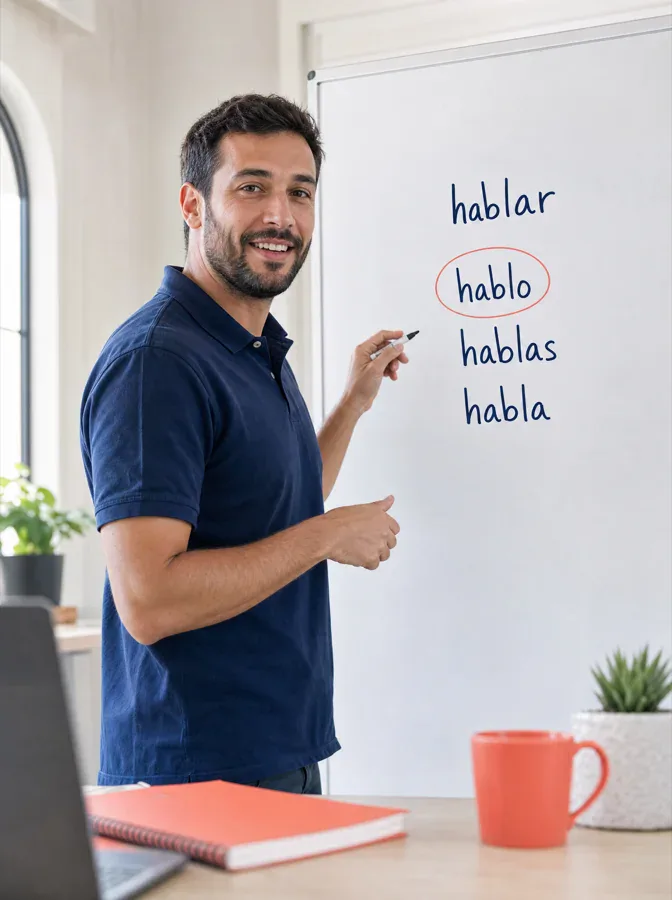 Verbs
Freezing mid-sentence because you cannot find the form
Spanish verbs
Verbs
Freezing mid-sentence because you cannot find the form
Spanish verbs
-
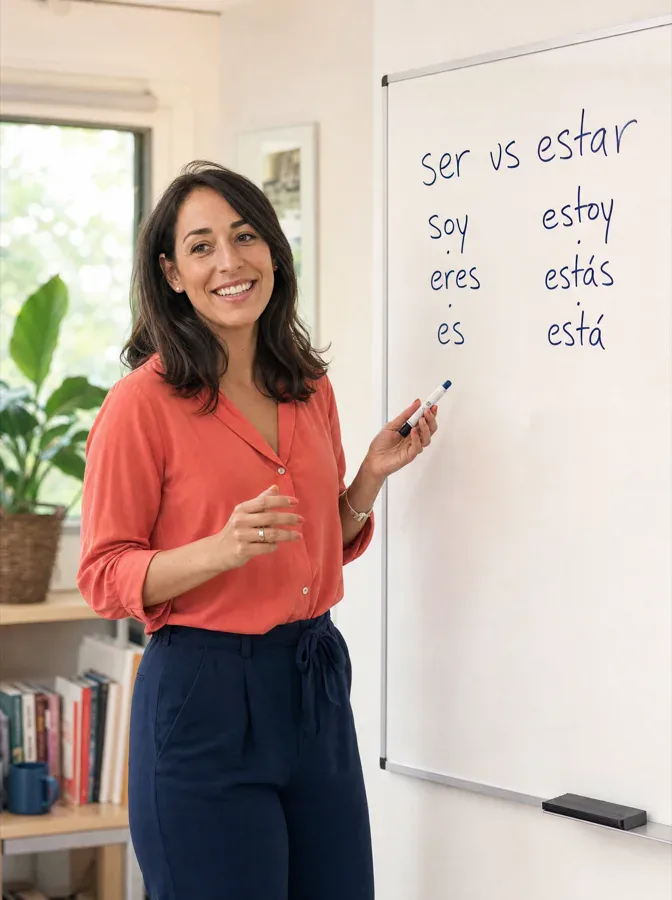 Grammar
Being understood but constantly corrected
Spanish grammar
Grammar
Being understood but constantly corrected
Spanish grammar
-
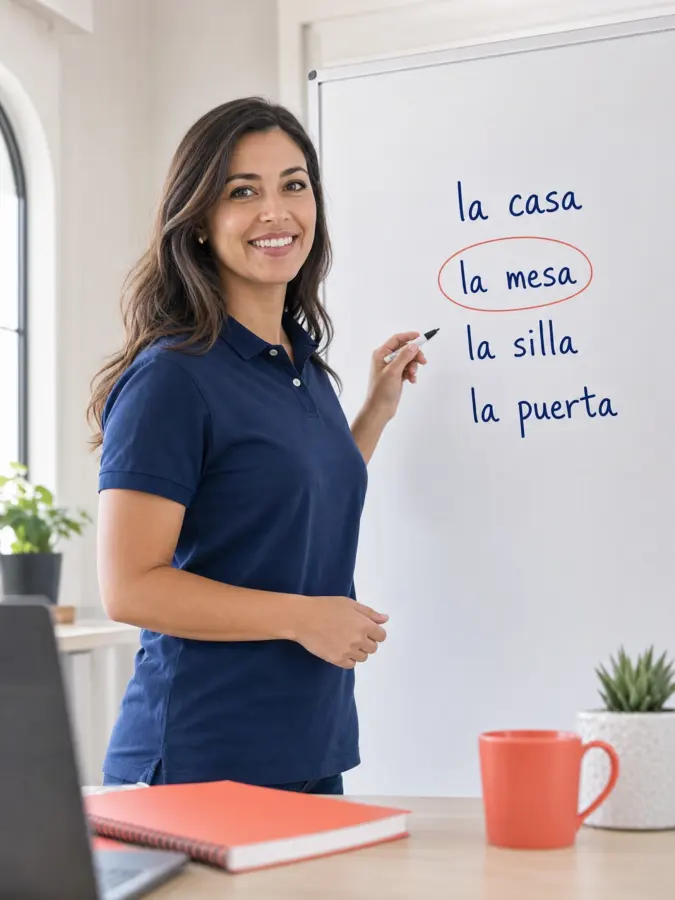 Vocabulary
Avoiding whole topics because you lack the words
Spanish numbers
Vocabulary
Avoiding whole topics because you lack the words
Spanish numbers
-
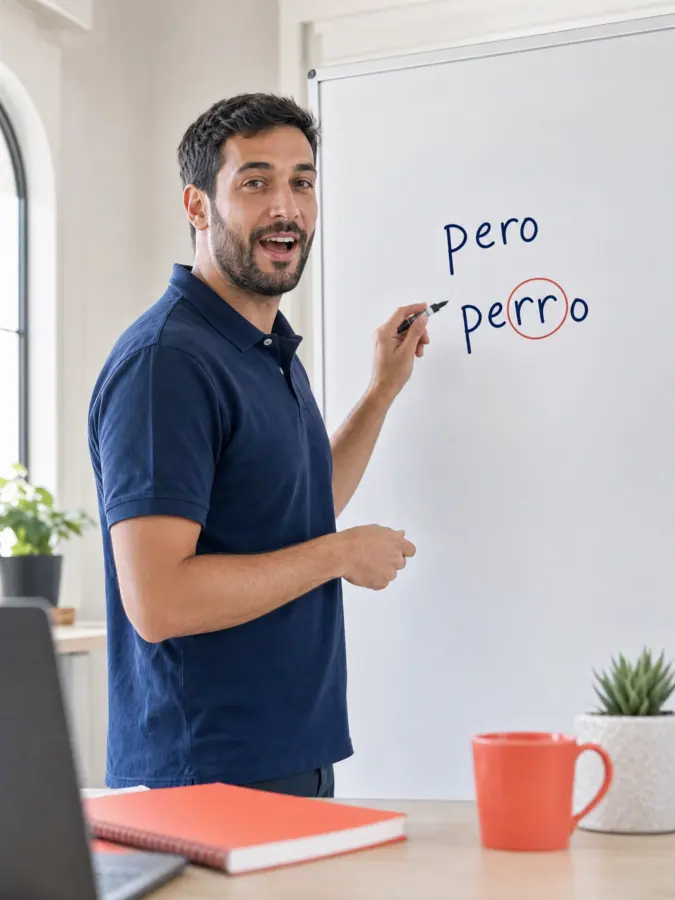 Pronunciation
Having to repeat yourself, or not catching what you hear
Spanish alphabet pronunciation
Pronunciation
Having to repeat yourself, or not catching what you hear
Spanish alphabet pronunciation
Verbs come first
Spanish puts the person inside the verb, so hablo already means “I speak” with no pronoun attached. That makes verbs the load-bearing wall: until you can produce the present tense of the common ones without pausing, everything else waits. Start with conjugate ser, conjugation estar and conjugate tener, then open the full Spanish verbs index.
Grammar, only the rules that change your speech
You don’t need to study Spanish grammar as a subject. You need a small set of high-impact rules — noun gender, agreement, ser versus estar, the two past tenses, object pronouns — and the rest can arrive as you meet it. The Spanish grammar index puts them in the order that pays off first, not in textbook order.
Vocabulary, in the order you will need it
Numbers, days, food, family, work, health. Numbers are the first useful set, because they run through prices, phone numbers, ages, dates and times. See Spanish numbers. Learn words in phrases rather than as isolated items: you’ll retrieve la semana pasada faster than you’ll ever retrieve semana on its own.
Pronunciation, early and once
Spanish spelling is far more predictable than English, so learning the core sound system early gives you an advantage that keeps paying off. Learn the five vowel sounds and hold them steady, because Spanish vowels don’t glide the way English ones do. Then deal with rr, ñ, j and the ll/y pair. The Spanish alphabet pronunciation page covers all of it.
Where to start
Three routes. Pick the one that sounds like you.
-
You are starting from zero.
Weeks one to four: the five vowel sounds, numbers to 100, and the present tense of ser, estar and tener. Nothing else. Then read ser vs estar, which is the single distinction that separates Spanish that sounds native from Spanish that sounds translated. If you want that mapped onto lessons, see Spanish for beginners.
-
You studied Spanish in high school and lost it.
You have more than you think, buried under disuse. Skip the alphabet. Go to Spanish verbs, rebuild the present tense of the top eight, then go straight to the past tenses at imperfect past tense spanish. Most returning learners find the grammar comes back in weeks and the speaking does not come back at all without practice.
-
You read and understand Spanish but freeze when you speak.
This is the most common profile among American adults, and it is not a knowledge problem. It is retrieval speed under pressure, and the only thing that trains it is speaking under pressure, regularly, with someone who corrects you. See conversational Spanish.
How long it takes, honestly
Nobody can tell you a number, and anyone who gives you one in weeks is selling something. What’s predictable is the shape: comprehension moves before production, plateaus arrive around the point where you can survive a conversation, and progress after that comes from widening topics rather than adding rules.
What you can control is frequency. Short, frequent speaking practice is easier to keep up than one long lesson you skip when work gets busy, because retrieval is a habit and habits need repetition. That is why our lessons are 25 minutes.
Practice Spanish with a real teacher
Charts get you halfway. The other half is saying it out loud to someone who corrects you on the spot. At 1on1Spanish you get 25-minute private lessons with a qualified native teacher, exercises built from the mistakes you make in class, and AI practice between lessons.
First month $1. No contracts, cancel anytime.
Take your free level testBuilt on RingTeacher's method — 700,000+ classes delivered since 2017, teaching English to Spanish speakers. Now in the other direction.
Frequently asked questions
What is the best way to learn Spanish as an adult?
Split your time between input and output, and protect the output. Adults who only consume, whether that’s apps or shows or flashcards, build comprehension and stay unable to speak. The pattern that works is short, frequent speaking sessions with someone who corrects you, backed by targeted study of verbs and the handful of grammar rules that decide most sentences. Frequency beats session length.
How long does it take to learn Spanish?
It depends on how much you speak, not how long you study, so honest answers come as ranges rather than dates. Comprehension arrives well before production. Most adults reach survival conversation faster than they expect and take much longer to feel comfortable, and the gap between those two points is almost entirely explained by how many hours they spent talking.
Can I learn Spanish for free?
Yes for the knowledge, no for the correction. Every chart, rule and practice set on this site is free, and there’s enough free material online to cover the entire grammar of the language. What isn’t free is somebody listening to you and telling you what you just got wrong, which is the part that changes how you speak.
Should I learn Spain Spanish or Latin American Spanish?
Learn whichever one is around you, and don’t worry about the choice. The grammar is the same everywhere and the differences are vocabulary, accent and the vosotros form used in Spain. Spanish speakers move between varieties constantly through television and travel. See Spanish-speaking countries for what actually varies.
Do I need to know my level before I start lessons?
No, and guessing is usually wrong in both directions. A short conversation with a teacher places you more accurately than any self-assessment or online quiz, because level is mostly about what you can produce under pressure rather than what you recognize on a page. That is what the free level test is for, and it costs nothing.