
Gender of nouns in Spanish: how to know if it’s el or la
Every Spanish noun is either masculine or feminine, and the ending tells you which in the large majority of cases: -o, -or, -aje and -ma from Greek are masculine, while -a, -ción, -sión, -dad, -tad, -tud and -umbre are feminine. Gender has nothing to do with meaning — a table isn’t female. So the only workable approach is to learn the endings, then the short list of words that ignore them. 1on1Spanish drills this in 25-minute one-on-one lessons with qualified native teachers, online across the United States.
Reviewed by María Jiménez — Licenciada en Filología Hispánica (BA in Hispanic Philology) · Updated Sep 2026
The endings that predict masculine
-o covers most of them: el libro, el trabajo, el dinero, el aeropuerto. This is the single most reliable ending in the language.
-or is almost always masculine: el color, el motor, el amor, el dolor. Watch for la flor and la labor, which are the two you’ll actually meet.
-aje is masculine without exception in practical vocabulary: el viaje, el mensaje, el equipaje, el paisaje. English speakers read the -e as neutral and default to la, which is where this ending earns its place on the list.
-ma, -pa, -ta from Greek are masculine despite ending in -a: el problema, el sistema, el tema, el idioma, el programa, el clima, el mapa, el planeta. These aren’t random exceptions, they’re a family with a shared origin, and there are only a couple dozen you’ll ever use.
Days of the week, months, numbers, colors and languages are also masculine: el lunes, el próximo enero, el treinta, el azul, el portugués. The days of the week and months of the year pages give you the full sets to practice el on.
The endings that predict feminine
-a is the counterpart to -o: la mesa, la ventana, la empresa, la carta.
-ción and -sión are feminine every single time, and they cover an enormous slice of adult vocabulary because they’re the Spanish equivalents of English -tion and -sion: la información, la decisión, la reunión, la operación. If you learn one rule from this page, learn this one: it converts hundreds of English words into correctly gendered Spanish.
-dad, -tad, -tud are feminine: la ciudad, la verdad, la libertad, la actitud, la salud. Again, they map onto English -ty: university → la universidad.
-umbre and -ie are feminine: la costumbre, la incertidumbre, la serie, la especie.
Reference chart
| Ending | Gender | Examples | Watch out for |
|---|---|---|---|
| -o | masculine | el banco, el seguro, el vuelo | la mano, la foto, la moto, la radio |
| -or | masculine | el error, el sabor, el valor | la flor, la labor |
| -aje | masculine | el viaje, el garaje, el porcentaje | — |
| -ma (Greek) | masculine | el problema, el sistema, el idioma | la cama, la firma, la forma are not Greek |
| -a | feminine | la casa, la cuenta, la tarjeta | el día, el mapa, el sofá, el agua |
| -ción / -sión | feminine | la dirección, la presión, la sesión | — |
| -dad / -tad / -tud | feminine | la edad, la dificultad, la juventud | — |
| -umbre | feminine | la costumbre, la cumbre | — |
| -ista | either | el dentista / la dentista | Gender comes from the person |
Exceptions and edge cases
The exception list is short enough to memorize in an afternoon, and these words come up constantly.
Masculine but ending in -a: el día, el mapa, el sofá, el planeta, and the whole Greek -ma family above. El día is the one that keeps catching people, because it appears in every other sentence: un buen día, todos los días.
Feminine but ending in -o: la mano, la foto, la moto, la radio. The last three are shortened words that kept the gender of the full form (fotografía, motocicleta, radiodifusión), so they’re not really exceptions, just abbreviations. La mano is a genuine one, straight from Latin. Get the article wrong on la mano and the damage doubles, since the adjective copies the noun’s gender: it’s la mano derecha, and the -a on derecha follows from the la.
Nouns for people that don’t change: -ista words take their gender from the person, not the ending: el periodista, la periodista, el turista, la turista. The same goes for el/la estudiante, el/la cantante, el/la joven.
Animals with one fixed gender: la jirafa covers males too, and el pez covers females. To specify, Spanish adds macho or hembra: una jirafa macho.
The words that change meaning with gender
Same spelling, two genders, two different words. Getting this wrong doesn’t sound like a grammar slip, it changes what you said.
| Masculine | Feminine |
|---|---|
| el capital — money, capital funds | la capital — the capital city |
| el policía — the police officer | la policía — the police force (or a female officer) |
| el orden — order, sequence | la orden — an order given, a command |
| el cura — the priest | la cura — the cure |
| el frente — the front (military, weather) | la frente — the forehead |
| el corte — a cut | la corte — the court |
| el papa — the Pope | la papa — the potato (Latin America) |
| el guía — the guide (person) | la guía — the guidebook |
Necesitamos capital is a business plan. Necesitamos la capital is a geography problem.
Common mistakes English speakers make
Problema comes from Greek and is masculine despite the -a. The same applies to tema, sistema, idioma and programa.
Mano is feminine, and the adjective has to follow: derecha, not derecho.
Feminine nouns starting with a stressed a- take el in the singular, while the adjective stays feminine: el agua fría.
The article flips the meaning from the city to the money.
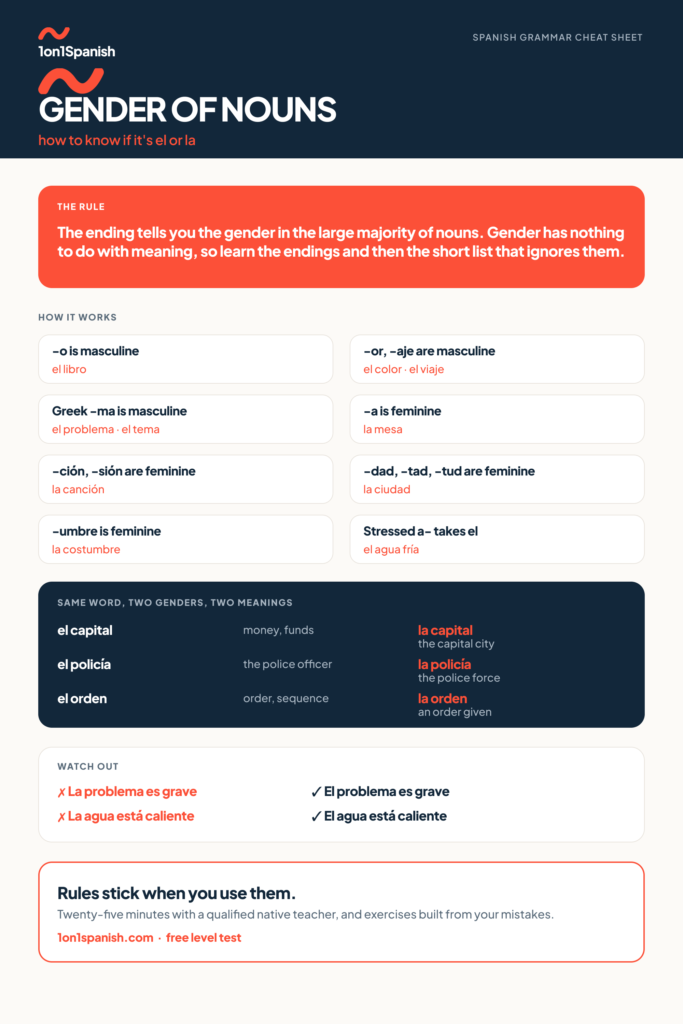
Take the chart with you
The chart is free to view and share. Drop your email and we’ll send the print-ready US Letter PDF — the version you stick on the fridge.
Practice
Practice noun gender with a real teacher
Charts get you halfway. The other half is saying it out loud to someone who corrects you on the spot. At 1on1Spanish you get 25-minute private lessons with a qualified native teacher, exercises built from the mistakes you make in class, and AI practice between lessons.
First month $1. No contracts, cancel anytime.
Grammar you can read. Speaking you cannot. Learn Spanish online and practice it live.
Take your free level testBuilt on RingTeacher's method — 700,000+ classes delivered since 2017, teaching English to Spanish speakers. Now in the other direction.
Frequently asked questions
How do you know if a Spanish noun is masculine or feminine?
Look at the ending. Nouns in -o, -or and -aje are almost always masculine; nouns in -a, -ción, -sión, -dad, -tad, -tud and -umbre are almost always feminine. Those endings cover most of the vocabulary you’ll meet. Then learn the short exception list: el día, el mapa, la mano, la foto, plus the Greek -ma family, which is masculine.
Why is “el problema” masculine if it ends in -a?
Because it came into Spanish from Greek, where the word was neuter, and Spanish absorbed that group as masculine. The family includes el tema, el sistema, el idioma, el programa, el clima, el drama and el poema. Not every -ma word belongs to it: la cama, la firma and la forma are ordinary feminine nouns. Learn the Greek set as a block.
Which Spanish words change meaning depending on gender?
The frequent ones are el capital (money) versus la capital (capital city), el orden (sequence) versus la orden (a command), el cura (priest) versus la cura (cure), el frente (front) versus la frente (forehead), and el policía (officer) versus la policía (police force). These are separate words that happen to share a spelling, not variations of one word.
Do I have to memorize the gender of every Spanish noun?
No, but you do have to learn each noun with its article rather than alone. Store el problema and la reunión as units and gender stops being a second thing to remember. Endings cover most cases, and the words that break the pattern are few enough to learn as a list. Speaking is what makes it automatic, because a wrong article sounds wrong out loud long before you can explain why.
Does noun gender affect anything besides the article?
Yes, and that’s why it matters. Adjectives, demonstratives and possessives all agree with the noun, so one wrong gender spreads through the sentence: la mano izquierda, not el mano izquierdo. Past participles used as adjectives agree too: La puerta está cerrada. Getting the gender right once fixes every other word that points at that noun.