
Common Spanish adjectives: agreement, position and meaning
A Spanish adjective copies the gender and number of the noun it describes, and normally comes after it. The small group that can also come before the noun changes meaning when it does. English adjectives never change shape and always sit in front, so both halves of that rule are new habits rather than new vocabulary. 1on1Spanish drills them in 25-minute one-on-one lessons with qualified native teachers, online across the United States.
Reviewed by María Jiménez — Licenciada en Filología Hispánica (BA in Hispanic Philology) · Updated Sep 2026
Agreement in gender
Adjectives ending in -o have four forms: alto, alta, altos, altas. The ending follows the noun, not the person speaking, so a woman says el carro es rojo and a man says la casa es roja. That makes the noun’s gender the first question every time, and the endings on the gender of Spanish nouns page settle most of it before the adjective even shows up.
Adjectives ending in -e or in a consonant have one form for both genders: un informe interesante, una reunión interesante; un examen difícil, una pregunta difícil.
Two groups break that: adjectives of nationality (español → española, francés → francesa, alemán → alemana) and adjectives ending in -or, -ón or -án (trabajador → trabajadora, hablador → habladora). Comparatives are the exception inside the exception: mejor, peor, mayor and menor stay the same. Those four are the irregular Spanish comparatives, and they keep one form for both genders in front of any noun.
Agreement in number
Add -s after a vowel and -es after a consonant: caros, verdes, difíciles, jóvenes. An adjective ending in -z switches to -ces: feliz → felices, capaz → capaces.
When one adjective covers several nouns of different genders, it goes masculine plural: el contrato y la factura están firmados. Native speakers place the masculine noun closest to the adjective when they can, which is why la factura y el contrato están firmados sounds smoother.
Position: after the noun by default
The neutral spot is after the noun, and that’s where an adjective goes when it distinguishes this thing from others of its kind: un carro rojo, una empresa americana, el informe mensual.
Adjectives go before the noun when they state something already assumed rather than sorting one thing from another: la blanca nieve, mi querido amigo. Numbers, quantifiers and possessives always go first: tres hijos, muchos años, poca paciencia, mi jefe. The possessives have a twist of their own — mi, tu, su agree with the thing owned, never with the owner — which is why Spanish possessive adjectives get a page to themselves.
Five adjectives shorten before a masculine singular noun. Bueno → buen, malo → mal, primero → primer, tercero → tercer, alguno → algún. Grande shortens to gran before any singular noun, masculine or feminine: un gran problema, una gran oportunidad.
Reference chart
| Ending | Masculine sing. | Feminine sing. | Masculine pl. | Feminine pl. |
|---|---|---|---|---|
| -o | alto | alta | altos | altas |
| -e | grande | grande | grandes | grandes |
| consonant | difícil | difícil | difíciles | difíciles |
| -z | feliz | feliz | felices | felices |
| -or | trabajador | trabajadora | trabajadores | trabajadoras |
| nationality | español | española | españoles | españolas |
| Common adjective | Meaning | In a sentence |
|---|---|---|
| bueno / malo | good / bad | Es un buen médico. |
| grande / pequeño | big / small | Vivimos en una casa pequeña. |
| caro / barato | expensive / inexpensive | El seguro es caro. |
| fácil / difícil | easy / hard | La entrevista fue difícil. |
| joven / viejo | young / old | Mis padres ya son mayores. |
| ocupado / libre | busy / free | Estoy ocupado hasta las seis. |
| cansado | tired | Llegué cansada del viaje. |
| contento | happy, pleased | Está contenta con el resultado. |
The adjectives that change meaning by position
For a short list of adjectives, moving the word changes the sentence. Before the noun they express a judgment; after it they describe a measurable fact.
| Before the noun | After the noun |
|---|---|
| un gran hombre — a great man | un hombre grande — a big man |
| un viejo amigo — a longtime friend | un amigo viejo — an elderly friend |
| un pobre hombre — a poor guy, pitiable | un hombre pobre — a man with no money |
| un antiguo jefe — a former boss | un mueble antiguo — an antique piece |
| un nuevo carro — another car, new to me | un carro nuevo — a brand-new car |
| cierta información — some information | información cierta — true information |
| diferentes personas — various people | personas diferentes — people unlike each other |
| el mismo día — the same day | el día mismo — that very day |
Native speakers don’t experience these as exceptions either. Un viejo amigo and un amigo viejo are two different pieces of information about the same person.
Common mistakes English speakers make
English word order carries over intact, and the result is understandable but immediately marks you as a learner. Default to putting the adjective second and you’ll be right most of the time.
Grande has to shorten before a singular noun, and leaving it whole also flips the meaning toward physical size. The short form is the one that means “great”.
The adjective has to travel to the noun, not to the verb. English trains you to leave the adjective alone once the sentence gets long.
Adjectives ending in -or look invariable because they end in a consonant, but they add -a in the feminine.
Colors are adjectives and take the plural like any other. The exceptions are colors borrowed from nouns, naranja and rosa, which many speakers leave unchanged.
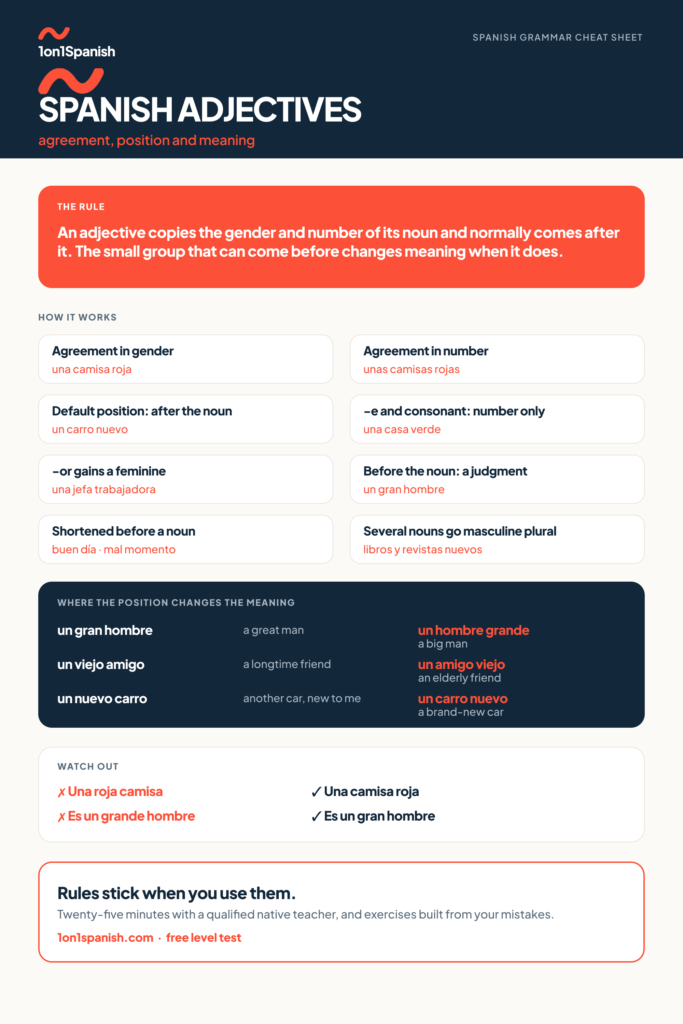
Take the chart with you
The chart is free to view and share. Drop your email and we’ll send the print-ready US Letter PDF — the version you stick on the fridge.
Practice
Practice Spanish adjectives with a real teacher
Charts get you halfway. The other half is saying it out loud to someone who corrects you on the spot. At 1on1Spanish you get 25-minute private lessons with a qualified native teacher, exercises built from the mistakes you make in class, and AI practice between lessons.
First month $1. No contracts, cancel anytime.
You can go further with someone listening: Learn Spanish with 1on1Spanish, 25 minutes at a time.
Take your free level testBuilt on RingTeacher's method — 700,000+ classes delivered since 2017, teaching English to Spanish speakers. Now in the other direction.
Frequently asked questions
Do Spanish adjectives always come after the noun?
No, but that’s the default and the safe choice. An adjective that tells you which one — un carro rojo, una empresa americana — goes after. An adjective that states an expected quality or a personal judgment can go before: un gran médico, mi querido tío. Numbers, quantifiers and possessives always come first, as in tres hijos or mucha gente.
How do you make a Spanish adjective agree with the noun?
Match gender and number. Adjectives ending in -o have four forms: alto, alta, altos, altas. Ones ending in -e or a consonant change only for plural: grande / grandes, difícil / difíciles. Nationalities and adjectives ending in -or, -ón or -án add -a in the feminine: español / española, trabajador / trabajadora.
What’s the difference between gran and grande?
Gran goes before a singular noun and means great or important: un gran cambio, una gran oportunidad. Grande goes after the noun and means large in size: una casa grande. In the plural the short form disappears, so grandes covers both, and only the position tells you which meaning is intended: grandes empresas versus empresas grandes.
Which Spanish adjectives change meaning before the noun?
The main ones are grande, viejo, pobre, antiguo, nuevo, cierto, diferente and mismo. Before the noun they carry a judgment — un pobre hombre is someone you feel sorry for. After the noun they state a fact — un hombre pobre has no money. There are fewer than a dozen in everyday use, so they’re worth memorizing as pairs.
What are the most common Spanish adjectives to learn first?
Start with the pairs you use to describe a day: bueno / malo, grande / pequeño, caro / barato, fácil / difícil, ocupado / libre, cansado, contento, nuevo, joven. Learn each one in a full sentence with a noun attached, so the agreement comes along with the word instead of being a separate rule to apply later.