
Por vs para: the difference, in one question
Use por when the sentence looks backward at a cause, a route, an exchange or a means, and para when it looks forward at a destination, a deadline, a recipient or a purpose. English covers all of that with “for”, plus “by”, “through”, “per” and “in order to”. That is why the two Spanish words feel interchangeable and never are. 1on1Spanish teaches this distinction in 25-minute one-on-one lessons with qualified native teachers, online across the United States.
Reviewed by María Jiménez — Licenciada en Filología Hispánica (BA in Hispanic Philology) · Updated Sep 2026
What por is doing in the sentence
Por points at what came before the action or at what the action passes through. Everything it covers is a reason, a route, a price or a method.
Cause and motive: Lo hice por mi familia. Cerraron la tienda por la tormenta. Exchange and price: Compré el carro por ocho mil dólares. Te cambio mi turno por el tuyo. Movement through a place: Pasamos por Denver. Caminé por el parque. Means and channel: Te lo mando por correo. Hablamos por teléfono. Time span or approximate time: Estuvimos allí por tres semanas. Te llamo por la tarde. Rate: Dos veces por semana. On behalf of, in place of: Firmé por mi jefe. And the agent in a passive sentence: La casa fue construida por mi abuelo.
The thread through all of it: something already existed — a reason, a road, a price — and the action runs over it.
What para is doing in the sentence
Para points forward, at where the action is going or what it’s for. It has no cause in it at all.
Purpose, with an infinitive: Estudio para aprobar el examen. This is English “in order to”, and it is always para. Recipient: Este regalo es para ti. Destination: Salgo para Chicago mañana. Deadline: Lo necesito para el viernes. Opinion: Para mí, es demasiado caro. Employer: Trabajo para una empresa de seguros. Comparison against expectation: Para ser diciembre, hace buen tiempo.
If you can insert “in order to”, “toward” or “by that date” into the English sentence, para is the word.
Por and para are the pair that causes the most trouble, but they’re two of a larger set. The other Spanish prepositions — a, de, en, con — give English speakers far less grief.
Usage table
| Category | Word | Example | English |
|---|---|---|---|
| Cause, motive | por | Llegué tarde por el tráfico. | I was late because of traffic. |
| Purpose, in order to | para | Ahorro para comprar una casa. | I’m saving in order to buy a house. |
| Exchange, price | por | Lo vendí por trescientos dólares. | I sold it for three hundred dollars. |
| Recipient | para | La carta es para mi madre. | The letter is for my mother. |
| Through, along | por | Corro por el río. | I run along the river. |
| Destination | para | Este tren va para Boston. | This train is going to Boston. |
| Duration, time span | por | Vivimos allí por dos años. | We lived there for two years. |
| Deadline | para | Entrégalo para el lunes. | Turn it in by Monday. |
| Means, channel | por | Firmamos por videollamada. | We signed by video call. |
| Employer | para | Trabaja para un hospital. | She works for a hospital. |
| Rate, per | por | Cincuenta dólares por hora. | Fifty dollars an hour. |
| Opinion | para | Para mí, no vale la pena. | To me, it isn’t worth it. |
| On behalf of, instead of | por | Voy a la reunión por ti. | I’ll go to the meeting for you. |
| Against expectation | para | Para ser nuevo, trabaja muy bien. | For someone new, he works very well. |
| Passive agent | por | Fue escrito por un médico. | It was written by a doctor. |
| Gratitude, apology | por | Gracias por tu ayuda. | Thanks for your help. |
The pairs where the same words mean different things
This is where por and para stop being a list and start being a distinction. Same noun, same verb, two sentences that don’t overlap.
| Sentence | What it means |
|---|---|
| Trabajo por ti. | I’m covering your shift, or I’m doing it for your sake. |
| Trabajo para ti. | You’re my boss. |
| Lo hice por ella. | I did it because of her, or on her behalf. |
| Lo hice para ella. | I made it to give to her. |
| Voy por el centro. | I’m going through downtown. |
| Voy para el centro. | I’m heading downtown. |
| Es por ti. | It’s because of you. |
| Es para ti. | It’s a gift for you. |
| Estudia por su padre. | He studies because his father pushes him. |
| Estudia para médico. | He’s studying to become a doctor. |
| Compré el regalo por mi hermana. | I bought it in her place — she couldn’t go. |
| Compré el regalo para mi hermana. | I bought it to give to her. |
| Por mí, adelante. | As far as I’m concerned, go ahead. |
| Para mí, es un error. | In my opinion, it’s a mistake. |
| Lo tomó por otro. | He mistook him for someone else. |
| Lo tomó para otro. | He took it to give to someone else. |
Read the left column out loud and then the right one. Nothing changes in the pair except the preposition, and nothing survives of the first meaning.
Fixed expressions you just learn
A handful of phrases don’t answer to the rule; they’re set. Por favor, por supuesto, por ejemplo, por fin, por eso, por lo menos, por si acaso, por cierto. On the other side: para siempre, para nada, para variar. Por eso and por ejemplo also do duty as connectors, and the Spanish transition words page shows them linking one sentence to the next.
There are fewer of these than the lists on the internet suggest, and they’re all high-frequency, so they arrive on their own once you’re speaking.
Common mistakes English speakers make
Purpose with an infinitive is always para. English “for studying” pulls toward por, but the meaning is “in order to pass”.
Thanks always look backward at what someone already did, so they take por. Same with perdón por and lo siento por.
Por here means you’re standing in for Amazon, not employed by it. The English “work for” maps onto the wrong word.
Opinions take para. Por mí exists but means “as far as I’m concerned” — a different sentence.
Money exchanged for something is por. Use para only when the money is destined for something not yet bought: Ahorro cincuenta dólares para la cena.
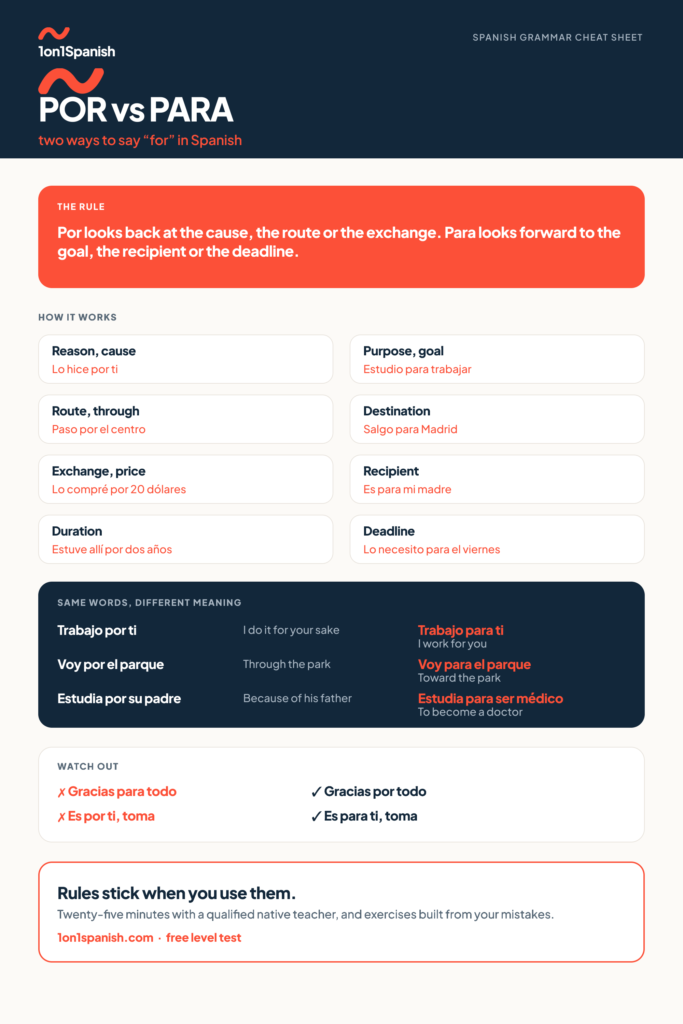
Take the chart with you
The chart is free to view and share. Drop your email and we’ll send the print-ready US Letter PDF — the version you stick on the fridge.
Practice
Practice por and para with a real teacher
Charts get you halfway. The other half is saying it out loud to someone who corrects you on the spot. At 1on1Spanish you get 25-minute private lessons with a qualified native teacher, exercises built from the mistakes you make in class, and AI practice between lessons.
First month $1. No contracts, cancel anytime.
Guides help. A teacher hears what a guide cannot — Learn Spanish online with a real teacher.
Take your free level testBuilt on RingTeacher's method — 700,000+ classes delivered since 2017, teaching English to Spanish speakers. Now in the other direction.
Frequently asked questions
When do you use por instead of para in Spanish?
Use por when the sentence names a cause, a price, a route, a means or a time span: por la lluvia, por cien dólares, por el parque, por correo, por dos horas. Use para when it names a goal, a recipient, a destination or a deadline: para aprobar, para ti, para Miami, para el viernes. One looks back at why, the other looks forward at what for.
What’s the easiest way to remember por vs para?
Ask whether the sentence explains what came before the action or what comes after it. Cause, route, price and method came before: por. Goal, recipient, destination and deadline come after: para. A second check that catches most cases: if the English is “in order to”, the Spanish is para; if the English is “because of”, it’s por.
Is por vs para different in Latin America and Spain?
The rule is the same everywhere. The only visible variation is in duration, where por dos años is common in Latin America while Spain leans toward durante dos años or no preposition at all. Both are understood on both sides, and nothing about the minimal pairs changes by region.
Do native speakers ever hesitate between por and para?
No, because they aren’t choosing between two versions of “for”. Trabajo por ti and trabajo para ti are as different to a native ear as “covering your shift” and “working for you” are in English. The pair only feels like a decision to someone translating from a language that fuses cause and purpose into a single preposition.
What’s the most common mistake with por and para?
Using por for purpose: estudio por aprobar instead of estudio para aprobar. English speakers reach for por whenever the sentence answers “why”, but purpose and cause split in Spanish — a goal you haven’t reached yet takes para, and a reason that already exists takes por. Thanking someone with gracias para is the second most frequent version of the same slip.