
Gustar and similar verbs: the backwards Spanish construction
Gustar does not mean “to like” — it means “to be pleasing” — so the thing you like is the subject of the sentence and you are the person it happens to. Me gusta el café is literally “coffee is pleasing to me”, which is why the verb agrees with the coffee and not with you. Get that one inversion and a dozen high-frequency verbs fall into place at once. 1on1Spanish drills this construction in 25-minute one-on-one lessons with qualified native teachers, online across the United States.
Reviewed by María Jiménez — Licenciada en Filología Hispánica (BA in Hispanic Philology) · Updated Sep 2026
The structure, in three slots
Every sentence with gustar has the same shape: pronoun + verb + the thing.
| Person | Pronoun | Sentence |
|---|---|---|
| I | me | Me gusta mi trabajo. |
| you | te | Te gusta el café. |
| he, she, you (formal) | le | Le gusta el café. |
| we | nos | Nos gusta el barrio. |
| you all (Spain) | os | Os gusta el barrio. |
| they, you all | les | Les gusta el barrio. |
The pronoun tells you who does the liking. It never changes with the verb, and it never disappears. These six are the indirect object pronoun set — the same me, te, le, nos, os, les you use with dar or decir.
Why there are only two forms
Because the thing is the subject, the verb only ever needs two endings in the present: gusta for one thing, gustan for several.
Me gusta mi trabajo. Me gustan mis compañeros. Nothing about “I” appears in the verb at all.
Infinitives count as one thing, even a whole list of them: Me gusta cocinar, Me gusta viajar y leer. Two activities, still gusta, because a stack of infinitives is one idea.
Other tenses work the same way; only the verb moves. Me gustó la película, Me gustaban las clases de los martes, Te va a gustar el restaurante. Every tense of gusta and gustan is laid out on the gustar conjugation page.
The verb family
Every verb below is built exactly like gustar. Learn the pattern once, get all of them.
| Verb | Meaning | Example | English |
|---|---|---|---|
| gustar | to like | Me gusta mi trabajo. | I like my job. |
| encantar | to love | A mi mujer le encanta viajar. | My wife loves traveling. |
| interesar | to be interested in | No me interesan las reuniones largas. | Long meetings don’t interest me. |
| faltar | to be missing, to need | Me faltan doscientos dólares. | I’m two hundred dollars short. |
| doler | to hurt | Me duele la espalda. | My back hurts. |
| importar | to matter, to mind | ¿Te importa si pago con tarjeta? | Do you mind if I pay by card? |
| molestar | to bother | Nos molesta el ruido del hotel. | The hotel noise bothers us. |
| parecer | to seem | Me parece caro. | It seems expensive to me. |
| quedar | to have left | Nos quedan dos días de vacaciones. | We have two vacation days left. |
| apetecer | to feel like | ¿Te apetece un café? | Do you feel like a coffee? |
| costar | to find hard | Me cuesta madrugar. | I find it hard to get up early. |
| convenir | to suit | No nos conviene firmar hoy. | Signing today doesn’t suit us. |
| preocupar | to worry | Le preocupa la factura del médico. | The doctor’s bill worries him. |
Edge cases worth knowing
Body parts drop the possessive. Me duele la espalda, not mi espalda. The pronoun already says whose back it is, so the possessive would be a duplicate. The nouns doler runs on — la espalda, la cabeza, el estómago — are on the body parts in Spanish page.
Gustar with a person means attraction. Me gusta mi jefe is not a compliment about his management. For liking someone as a person, Spanish uses me cae bien: Mi jefe me cae muy bien.
Quedar splits in two. Me quedan dos días is “I have two days left”. Me queda bien la chaqueta is “the jacket fits me well”. Same verb, same structure, two meanings the context sorts out.
Parecer takes an opinion, not a fact. Me parece bien, me parece caro, ¿qué te parece? This is how Spanish asks what you think without any verb for “think”.
Faltar counts down. Me falta un documento (I’m missing one), Faltan dos semanas para el viaje (two weeks to go). The second one has no person at all.
Common mistakes English speakers make
Yo gusto means other people find you attractive. The English subject “I” has no slot in this sentence.
The verb agrees with the books, because the books are the subject. Plural thing, plural verb, every time.
Naming the person requires the a. Without it the sentence has two subjects fighting for the same slot.
The a mí adds emphasis; it doesn’t replace me. Both pieces stay.
The pronoun already assigns ownership. Spanish uses the article with body parts in this construction.
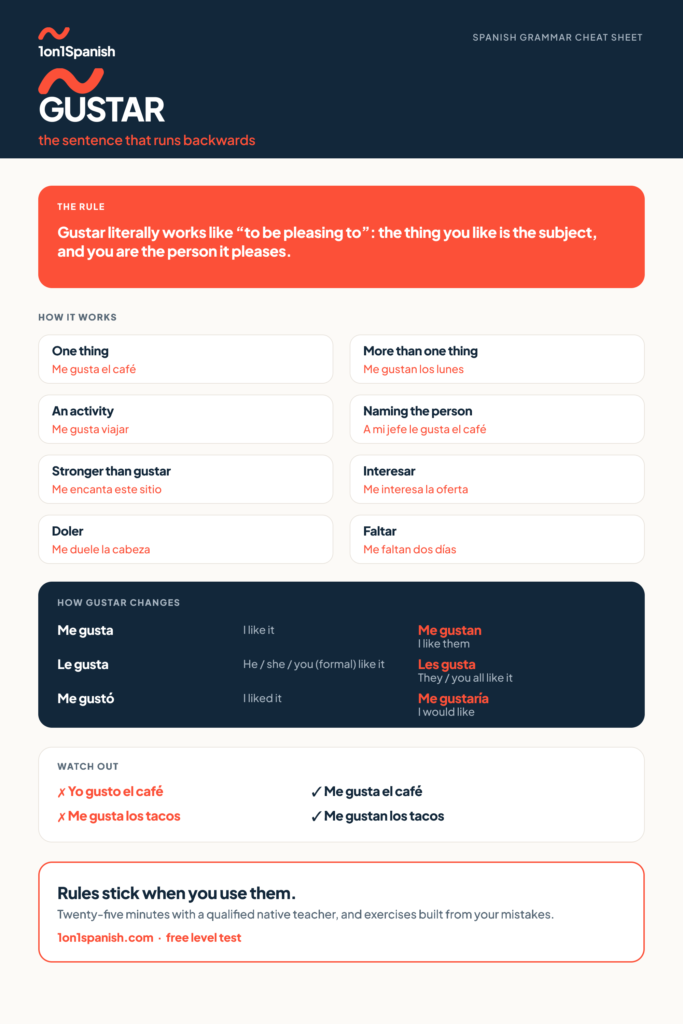
Take the chart with you
The chart is free to view and share. Drop your email and we’ll send the print-ready US Letter PDF — the version you stick on the fridge.
Practice
Practice gustar and similar verbs with a real teacher
Charts get you halfway. The other half is saying it out loud to someone who corrects you on the spot. At 1on1Spanish you get 25-minute private lessons with a qualified native teacher, exercises built from the mistakes you make in class, and AI practice between lessons.
First month $1. No contracts, cancel anytime.
These guides are free. When you want someone correcting you out loud, learn Spanish online with a qualified native teacher.
Take your free level testBuilt on RingTeacher's method — 700,000+ classes delivered since 2017, teaching English to Spanish speakers. Now in the other direction.
Frequently asked questions
Why does gustar work backwards in Spanish?
Because it doesn’t mean “to like”, it means “to be pleasing”. In me gusta el café, the coffee is doing the pleasing and you are the one receiving it, so the verb agrees with the coffee. English puts the person in the subject slot and Spanish puts the thing there. Nothing else about the verb is unusual.
How do you say “I like them” versus “I like it” in Spanish?
Change the verb, not the pronoun. Me gusta for one thing, me gustan for more than one: me gusta el libro, me gustan los libros. The me stays the same because it marks who is doing the liking. If the thing is an action, use the infinitive and the singular: me gusta leer.
What other Spanish verbs work like gustar?
Encantar, interesar, faltar, doler, importar, molestar, parecer, quedar, apetecer, costar, convenir and preocupar all take the same structure: pronoun, verb, thing. Me duele la espalda, nos quedan dos días, ¿te apetece un café?. Learning the pattern once gives you the whole group.
Do you always need “a mí” or “a mi marido” with gustar?
Not with me, te, nos and os, where the pronoun is already unambiguous — there you add the a phrase only for contrast: a mí me gusta, a él no. With le and les it’s usually necessary, since those pronouns could point to several people. A mi marido le gusta removes the doubt.
What’s the most common mistake with gustar?
Making the verb agree with the person instead of the thing, as in me gusta los libros or yo gusto el café. English trains you to put yourself in the subject slot and the Spanish sentence has no room for you there. The fix is to ask what is doing the pleasing before choosing between gusta and gustan.