
LL in Spanish: why it sounds like y (yeísmo)
The Spanish ll used to be its own distinct sound, different from y, and for most of the Spanish-speaking world today it isn’t anymore. In almost every country, ll and y have merged into the same sound — the English y in “yes” — a shift linguists call yeísmo. That means pollo (chicken) and poyo (a stone bench) sound identical for most speakers, even though they’re spelled with different letters.
A pocket of speakers in the Andes and in Paraguay still keep the two sounds apart, and Argentina and Uruguay pronounce the merged sound as something closer to English “sh”. At 1on1Spanish we work on this in 25-minute one-on-one lessons with qualified native teachers, online across the United States.
Below is what ll sounds like today, where the old distinction survives, and the “sh” version that catches learners off guard the first time they hear Argentine Spanish.
Reviewed by María Jiménez — Licenciada en Filología Hispánica (BA in Hispanic Philology) · Updated Sep 2026
The sound you already have: the English y
For the vast majority of Spanish speakers, ll is pronounced exactly like y — the sound at the start of “yes”, “yard” or “yellow” in English. You already make this sound correctly without any adjustment:
- llama (llama, or “flame”/”he calls”) · pollo (chicken) · calle (street) · llover (to rain) · silla (chair)
Say the English word “yellow” slowly, then move that same y-sound into silla: that’s a correct, standard Latin American pronunciation of ll. This is the version 1on1Spanish teaches by default, since it’s the one used by most Spanish speakers worldwide.
Why ll and y sound the same: yeísmo
Yeísmo is the name for this merger, and it isn’t a mistake or a regional accent limited to one country — it’s the majority pronunciation across Latin America and most of Spain. Historically, ll was a distinct sound, a palatal lateral made with the middle of the tongue pressed against the roof of the mouth, different from the consonant y. Over centuries, most Spanish speakers stopped making that distinction and let both letters collapse into one sound. Today, spelling is often the only way to tell ll words and y words apart on paper, even though they’re identical out loud. The other half of the pair, the Spanish y, has its own page, including the one job it does that ll never does: standing alone as the word for “and”.
Where the old, distinct ll sound survives
A minority of speakers, mainly in parts of the Andes — highland Bolivia, Peru, Ecuador, Colombia — and in Paraguay, still keep ll and y as two separate sounds. For them, pollo and poyo really do sound different, with ll closer to the “lli” in the English word “million” said quickly. This is a regional feature, not the standard taught to learners, and you won’t be misunderstood anywhere in the Spanish-speaking world by using the merged y-sound instead.
The Argentine and Uruguayan shift: rehilamiento
In Argentina and Uruguay — the Rioplatense region — the merged ll/y sound shifted again, into something closer to the English “sh” in “shoe” or, for some speakers, the “zh” in “measure”. This is called rehilamiento. Yo me llamo in Rioplatense Spanish comes out closer to “sho me shamo” than “yo me yamo”. It’s not a mistake or a different language — it’s simply how Argentina and Uruguay pronounce the same letters everyone else pronounces as y.
Reference chart
| Region | Sound of ll and y | Example (llamo) |
|---|---|---|
| Most of Latin America, most of Spain | English y, as in “yes” | “YAH-moh” |
| Andes highlands, Paraguay | distinct ll sound (old pronunciation) | “LYAH-moh” |
| Argentina, Uruguay | “sh” or “zh” sound | “SHAH-moh” |
Why ll and y don’t create true minimal pairs for most speakers
Because yeísmo is so widespread, ll and y rarely create a meaningful contrast the way, say, pero and perro do with a single and double r. What they do create is spelling confusion: since both letters sound the same, native speakers themselves sometimes have to think about which one a word uses. Cayó (he/she fell) and calló (he/she went quiet) are a rare pair that stays distinct in writing and sounds completely identical when spoken by a yeísta speaker — context is what tells them apart, not sound. That single-versus-double r contrast is the real thing, and the Spanish r and rr page is built around it.
Common mistakes English speakers make
✗ Pronouncing ll as an English “l” sound. Silla said with an English l, like “SEE-lah”, doesn’t exist in standard Spanish. The letter combination ll is never read as a plain l.
✗ Overcorrecting with a strong “lyuh” sound everywhere. Some learners, after reading that ll used to be its own sound, force a heavy “ly” blend into every word. Unless the goal is specifically Andean or Paraguayan Spanish, the simple English y is the more natural, widely understood choice.
✗ Being thrown off the first time you hear Argentine Spanish. Hearing lluvia pronounced with a “sh” sound feels like a different word the first few times. It’s the same word, the same spelling, one regional pronunciation among several correct ones.
✗ Avoiding words with ll out of uncertainty about which sound to use. Llamar, calle, pollo are everyday words. Using the simple y-sound is correct almost everywhere; there’s no need to wait until the regional variation makes sense.
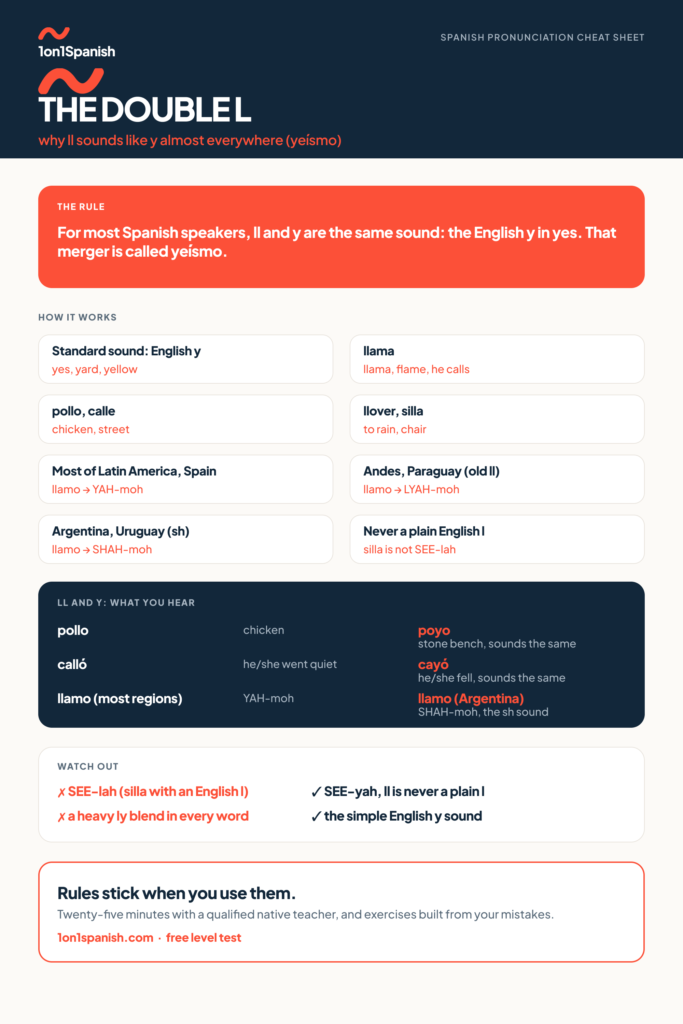
Take the chart with you
The chart is free to view and share. Drop your email and we’ll send the print-ready US Letter PDF — the version you stick on the fridge.
Practice
Practice Spanish pronunciation with a real teacher
Charts get you halfway. The other half is saying it out loud to someone who corrects you on the spot. At 1on1Spanish you get 25-minute private lessons with a qualified native teacher, exercises built from the mistakes you make in class, and AI practice between lessons.
First month $1. No contracts, cancel anytime.
Grammar you can read. Speaking you cannot. Learn Spanish online and practice it live.
Take your free level testBuilt on RingTeacher's method — 700,000+ classes delivered since 2017, teaching English to Spanish speakers. Now in the other direction.
Frequently asked questions
Does ll sound different from y in Spanish?
For most Spanish speakers today, no — both sound like the English y in “yes”, a merger called yeísmo. A minority of speakers in the Andes and in Paraguay still keep the two sounds distinct, with ll closer to the “lli” in “million”. Argentina and Uruguay pronounce the merged sound as something closer to “sh”.
Why do Argentinians pronounce ll like “sh”?
It’s a regional shift called rehilamiento, layered on top of the yeísmo merger that already made ll and y sound the same across most of the Spanish-speaking world. In Argentina and Uruguay, that merged sound moved further, into something between the English “sh” in “shoe” and the “zh” in “measure”. Yo me llamo becomes closer to “sho me shamo”.
Is it wrong to pronounce ll like y in Spanish?
No, it’s the standard, majority pronunciation across almost all of Latin America and most of Spain. It’s the version taught by default at 1on1Spanish and the one that will be understood everywhere. The distinct, older ll sound is a regional feature today, not the baseline correct form.
What’s the difference between ll in Spain and Latin America?
Most of Spain merged ll and y into the same y-sound, just like most of Latin America. The parts of Spain that still keep the distinction are a minority, similar in status to the Andean and Paraguayan pockets in Latin America that also preserve the older sound.
How do you know if a word uses ll or y in Spanish?
By spelling, not by sound, since the two letters are pronounced the same way for most speakers. Cayó (fell) and calló (went quiet) sound identical out loud and differ only on paper. Learning which letter a specific word uses comes from reading and memorization, the same way English speakers learn “there” versus “their”.