
Accents in Spanish: stress rules and how to type them
Spanish marks stress in writing with a small line called a tilde, and once you know three rules you can read almost any word out loud correctly on the first try — no dictionary, no guessing. English does the opposite: it stresses syllables constantly (RECord the noun, reCORD the verb) but never writes it down. Skip a Spanish tilde and you don’t just mispronounce a word, you sometimes say a different one: tú is “you”, tu is “your”.
Below are the three stress rules, the accented pairs that change meaning, and how to actually type á, é, í, ó, ú and ñ on an American keyboard. 1on1Spanish works on this with qualified native teachers in 25-minute one-on-one lessons, online across the United States.
Reviewed by María Jiménez — Licenciada en Filología Hispánica (BA in Hispanic Philology) · Updated Sep 2026
The sound you already make: stress you just don’t write
English speakers already stress one syllable per word without thinking about it — that’s what separates the noun PERmit from the verb perMIT. Spanish does the same thing, but with a rule instead of memory: every word has a stressed syllable, and Spanish tells you exactly which one by a mix of a default pattern and, when a word breaks the pattern, a written tilde. You’re not learning a new skill here, you’re learning where your existing skill for hearing stress gets written down on paper.
The three rules, in order
Every Spanish word falls into one of three groups depending on which syllable is stressed. Learn these three and you can read any word out loud, tilde or not.
- Palabras agudas — stress on the last syllable. They carry a written tilde only if they end in a vowel, n, or s: ca-FÉ, jar-DÍN, in-GLÉS. If they end in any other consonant, no tilde is needed: reloj, ciudad, feliz.
- Palabras llanas (also called graves) — stress on the second-to-last syllable, which is the default pattern for most Spanish words. They carry a tilde only when they end in a consonant other than n or s: FÁ-cil, ÁR-bol, a-ZÚ-car. Words that already follow the default and end in a vowel, n, or s need no tilde: casa, comen, lunes.
- Palabras esdrújulas (and the rarer sobresdrújulas) — stress on the third-to-last syllable or earlier. These always carry a tilde, no exceptions: MÚ-si-ca, te-LÉ-fo-no, SÁ-ba-do, DÍ-ga-me-lo.
The pattern behind all three: Spanish assumes stress falls on the second-to-last syllable if the word ends in a vowel, n, or s, and on the last syllable otherwise. A tilde only shows up when a word breaks that assumption.
The hiato: two vowels, two syllables
A written accent also shows up to split two vowels that would otherwise blend into one syllable. Día, país, María, río, baúl all carry a tilde on a weak vowel (i or u) next to a strong one (a, e, o) precisely to force two separate syllables: dí-a, not dia in one breath. Without the tilde, Spanish would read those vowels together as a single glide, called a diphthong, and the word would lose a syllable. This is the one context where a tilde isn’t about stress on a whole word — it’s about keeping two vowels apart. The fusion side of that rule — which vowel pairs glide together and which never do — is on the Spanish diphthongs page.
Where each accent goes, by word type
| Word type | Stress falls on | Gets a tilde when | Example |
|---|---|---|---|
| Aguda | Last syllable | Ends in vowel, n, or s | ca-FÉ, jar-DÍN |
| Llana / grave | Second-to-last syllable | Ends in a consonant other than n/s | FÁ-cil, ÁR-bol |
| Esdrújula | Third-to-last syllable | Always | MÚ-si-ca, te-LÉ-fo-no |
| Hiato | — | Weak vowel next to strong vowel, split into two syllables | DÍ-a, pa-ÍS |
The pairs a tilde tells apart: la tilde diacrítica
These word pairs are spelled identically except for one accent mark, and the tilde is the only thing separating them. Spanish speakers rely on it in writing the same way English speakers rely on “its” versus “it’s”.
| Without tilde | With tilde |
|---|---|
| tu (your) | tú (you) |
| el (the) | él (he) |
| si (if) | sí (yes) |
| mas (but, literary) | más (more) |
| se (himself/herself, reflexive) | sé (I know / be, command) |
| de (of, from) | dé (give, subjunctive) |
| mi (my) | mí (me, after a preposition) |
| como (like, as) | cómo (how) |
| que (that, which) | qué (what) |
¿Tú sabes cómo se llama tu perro? — “Do you know what your dog’s name is?” — uses three of these pairs correctly in a single sentence.
Common mistakes English speakers make
✗ Dropping the tilde because it looks optional. In English, missing punctuation rarely changes meaning. In Spanish, esta (this) and está (is/are) are different words entirely.
✗ Guessing stress by ear instead of applying the rule. English stress is memorized word by word. Spanish stress is rule-based: check the ending, decide if the word breaks the default pattern, and you know where the tilde goes before you ever hear the word spoken.
✗ Treating question and exclamation words as unaccented. Qué, cómo, dónde, cuándo, cuál and quién all carry a tilde whenever they ask or exclaim something, even mid-sentence: No sé qué hacer. Without the tilde they become the connector versions: que, como, donde.
✗ Assuming ñ is an accented letter. It isn’t a stress mark at all — the ñ is its own letter of the Spanish alphabet, with its own separate keyboard shortcut. Mixing it up with the tilde on vowels is common and worth untangling early.
✗ Skipping accents when typing because the keyboard “doesn’t have them”. It does. See below.
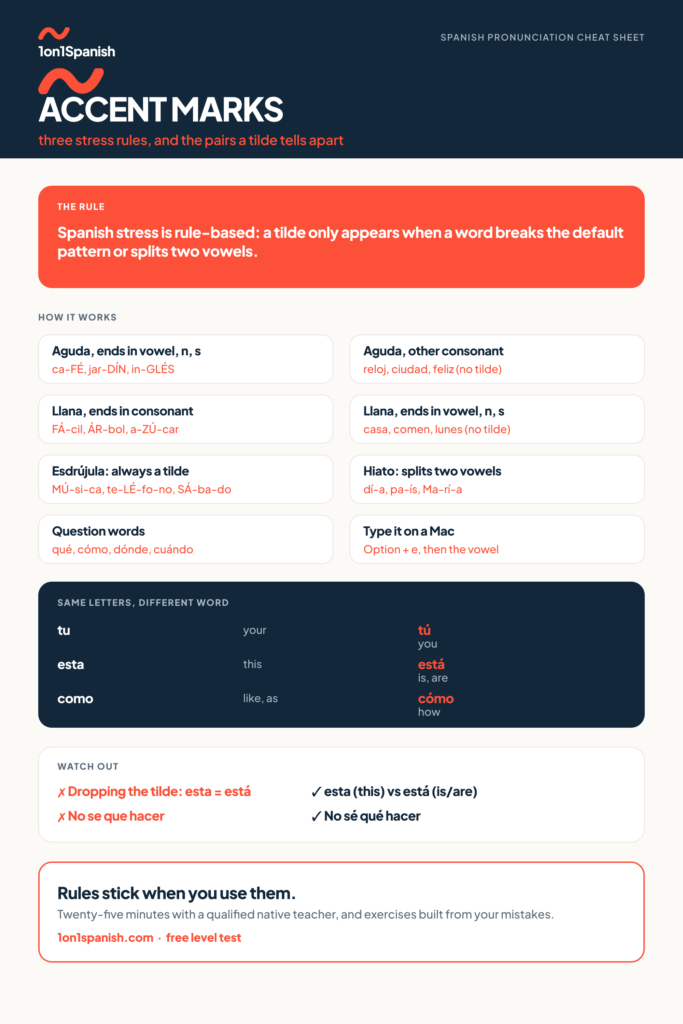
Take the chart with you
The chart is free to view and share. Drop your email and we’ll send the print-ready US Letter PDF — the version you stick on the fridge.
How to type accents and the ñ on an American keyboard
This is where most guides stop short, and it’s the part people actually search for. No app, no copy-pasting from a website.
On a Mac: hold Option, tap e, release, then type the vowel: á, é, í, ó, ú. For the ñ, hold Option, tap n, release, then type n again: ñ. For the upside-down punctuation: Option + Shift + ? gives ¿, and Option + 1 gives ¡. The ñ gets its own combination because it isn’t an accented n but the fifteenth letter of the Spanish alphabet; the Spanish ñ page covers the sound, pairs like año and ano, and where that wavy line came from.
On Windows: the fastest fix is switching to the United States-International keyboard layout (Settings → Time & Language → Language → add a keyboard). With it active, type an apostrophe ‘ followed by a vowel for á, é, í, ó, ú, and a tilde key ~ followed by n for ñ. Without switching layouts, hold Alt and type the number on the numeric keypad: Alt+0225 = á, Alt+0233 = é, Alt+0237 = í, Alt+0243 = ó, Alt+0250 = ú, Alt+0241 = ñ, Alt+0191 = ¿, Alt+0161 = ¡.
On a phone: press and hold any vowel key or the n key on the default keyboard, and the accented options pop up above it, including ñ. That part already works out of the box on iOS and Android.
Practice
Practice accents in Spanish with a real teacher
Charts get you halfway. The other half is saying it out loud to someone who corrects you on the spot. At 1on1Spanish you get 25-minute private lessons with a qualified native teacher, exercises built from the mistakes you make in class, and AI practice between lessons.
First month $1. No contracts, cancel anytime.
Everything on this page is free to use. If you want feedback on your own Spanish, learn Spanish online with us.
Take your free level testBuilt on RingTeacher's method — 700,000+ classes delivered since 2017, teaching English to Spanish speakers. Now in the other direction.
Frequently asked questions
What is the accent mark in Spanish called?
It’s called a tilde. The word covers two different marks: the small line over a vowel that shows stress or breaks a hiato (á, é, í, ó, ú), and the wave-shaped mark over the ñ, which is technically a separate mark called a virgulilla but is often called a tilde too in everyday speech.
Do all Spanish words need a written accent?
No. Most words follow the default stress pattern — second-to-last syllable if they end in a vowel, n, or s, last syllable otherwise — and get no tilde at all. A written accent only appears when a word breaks that default, when it’s an esdrújula, or when a diacritical tilde separates two otherwise identical words.
What’s the difference between tú and tu?
Tú with a tilde means “you”. Tu without one means “your”. Tú tienes tu libro — “You have your book” — uses both correctly in one sentence. The same pattern splits él/el, sí/si, más/mas, sé/se, dé/de, mí/mi and qué/que: identical spelling, different word, and the tilde is the only signal.
How do I type accent marks on an American keyboard?
On a Mac, hold Option, tap e, then the vowel for á/é/í/ó/ú, and Option then n then n again for ñ. On Windows, switch to the United States-International keyboard layout and type an apostrophe before a vowel, or use Alt codes like Alt+0241 for ñ. Phones show accented letters when you press and hold the base letter.
What happens if I leave out an accent mark?
Sometimes nothing — context makes the meaning obvious. Other times it changes the word entirely: esta (this) versus está (is), como (like) versus cómo (how), papa (potato, in Latin America) versus papá (dad). In formal or written Spanish, missing tildes read as a spelling mistake even when the meaning survives.