
How to pronounce y in Spanish: vowel and consonant
The Spanish y does two different jobs, and the sound changes depending on which one it’s doing. As a vowel — on its own, or at the end of a word — it sounds exactly like the Spanish i: hoy (today), rey (king), and the word y itself, meaning “and”, all use a plain ee sound. As a consonant, at the start of a syllable — yo (I), ayer (yesterday), playa (beach) — it sounds like the English y in “yes”. Across most of Latin America that consonant sound also merges with the letters ll, a pattern called yeísmo, and in Argentina and Uruguay it shifts again into something closer to “sh”.
Below is when y is a vowel, when it’s a consonant, and what changes as you cross the Río de la Plata. 1on1Spanish works on pronunciation in 25-minute one-on-one lessons with qualified native teachers, online across the United States.
Reviewed by María Jiménez — Licenciada en Filología Hispánica (BA in Hispanic Philology) · Updated Sep 2026
Y as a vowel: the sound you already have
When y stands alone as a word, or closes off a syllable at the end of a word, it behaves exactly like the vowel i — a plain ee sound, the same one in the English word “see”:
- y — “and” — pronounced ee
- hoy — today — the y closes the word, sounding like ee
- rey — king — same pattern
- muy — very — same pattern
There’s nothing to build here. English already has this exact vowel sound, and Spanish just spells it with y in these specific spots instead of i. That i is one of the five Spanish vowel sounds that never glide, which is why hoy stops clean instead of drifting into “oy-ee”.
Y as a consonant: the sound you already have, too
At the start of a syllable — before a vowel, opening a word or a syllable inside one — y sounds like the English y in “yes”, “yellow” or “yard”. This is the far more common use of the letter, and it’s also a sound English speakers already produce correctly without thinking about it:
- yo (I) · ayer (yesterday) · playa (beach) · mayo (May) · ya (already)
The only adjustment: Spanish speakers often press it slightly harder than the soft English y, especially at the start of a word, giving it a touch more friction — something closer to the “j” in the English word “jeans” said lightly. That extra firmness varies a lot by region and by speaker, and a plain English y is understood everywhere.
Where the letter y sounds, by position
| Position | Example | Sound |
|---|---|---|
| Standing alone (the word “and”) | y | vowel, like i |
| End of a word, after a vowel | hoy, rey, muy | vowel, like i |
| Start of a word, before a vowel | yo, ya | consonant, like English y |
| Middle of a word, before a vowel | ayer, mayo | consonant, like English y |
The rule is really just one question: is the y followed by a vowel in the same syllable? If yes, it’s a consonant. If not — if it’s closing the syllable or standing alone — it’s a vowel.
Yeísmo: when y and ll are the same sound
Spanish used to distinguish the consonant y from the double-l, ll, as two separate sounds. In nearly all of Latin America today, and in most of Spain, that distinction has disappeared: y and ll are pronounced identically. This merger is called yeísmo, and it means se cayó (he/she fell) and a hypothetical spelling with ll would sound the same, and real pairs like pollo (chicken) and poyo (a type of stone bench) are true homophones for the vast majority of Spanish speakers.
For a learner, yeísmo is good news: it means you only need to learn one consonant sound, the English y, and it covers both letters almost everywhere Spanish is spoken. Where that merger came from, and the few places it still doesn’t hold, is on the page for the Spanish ll.
The pairs yeísmo makes identical
| Written with ll | Written with y | Sound (yeísmo) |
|---|---|---|
| pollo — chicken | poyo — stone bench | identical |
| calló — he/she went quiet | cayó — he/she fell | identical |
| valla — fence | vaya — go (command) | identical |
| halla — he/she finds | haya — there may be | identical |
None of these cause real confusion in conversation, since context does the work — the same way “there”, “their” and “they’re” don’t trip up an English listener out loud.
The exception: rehilamiento in Argentina and Uruguay
In Buenos Aires, Montevideo, and across the Río de la Plata region generally, both y and ll shift into a different sound entirely, called rehilamiento: something close to the “sh” in the English word “she”, or in some speakers a softer “zh” like the s in “measure”. Calle (street) comes out close to “CAH-sheh” instead of “CAH-yeh”, and yo sounds close to “sho”.
This is a real, well-documented regional accent, not a mistake and not slang. 1on1Spanish teaches the more widespread Latin American pronunciation — the English-y sound — as the default, since it’s understood everywhere including Argentina and Uruguay. Recognizing the “sh” version is useful mostly for anyone watching Argentine media or planning to visit.
Common mistakes English speakers make
✗ Treating every y as a consonant. Reading hoy or muy with a consonant y sound, instead of letting it act as a vowel, distorts words that are actually simple once you spot the pattern.
✗ Missing yeísmo and trying to invent a separate ll sound. There’s no need to build a special sound for ll in most Spanish — it’s the same English y sound that already covers the consonant y.
✗ Assuming the Argentine “sh” sound is used everywhere. It’s specific to the Río de la Plata region. Using it in Mexico or Colombia would sound unusual, the way a strong regional English accent would stand out in the wrong context.
✗ Softening the consonant y too much. A whisper-quiet y can disappear entirely in fast speech. The English y sound, said with normal firmness, carries better in Spanish than it does in English.
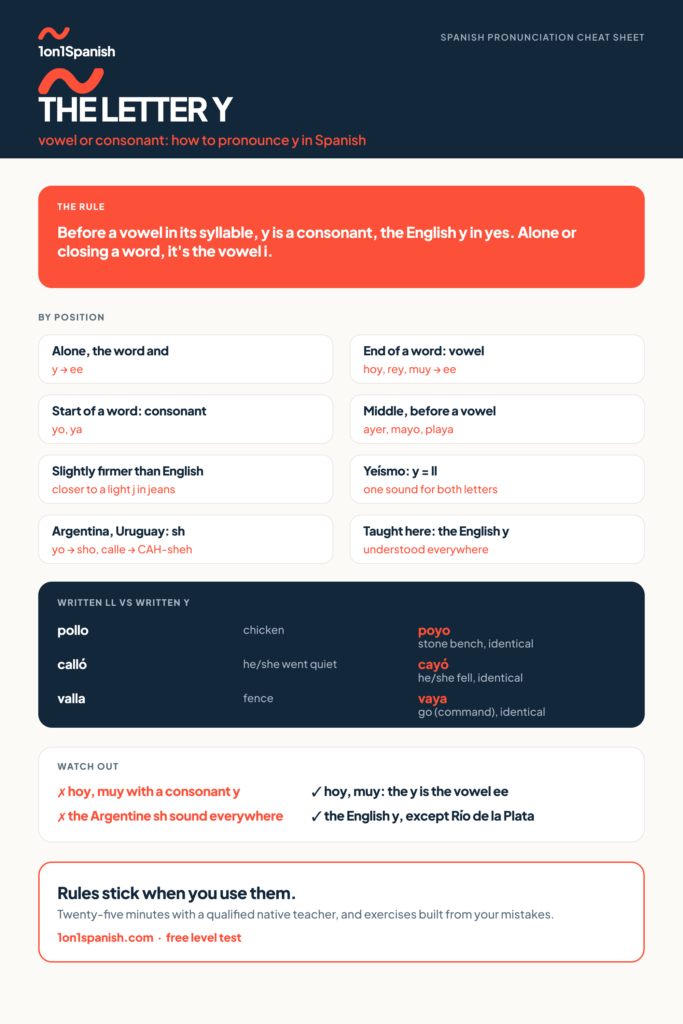
Take the chart with you
The chart is free to view and share. Drop your email and we’ll send the print-ready US Letter PDF — the version you stick on the fridge.
Practice
Practice the Spanish y with a real teacher
Charts get you halfway. The other half is saying it out loud to someone who corrects you on the spot. At 1on1Spanish you get 25-minute private lessons with a qualified native teacher, exercises built from the mistakes you make in class, and AI practice between lessons.
First month $1. No contracts, cancel anytime.
These guides are free. When you want someone correcting you out loud, learn Spanish online with a qualified native teacher.
Take your free level testBuilt on RingTeacher's method — 700,000+ classes delivered since 2017, teaching English to Spanish speakers. Now in the other direction.
Frequently asked questions
How do you pronounce y in Spanish?
It depends on its job in the word. As a vowel — standing alone as “and”, or ending a word like hoy or rey — it sounds like the Spanish i, a plain ee. As a consonant, starting a syllable before a vowel, like in yo or playa, it sounds like the English y in “yes”. Both sounds already exist in English, so there’s nothing new to build, only the rule for which one applies.
What is yeísmo in Spanish?
Yeísmo is the merger of two sounds, y and ll, into one identical pronunciation across nearly all of Latin America and most of Spain. Words like pollo (chicken) and poyo (stone bench) end up sounding the same. For learners it simplifies things: one consonant sound, close to the English y, covers both letters almost everywhere.
Why does y sound like “sh” in some Spanish accents?
That’s called rehilamiento, and it’s specific to the Río de la Plata region — mainly Argentina and Uruguay, especially Buenos Aires and Montevideo. There, both y and ll shift toward a “sh” or soft “zh” sound, so calle (street) sounds close to “CAH-sheh”. It’s a well-established regional accent, not a mistake, and it doesn’t happen in most other Spanish-speaking countries.
Is the Spanish y the same as ll?
In pronunciation, yes, almost everywhere, thanks to yeísmo. In spelling, no — they’re two different letters with different histories, and a word is only correct with the letter it’s actually spelled with. Cayó (fell) and a misspelling with ll would sound identical but only one is the real word.
When is y a vowel instead of a consonant in Spanish?
When it stands alone as the word y (“and”), or when it closes a syllable at the end of a word, as in hoy, rey or muy. In both cases it behaves exactly like the vowel i. When a vowel follows it in the same syllable — yo, ayer, playa — it acts as a consonant instead, closer to the English y in “yes”.