
How to roll your rs in Spanish: the r and rr sounds
Spanish has two r sounds and English speakers usually only worry about one of them. The single r between vowels is a tap: one quick flick of the tongue, and you already make it every day in the middle of butter and ladder. The double rr is a trill: the same spot, but the tongue vibrates several times on a stream of air. Mixing them up changes words — pero is “but” and perro is “dog” — so this is not a cosmetic detail. Below is where each sound goes, how to produce the trill, and what to do while it isn’t coming out yet. At 1on1Spanish we drill it with qualified native teachers in 25-minute lessons.
Reviewed by María Jiménez — Licenciada en Filología Hispánica (BA in Hispanic Philology) · Updated Sep 2026
The sound you already have: the Spanish tap
A single r between two vowels is not the American r at all. The American r is made with the tongue bunched in the middle of the mouth and never touching anything. The Spanish tap touches: the tip of the tongue hits the ridge behind your top teeth once, fast, and leaves.
You produce that exact sound in the middle of these English words, without thinking about it:
- butter · ladder · pot of tea · Betty · water
Say butter at normal speed, then hold on to that middle consonant and put it into caro — the Spanish word for expensive. That’s a correct Spanish r. The mistake almost every beginner makes is importing the American r instead, which is why pero comes out sounding like an English speaker reading pear-oh.
The sound you have to build: the trill
The rr is the same tongue position, but instead of one tap you let air push the tongue tip so it flutters against the ridge two, three, four times. It is not a throat sound and it has nothing to do with the French r. Everything happens at the front of the mouth. The one Spanish sound that does live back in the throat is the raspy Spanish j, and it has nothing to do with either r.
Where your tongue goes
Behind your top front teeth there’s a bump — the alveolar ridge. The tip of the tongue rests loosely against it, the sides of the tongue press against your upper molars to seal the air in, and the tip stays relaxed. Tension is what kills the trill: a stiff tongue can’t vibrate.
The method that works
- Say tee-dee-tee-dee fast, over and over. You’ll feel the tongue tip bouncing off the right spot. That’s the location.
- Now blow air continuously while keeping the tip resting there, without pushing it. The goal is air doing the work, not muscle.
- Start from a t or d: say tres, drama, butter-ro. The stop before the r gives the tongue a launch point, which is why tres and dro are easier than a naked rr.
- When one flutter appears, don’t chase more. One extra flap is already a trill.
Some people get it in an afternoon and some take months. It’s a motor skill, like whistling — the instructions are five lines, the practice is not.
When a written r is a trill anyway
This is the part that texts skip and that changes how you read out loud. A single r is pronounced as a trill, not a tap, in three positions:
| Position | Example | Sound |
|---|---|---|
| Start of a word | rojo, ropa, Roberto | trill |
| After n | Enrique, honra | trill |
| After l | alrededor | trill |
| After s | Israel | trill |
| Between vowels | caro, pero, hora | tap |
| End of a syllable or word | hablar, carta, mar | tap (may sound stronger when emphasized) |
| Written rr | perro, carro, perra | trill, always |
Two consequences worth memorizing: rr never starts a word in Spanish, because that position already produces a trill with a single r. And a word that gets a prefix gets the double letter to keep the sound: rojo but pelirrojo.
The pairs that change meaning
These are real words, and the only difference is the number of taps. Latin American speakers hear the distinction instantly, the same way you hear ship and sheep.
| Tap (one r) | Trill (rr) |
|---|---|
| pero — but | perro — dog |
| caro — expensive | carro — car |
| cero — zero | cerro — hill |
| coro — choir | corro — I run |
| pera — pear | perra — female dog |
| ahora — now | ahorra — he/she saves (money) |
Mi carro es caro — my car is expensive — is the sentence teachers use to test both sounds in a row, and it’s a fair test.
Common mistakes English speakers make
✗ Using the American r for the single r. Pero said with an American r doesn’t become another word, but it marks the accent more than any other single sound in Spanish. Fix the tap first: it’s one flick, and you already own it from butter.
✗ Trying to trill from the throat. If you’re producing something that feels like gargling, that’s a uvular r — French and German use it, Spanish doesn’t. Move everything to the tip of the tongue behind the teeth.
✗ Tensing up. The most common physical error. A tight tongue cannot flutter. If nothing is happening, relax the jaw, drop the tongue tip until it barely grazes the ridge, and push air.
✗ Avoiding the words. Learners route around perro, arroz, carro for years. Say them anyway with a single tap while the trill develops. A tap where a trill belongs is a mild accent; silence is not communication.
✗ Reading a word-initial r as a tap. Roberto, Rosa and rojo all start with a trill even though only one r is written. It’s the single most common misreading out loud.
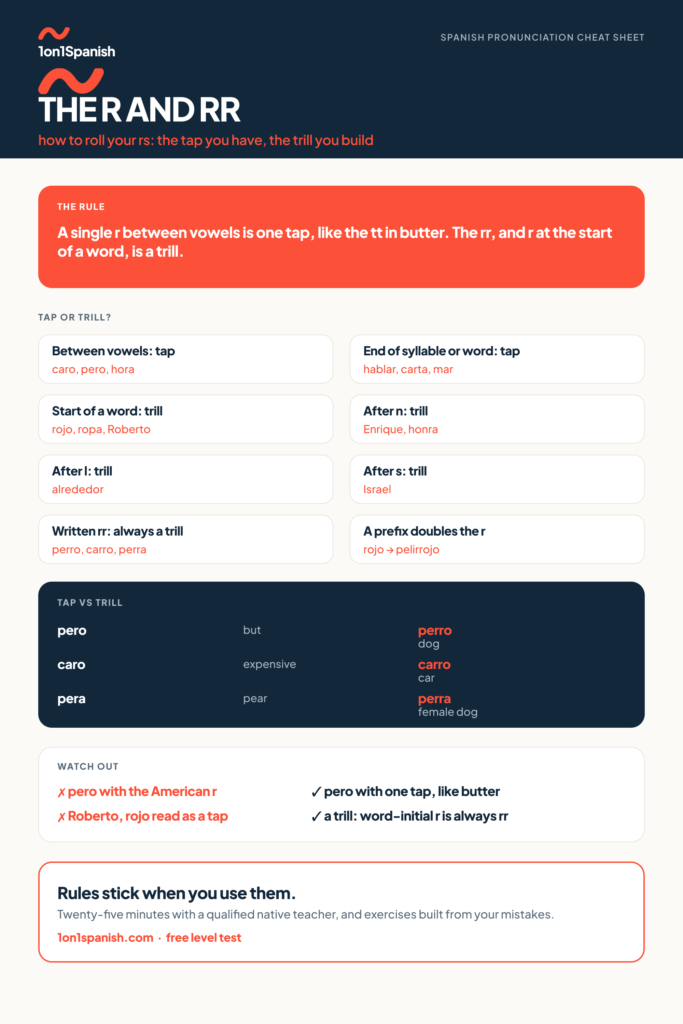
Take the chart with you
The chart is free to view and share. Drop your email and we’ll send the print-ready US Letter PDF — the version you stick on the fridge.
Practice
Practice the Spanish r and rr with a real teacher
Charts get you halfway. The other half is saying it out loud to someone who corrects you on the spot. At 1on1Spanish you get 25-minute private lessons with a qualified native teacher, exercises built from the mistakes you make in class, and AI practice between lessons.
First month $1. No contracts, cancel anytime.
You can go further with someone listening: Learn Spanish with 1on1Spanish, 25 minutes at a time.
Take your free level testBuilt on RingTeacher's method — 700,000+ classes delivered since 2017, teaching English to Spanish speakers. Now in the other direction.
Frequently asked questions
How do you roll your rs in Spanish?
Put the tip of your tongue against the ridge behind your top front teeth, keep it relaxed, seal the sides of the tongue against your upper molars, and push a steady stream of air until the tip flutters. Starting from a t or d helps, which is why tres and drama are the easiest words to practice with. It’s a motor skill: short daily attempts beat long sessions.
Can you speak Spanish without rolling your rs?
Yes. You’ll be understood everywhere, and plenty of native speakers have a weak trill or none at all — it’s a known speech variation, not a foreign marker. Use a single tap wherever a trill belongs and keep going. What does hurt comprehension is using the American r, because that sound doesn’t exist in Spanish and listeners have nothing to map it onto.
What’s the difference between r and rr in Spanish?
The single r between vowels is one quick tap of the tongue, the same sound as the middle of butter. The double rr is a trill, several vibrations in a row. The difference is meaningful: pero is “but” and perro is “dog”, caro is “expensive” and carro is “car”. A written single r is also pronounced as a trill at the start of a word and after n, l or s.
Why do some people never learn to roll their rs?
Because it’s a motor skill with no shortcut, like whistling or raising one eyebrow. The tongue has to stay loose while air does the work, and adults tend to add muscle instead of removing it. Age isn’t the barrier — tension is. Most learners who practice it in short daily bursts get a first flutter within a few weeks, and a reliable trill some time after that.
Is the Spanish r the same as the r in other languages?
No. The Spanish tap and trill are made at the front of the mouth with the tongue tip. French and German use a uvular r, produced at the back of the throat, which is why imitating those languages leads you away from Spanish. Italian has a similar trill, and the tap exists in American English inside words like ladder — you just don’t think of it as an r.