
How to ask questions in Spanish with intonation
Spanish has no “do” or “does”. English turns a statement into a yes-no question by adding an auxiliary verb — “you work here” becomes “do you work here?” — and Spanish has no equivalent word to insert. Instead, a yes-no question is often the exact same words as the statement, said with a rise in pitch at the end: ¿Trabajas aquí? and Trabajas aquí can use identical word order, and pitch alone is what tells a listener which one they’re hearing. Miss that rise and a real question can land as a flat statement, or vice versa. At 1on1Spanish we drill this in 25-minute one-on-one lessons with qualified native teachers, online across the United States.
Below is how the pitch pattern works, the difference between a yes-no question and one built with a question word, and the tag questions that turn any statement into a quick check-in.
Reviewed by María Jiménez — Licenciada en Filología Hispánica (BA in Hispanic Philology) · Updated Sep 2026
The sound you already have: rising pitch for a question
English does this too, just less often — “You’re coming?” said as a surprised follow-up rises in pitch at the end the same way a Spanish yes-no question does. That same rise, applied consistently rather than occasionally, is most of what makes a Spanish sentence sound like a question instead of a statement.
Say the English phrase “you’re coming” flat, then say it again letting your voice climb on the last word, like you’re double-checking something you weren’t sure of. That upward climb is the exact shape Spanish uses on ¿Vienes?
How the pitch pattern works, step by step
- A Spanish statement — Vienes a la fiesta — keeps a fairly level or slightly falling pitch through to the end.
- A yes-no question built from the same words — ¿Vienes a la fiesta? — keeps that same level pitch through most of the sentence, then rises noticeably on the last stressed syllable.
- The rise isn’t gradual across the whole sentence; it’s concentrated at the end, which is why a Spanish question can sound almost identical to its statement version until the very last word.
- Questions built with a question word — qué, dónde, cuándo — behave differently: pitch tends to start higher, right on the question word itself, and then fall gradually rather than rising at the end. ¿Dónde vives? starts high on dónde and comes back down.
The two patterns are worth practicing separately, because English speakers tend to default to the rising-at-the-end shape for every kind of question, including the ones that should start high and fall instead.
Yes-no questions vs. questions with a question word
A yes-no question has no question word and asks for confirmation: ¿Vienes?, ¿Ya comiste?, ¿Tienes hambre? These lean hardest on intonation, since the word order is often unchanged from the statement. In writing, the ¿ that opens them does the job your pitch does in speech; where that mark goes, and where it doesn’t, is on the Spanish punctuation page.
A question with a question word — qué, cuál, quién, dónde, cuándo, cómo, cuánto — already signals it’s a question through vocabulary and word order (the verb usually moves before the subject), so the intonation carries less of the load. The full list of these words and how each one works is covered on its own page; the sound is the focus here. The words themselves, and what each one asks for, are on the question words in Spanish page; that verb-before-subject swap is one of the four places Spanish word order departs from English.
Reference chart
| Question type | Example | Pitch pattern |
|---|---|---|
| Yes-no, same word order as a statement | ¿Trabajas aquí? | level, then rises at the end |
| Yes-no, subject and verb swapped | ¿Es tu hermano? | level, then rises at the end |
| With a question word | ¿Dónde trabajas? | starts high on the question word, falls after |
| Tag question | Trabajas aquí, ¿verdad? | statement pitch, then a small rise on the tag |
The tag that turns any statement into a question
¿Verdad? and ¿no? tacked onto the end of a statement work like “right?” or “isn’t it?” in English, turning a flat sentence into a quick check: Vienes a la fiesta, ¿verdad?, Hace calor hoy, ¿no? The statement itself keeps its normal falling pitch, and only the short tag at the end gets the rise. This is one of the most common ways native speakers actually ask questions in casual conversation — often more common than a full yes-no question with rising pitch across the whole sentence.
Common mistakes English speakers make
✗ Flat pitch straight through a yes-no question. Trabajas aquí? said with no rise at the end sounds like a statement with a question mark accidentally attached, and a listener may simply answer as if no question was asked.
✗ Rising pitch on every question, including question-word ones. ¿Dónde vives? said with the rise at the end, English-style, instead of starting high on dónde, is understandable but sounds off to a native ear — question-word questions fall, they don’t climb.
✗ Forgetting the tag question shortcut. Building a full formal question every time, instead of adding ¿verdad? or ¿no? to a statement, is grammatically fine but less natural — tags are how a huge share of everyday questions actually get asked.
✗ Relying only on the written ¿ and skipping the pitch in speech. The opening upside-down question mark is a writing convention; it doesn’t produce any sound on its own. In spoken Spanish, the rise at the end is what actually signals a question — the mark just tells a reader to expect it in advance.
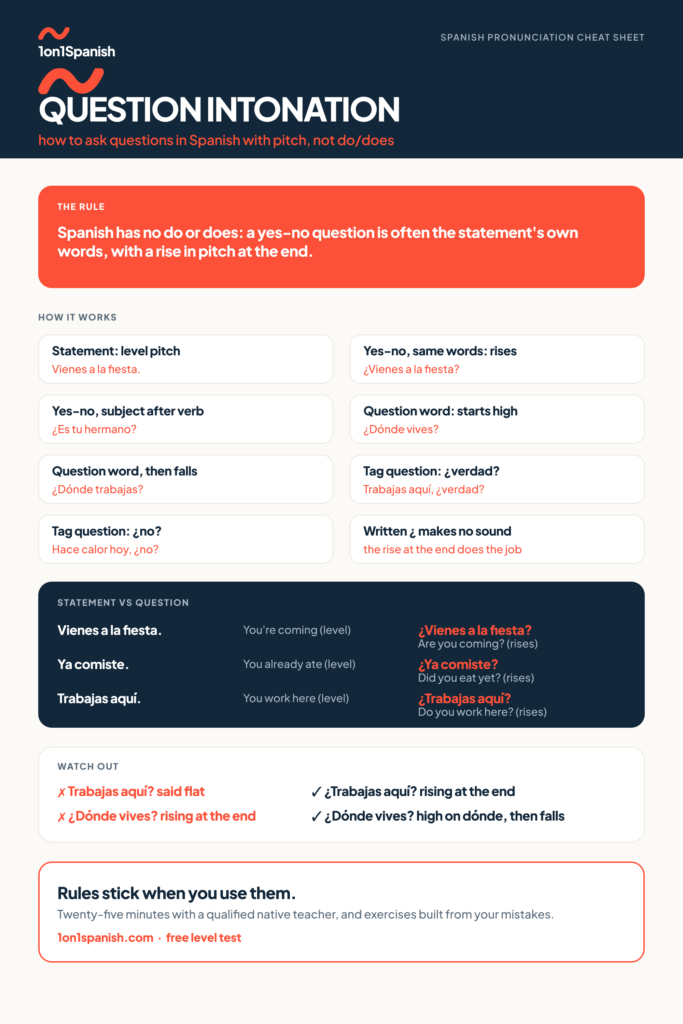
Take the chart with you
The chart is free to view and share. Drop your email and we’ll send the print-ready US Letter PDF — the version you stick on the fridge.
Practice
Practice Spanish pronunciation with a real teacher
Charts get you halfway. The other half is saying it out loud to someone who corrects you on the spot. At 1on1Spanish you get 25-minute private lessons with a qualified native teacher, exercises built from the mistakes you make in class, and AI practice between lessons.
First month $1. No contracts, cancel anytime.
Grammar you can read. Speaking you cannot. Learn Spanish online and practice it live.
Take your free level testBuilt on RingTeacher's method — 700,000+ classes delivered since 2017, teaching English to Spanish speakers. Now in the other direction.
Frequently asked questions
How do you ask a yes-no question in Spanish?
Often with the same word order as a statement, adding only a rise in pitch at the end and the written marks ¿ ?: ¿Vienes a la fiesta? uses the exact words of Vienes a la fiesta, and pitch alone tells a listener which one they heard. Word order can also swap the subject after the verb, but the intonation is what does most of the work in speech.
Why doesn’t Spanish use “do” or “does” in questions?
Because Spanish has no equivalent auxiliary verb to insert. English builds a question by adding “do” or “does” in front of the subject; Spanish builds the same question with the original words, a possible subject-verb swap, and rising intonation at the end. This is why word-for-word translation from English question structure doesn’t work.
What’s the difference between a yes-no question and a question-word question in Spanish?
A yes-no question — ¿Vienes? — asks for confirmation and leans on rising pitch at the end. A question built with qué, dónde, cuándo or another question word already signals a question through the word itself, and the pitch pattern flips: it starts high on the question word and falls afterward instead of rising at the end.
What does ¿verdad? mean at the end of a Spanish sentence?
It works like “right?” in English, turning a plain statement into a quick check for agreement: Hace calor hoy, ¿verdad? — it’s hot today, right? ¿No? does the same job. Both are extremely common in everyday spoken Spanish, often more common than building a full question from scratch.
Can you understand a Spanish question just from the written ¿ mark?
Yes in writing, but the mark itself makes no sound — it’s a heads-up for the reader before the question even starts. In spoken Spanish, the actual signal is intonation: a rise at the end for a yes-no question, or a high start and gradual fall for a question built with a question word.