
How to say the letter j in Spanish
The Spanish j — called jota — is one of the sounds American English simply doesn’t have, and that’s exactly why it trips people up. It’s not a stronger version of the English h, and it’s nothing like the j in “juice”. It’s a raspy sound made at the back of the throat, the same sound that shows up when g comes before e or i (gente, gimnasio). Say jefe with an English j and you get a different word’s worth of confusion; say it with a plain English h and you’re close but noticeably soft.
Below is where the sound comes from, how to build it from something you already say, and why it changes depending on which Spanish-speaking country you’re listening to. 1on1Spanish works on pronunciation in 25-minute one-on-one lessons with qualified native teachers, online across the United States.
Reviewed by María Jiménez — Licenciada en Filología Hispánica (BA in Hispanic Philology) · Updated Sep 2026
The sound English doesn’t have
Say the word “hello” and put extra breath behind the h — exaggerate it, the way you might do for comic effect. That breathy, forceful h is the closest thing American English has to the Spanish j, and it’s still not quite there: the Spanish sound is made further back in the throat, with real friction, closer to the German ch in “Bach” than to any English h. If you know that German sound, or the ch in Scottish “loch”, you already have the exact target — Spanish just spells it with a j or with g before e/i.
There’s no letter in English for this sound because English never developed it. That’s normal: every language has a handful of sounds that simply don’t exist elsewhere, and the j is Spanish’s most obvious one for an American ear.
How it’s produced
- Start from the exaggerated “hhh” of “hello” — breathy, audible, more air than a normal h.
- Pull the back of the tongue up toward the soft palate, the way you would to say a k or g, but don’t let it fully close. Air keeps moving through a narrow gap instead of stopping completely.
- Push air steadily through that gap. The friction of the air squeezing past is the sound itself — it should feel and sound rougher than any English h.
- Practice it isolated first — just the sound, no vowel attached — before attaching it to a word like jefe or jugar.
This is a sound made with air and a narrow gap, not with muscle or volume. Tensing the throat or pushing harder doesn’t make it more accurate, it just makes it uncomfortable. The target is friction, not force.
Where the letter j sounds, by position
| Position | Example | Sound |
|---|---|---|
| Start of a word | jefe, jugar, joven | raspy, throat sound |
| Middle of a word | trabajo, naranja | raspy, same sound |
| Before any vowel | ja, je, ji, jo, ju all use it | raspy, unlike English j |
| End of a word (rare) | reloj | often weakened or nearly silent in casual speech |
Unlike the letter g, which switches sound depending on the vowel that follows, the letter j makes the same raspy sound in front of every vowel, in every position. That consistency makes j easier to predict than g once the sound itself is built. The switch itself, and the silent u that keeps g hard in guerra, is on the Spanish g page.
Where it comes from and why it varies by country
The j sound isn’t the same intensity everywhere Spanish is spoken, and this matters for anyone learning from videos or podcasts recorded in different countries. In Spain, the j is stronger and scrapes further back in the throat — closer to that German ch. Across most of Latin America and the Caribbean, it’s softer, sitting much closer to a plain English h. 1on1Spanish teaches Latin American Spanish by default, so the version to aim for is the softer, more h-like j — it will be understood everywhere, and it’s the easier target to build first. The stronger Spain version is worth recognizing when you hear it, even if it’s not what you’re producing yet.
The words that change meaning
The j doesn’t have many true minimal pairs against other single letters, since no other Spanish sound is quite that close to it — but skipping it or softening it too far does change real words, and it’s the sound most closely tied to a handful of very common ones:
- jefe (boss) vs. a word without the j would simply not exist — there’s no safe substitute
- hijo (son) — the j here is often the hardest version to hear for beginners, buried between two vowels
- trabajo (work/job) — one of the highest-frequency words in the language that carries the sound
- ojo (eye) — a short, common word where a soft or skipped j is very noticeable
The clearest real-world test is a full sentence that stacks several: El jefe trabaja en Guadalajara y juega los jueves. Six j’s, one sentence, and every one of them is the same sound.
One more place the sound hides: a handful of Mexican place names, México and Oaxaca first among them, spell it with an x. The Spanish x page explains why the spelling never caught up with the sound.
Common mistakes English speakers make
✗ Using the English j sound. Jugar said with the j of “jungle” doesn’t just sound foreign, it uses a sound Spanish doesn’t have for that letter at all. This is the single most common error.
✗ Using a plain, weak English h. Closer than the English j, but too soft — it disappears in fast speech and doesn’t carry the same friction. It’s an acceptable stepping stone, not the final target.
✗ Confusing it with the Spanish g before e/i. They’re the same sound, so this isn’t really a mistake — it’s useful to know they’re identical, which means practicing one improves the other.
✗ Copying the wrong country’s intensity. Someone practicing from a video recorded in Spain and trying to reproduce the harsher, more guttural version will overshoot for Latin American Spanish, which the softer h-like version already covers well.
✗ Skipping the sound in common words. Learners avoid jefe, trabajo, hijo for a long time. An approximate, softened j is far more useful than silence or a substitute sound.
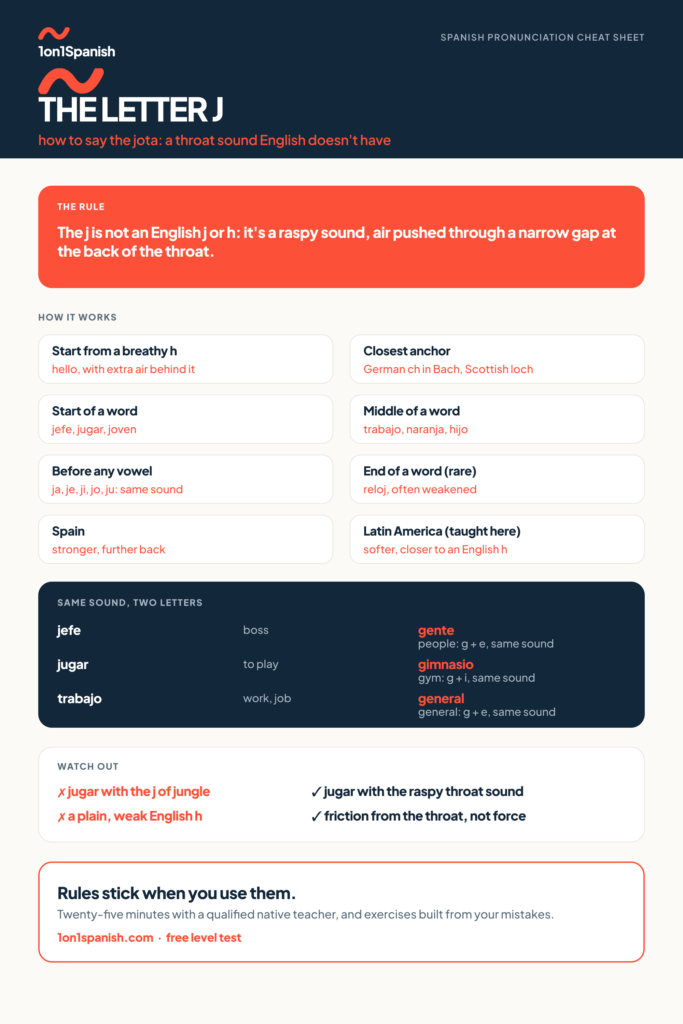
Take the chart with you
The chart is free to view and share. Drop your email and we’ll send the print-ready US Letter PDF — the version you stick on the fridge.
Practice
Practice the Spanish j with a real teacher
Charts get you halfway. The other half is saying it out loud to someone who corrects you on the spot. At 1on1Spanish you get 25-minute private lessons with a qualified native teacher, exercises built from the mistakes you make in class, and AI practice between lessons.
First month $1. No contracts, cancel anytime.
When you are ready to speak it out loud, try online Spanish lessons with a native teacher.
Take your free level testBuilt on RingTeacher's method — 700,000+ classes delivered since 2017, teaching English to Spanish speakers. Now in the other direction.
Frequently asked questions
How do you pronounce the letter j in Spanish?
It’s a raspy sound made at the back of the throat, with air pushed through a narrow gap between the back of the tongue and the soft palate — closer to the German ch in “Bach” than to any English sound. A useful starting point is an exaggerated, breathy English h, like in “hello” said with extra force, then pulled further back in the throat.
Is the Spanish j the same sound in every country?
No. In Spain it’s stronger, scraping further back in the throat. Across most of Latin America and the Caribbean it’s softer, much closer to a plain English h. 1on1Spanish teaches Latin American Spanish by default, so the softer version is the target — it’s understood everywhere and easier to build first.
What’s the difference between the Spanish j and the English j?
They don’t share a sound at all. The English j, as in “juice”, is made with the tongue touching the roof of the mouth near the front, similar to a soft “dzh”. The Spanish j is a throat sound with no tongue contact, made further back with friction from moving air. Using the English j for a Spanish word produces a different sound entirely, not a milder version.
Why can’t I hear the difference between j and a plain h in Spanish?
Because the softer, Latin American version of j really is close to an English h — that’s not a hearing problem, it’s an accurate impression. The difference is friction and throat position: the Spanish j has more rasp and sits further back than an English h ever does, even in its softest regional form.
Is the Spanish j the same sound as the g before e or i?
Yes, exactly. Gente and jefe both start with the identical raspy sound, even though they’re spelled differently. Spanish uses g for that sound before e and i, and j for it everywhere else — so practicing the j sound also fixes the raspy g automatically.