
Spanish for heritage speakers: you are not a beginner
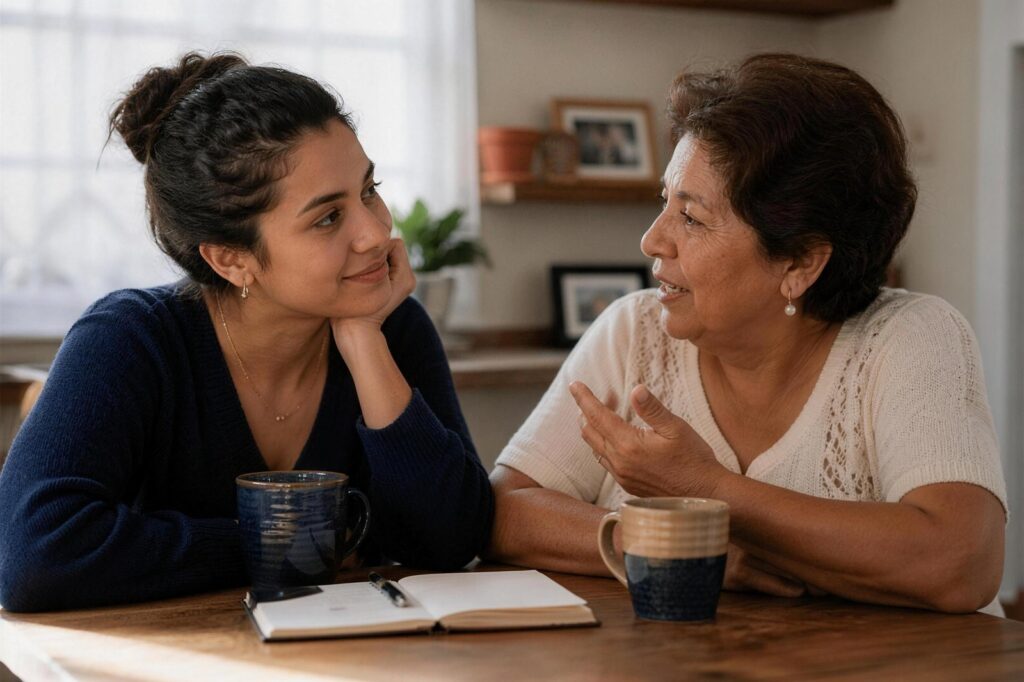
If you grew up with Spanish in the house and cannot comfortably hold a conversation in it now, you are the most common Spanish learner in the United States and almost none of the material is written for you. Spanish for heritage speakers is its own thing, and the first reason it goes wrong is that people keep being handed a beginner’s plan.
You are not a beginner. You have decades of Spanish in you: the sound system, the rhythm, the words for food and family and being told off. What you may not have is practice using it as an adult, in front of people, about things that matter.
We teach Spanish one-on-one at 1on1Spanish, so read this with that in mind. Heritage speakers are the group most often sold the wrong product, and that is worth saying out loud before anything else.
What a heritage speaker actually is
A heritage speaker is someone who grew up with a language at home while being schooled and socialized in another one. In the United States that usually means Spanish from parents or grandparents and English from school, television, friends and work.
The result is a very particular shape of ability, and it is not the shape a textbook expects. Understanding is usually excellent. Pronunciation is usually native or close to it. Speaking is uneven — fluent about some things, stranded about others. Reading and writing are often the weakest part, because nobody taught you to spell a language you only ever heard.
A beginner has none of that. Putting the two in the same room, or in the same lesson plan, wastes the heritage speaker’s time and confirms the suspicion they walked in with: that their Spanish does not count.
Your Spanish is a variety, not a broken version of someone else’s
Most heritage speakers have been corrected their whole lives, usually by people who love them. Somebody at a family gathering repeats what you said in a slightly different way. Somebody laughs, kindly. Somebody says eso no se dice así. After enough of that, a lot of people simply stop speaking, which is the worst possible outcome and the most understandable one.
Here is the part that rarely gets said clearly: the Spanish you speak is a legitimate variety of the language. Borrowing from English, switching between languages mid-sentence, and using the vocabulary of one region are things that every bilingual community on earth does, and they are features of contact between languages rather than personal failures.
What is true is that your Spanish has gaps, because it was built for one set of situations and not others. Gaps are specific, findable and fixable. “Speaking wrong” is neither specific nor fixable, and it is not an accurate description of anything.
The gaps are almost always the same three
Ask a hundred heritage speakers what they cannot do and you get roughly one answer in three parts. None of them are about basic grammar, and all three are about situations your home Spanish never had to cover.
Formal register
Kitchen Spanish is warm, fast and informal, and it is exactly the wrong tool for a meeting, a clinic, a government office or a condolence. Heritage speakers often know two registers of English and one of Spanish, so the moment the situation turns formal they switch to English and lose the room. This is the single most common reason an adult decides to work on Spanish again.
Writing and spelling
You can say a word perfectly and have no idea where its accent goes, because you learned it through your ears. Spanish spelling is regular enough that this is a few weeks of work rather than a few years, and the rules for accent marks and stress explain most of what looks arbitrary. The frustrating part is that the gap is invisible until you have to write something and then it is glaring.
Vocabulary outside the house
You have the vocabulary of the life you lived in Spanish. If that life was childhood, you have the words of childhood: family, food, weather, being scolded. What is missing is everything you learned after you switched to English — your job, money, medicine, law, the abstract words you argue with as an adult.
There is often a fourth, quieter gap in structures that home conversation simply does not use much, and the subjunctive is the one people notice first. You will recognize it instantly when you hear it. Producing it deliberately is a different matter.
Why being corrected by family stopped working
Family correction has two problems, and neither of them is bad intentions. The first is that it arrives with a relationship attached, so a note about a verb ending lands as a comment about who you are and how much of the family you kept.
The second is that native speakers are not teachers. They can tell you a sentence sounds wrong; most cannot tell you why, and almost none can see the pattern underneath five different mistakes and name it. So the same errors get corrected forever, one sentence at a time, without ever being fixed.
A trained teacher is a different situation in both respects. There is no family history in the room, and the correction comes with an explanation and a plan.
What actually works for adult heritage speakers
The goal is not to replace your Spanish with a textbook version of it. It is to add the registers, the writing and the vocabulary you never needed at seven years old, and to get you speaking often enough that the shame wears off.
- Start from what you can already do, not from lesson one. Nothing kills a returning heritage speaker faster than a plan that starts with hola, me llamo.
- Speak to one person, often. Short and frequent beats long and rare, and one listener is much easier to be imperfect in front of than a group.
- Work on register explicitly. The same sentence said three ways — to a cousin, to a client, to a doctor — is a lesson that a beginner cannot use and you can.
- Fix the writing separately. Accents and spelling are a small, closed system, and treating them as their own short project stops them from bleeding into how you feel about your speaking.
If you want a way into it that does not involve a classroom, conversational Spanish with a teacher who knows you are not starting from zero is usually the right first step.
You are not learning Spanish. You are getting yours back
This distinction is not sentimental, it is practical. Learning a language from scratch as an adult takes years. Reactivating one you already have takes months, because the hard parts — the sounds, the instincts, the enormous passive vocabulary — are already built and only need to be put back into use.
Heritage speakers routinely underestimate how fast this goes, because they measure themselves against the fluency of the person who raised them rather than against where they were three months ago. The first weeks feel worse than they are. Then something loosens, usually in a conversation you did not plan.
Where to start if you want a real read on your level
The one thing you genuinely cannot do for yourself is hear your own Spanish the way another person hears it, and for heritage speakers that is not a small problem — the whole difficulty is that you have been told your level is worse than it is.
Our level test is a real conversation with a qualified native teacher, it is free, and no card is required. You come out of it with an honest picture of where you actually are and what the specific gaps are, and that is yours whether or not you ever book anything.
If you carry on, lessons are 25 minutes, one-on-one, with a written report and exercises built from the mistakes you made that day. First month $1. No contracts, cancel anytime.
Common questions
What is a heritage speaker of Spanish?
Someone who grew up with Spanish at home while being educated and socialized mainly in English. The typical profile is strong listening, native or near-native pronunciation, uneven speaking, and weak reading and writing, because the language was learned by ear rather than at school. It is a different starting point from a beginner’s, and it needs a different plan.
I understand Spanish but cannot speak it. Why?
Because understanding and producing are separate skills, and your childhood only trained one of them hard. Listening happened constantly; answering in Spanish was optional, and most children answer in the school language. Add years of being corrected and the reluctance becomes a habit. The fix is production practice with someone safe to be imperfect in front of.
Is my Spanish wrong if my family says it is?
No. What you speak is a real variety of Spanish shaped by contact with English, and borrowing or switching between languages is normal in every bilingual community. What is true is that it has gaps in registers and vocabulary your home life never needed. Gaps can be listed and worked on. “Wrong” cannot, and it is not an accurate description.
Should heritage speakers take beginner Spanish classes?
Usually not, and doing it is a common reason people quit twice. A beginner plan spends weeks on sounds and basic vocabulary you have had since you were four, while never touching formal register, writing or the words for your adult life. One-on-one lessons work better here precisely because the plan can start from what you already have.
How long does it take to get my Spanish back?
Faster than learning it from scratch, because the sounds and the passive vocabulary are already there and only need reactivating. What is honest to say is the shape rather than a number: speaking loosens within weeks of speaking regularly, while writing and formal register are separate projects with their own timelines. Anyone quoting you a fixed number is guessing.