
Spanish levels explained: from Novice to Superior

Spanish levels are the labels teachers use to say how well you speak right now: Novice, Intermediate, Advanced and Superior. The first three are split into Low, Mid and High. This guide covers what each level sounds like, how the labels line up with the European A1 to C2 scale, and how to place yourself on the scale.
We are 1on1Spanish, and we teach one-on-one Spanish lessons online with native teachers across the United States. Our teachers place every student on the scale used in American schools and universities, so that is the scale we use in this article, and the one you will see again once you start lessons. Wherever it helps, we show the European letter next to it.
In short: there are ten ACTFL labels, from Novice Low to Superior. Novice means memorized phrases, Intermediate means building your own sentences, Advanced means telling stories across past, present and future, and Superior means handling abstract topics with ease. The letters A1 to C2 describe roughly the same road in a different system, and the table below puts the two side by side.
The Spanish levels at a glance
The ACTFL Spanish levels run from Novice Low to Superior, and the quickest way to read them is to see all of them in one place. Each row below is a step, the middle column says what that step sounds like in a real conversation, and the last column gives the closest European equivalent.
| Level | What you can do in conversation | European level (CEFR) |
|---|---|---|
| Novice Low | Say a few isolated words and memorized phrases | A1 |
| Novice Mid | Greet people, give basic details about yourself, use set phrases | A1+ |
| Novice High | Ask and answer simple questions about daily life in short sentences | A2 |
| Intermediate Low | Build your own simple sentences about familiar topics | A2+ |
| Intermediate Mid | Handle everyday situations and keep a short conversation going | B1 |
| Intermediate High | Link sentences together and start to talk about the past and the future | B1+ |
| Advanced Low | Tell a story and describe people and places across past, present and future | B2 |
| Advanced Mid | Speak in full paragraphs, with detail, and cope when something unexpected comes up | B2+ |
| Advanced High, first band | Discuss most topics in depth and begin to reach into abstract ones | C1 |
| Advanced High, second band | Argue a point and explain what might have happened with growing ease | C1+ |
| Superior | Discuss abstract, professional and unfamiliar topics with accuracy and ease | C2 |
That is ten ACTFL labels and eleven rows. Advanced High covers a wide stretch, so our teachers place students in one of two bands inside it, and each band lines up with a different European step.
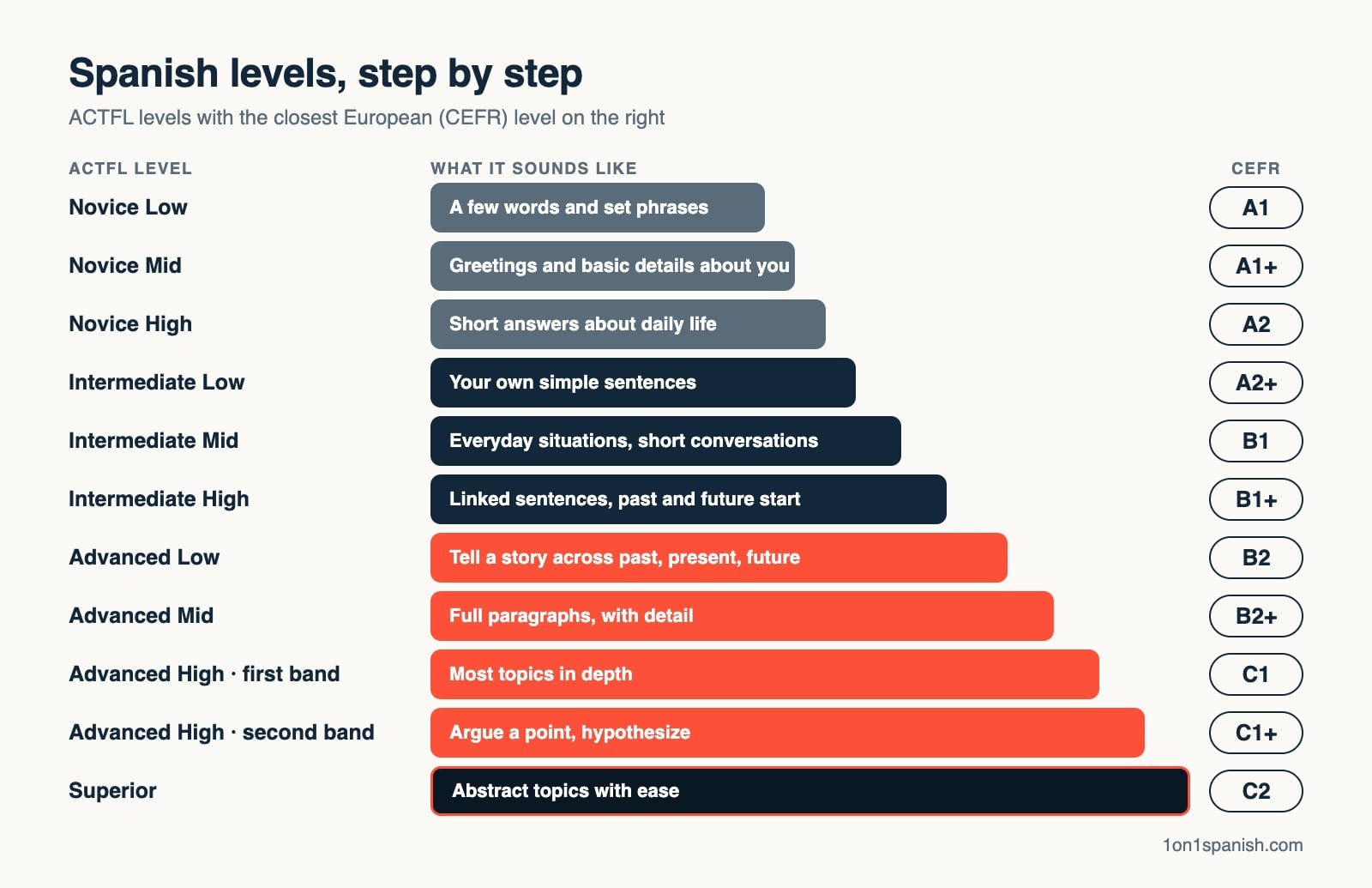
Want to keep it? Download the free printable PDF with the full scale, what each level sounds like and the European equivalents on one page.
What the ACTFL scale is and who uses it
The ACTFL scale is the main way language ability is described in the United States. ACTFL is the national organization for language educators (it dropped its older long name and now goes only by its acronym), and its Proficiency Guidelines are what many US schools, universities, school districts and testing programs build on. The current edition, ACTFL Proficiency Guidelines 2024, was released on April 2, 2024 and revises the 2012 version.
The scale has four main levels: Novice, Intermediate, Advanced and Superior. The first three are split into Low, Mid and High. Superior is not split. The 2024 guidelines also describe a Distinguished level above Superior, for language use beyond Superior. Almost nobody learning Spanish as an adult needs it, so our scale stops at Superior.
One detail changes how you read your own level. ACTFL describes four skills separately: listening, speaking, reading and writing. A person can read at Advanced and speak at Intermediate, and that is normal. When we talk about your level here, we mean your speaking, because that is what a conversation with a teacher shows most clearly.
Novice Spanish: words and memorized phrases
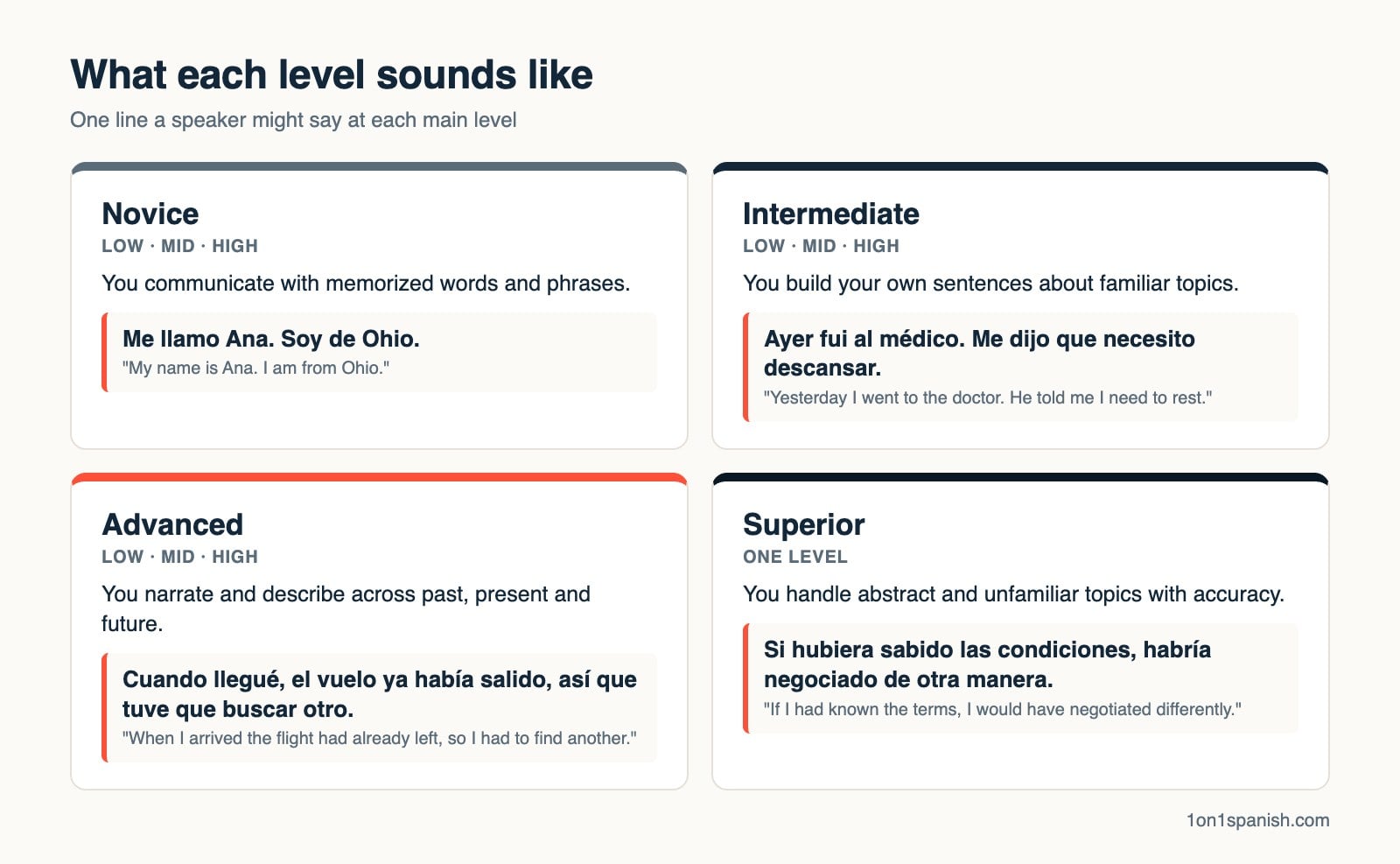
At Novice you communicate with what you have memorized. You are not yet building sentences from scratch: you are using phrases you have learned whole, and you are understanding a lot more than you can say. The people you talk with need patience, and you often need them to repeat or slow down.
Novice Low
At Novice Low you know a handful of words and a few phrases, mostly the ones you hear everywhere: hola, gracias, por favor, buenos días, adiós. You might read a menu and recognize some dishes. A conversation is mostly a list of single words and a lot of pointing.
What moves you up is sheer repetition of the most useful words, said out loud. Start with the greetings and farewells and the common phrases, and get the sounds right early with the vowel sounds guide, because five clean vowels carry you a long way.
Novice Mid
At Novice Mid you can say your name, where you are from, and a few facts about yourself, and you can ask for simple things: Me llamo Ana. Soy de Ohio. ¿Dónde está el baño? (“My name is Ana. I am from Ohio. Where is the bathroom?”) Most of it is memorized, and it works because the situation is predictable. If someone steps off the script, you are lost.
The step up is variety. Instead of one phrase for one situation, you start swapping words inside a phrase: Quiero un café becomes Quiero una mesa, Quiero agua, Quiero hablar con el gerente.
Novice High
At Novice High you can ask and answer simple questions about daily life, and you can put two or three short sentences together: Tengo dos hermanos. Uno vive en Texas. Trabaja mucho. (“I have two brothers. One lives in Texas. He works a lot.”) You still stumble when the topic leaves what you have rehearsed, and you may fall back on English for a missing word.
This is the stage where students often decide whether Spanish will stick. The Spanish for beginners page describes how lessons are built for it. What helps most is regular speaking with someone who corrects you on the spot, not more word lists.
Intermediate Spanish: building your own sentences
Intermediate is where the language becomes yours. The defining change is that you create with Spanish: you take words and structures you know and combine them in new ways to say what you actually mean, mostly about familiar topics like family, work, routines, food and travel. A sympathetic listener can follow you without much effort.
Intermediate Low
At Intermediate Low you can talk about yourself, your home and your day in simple sentences you build yourself. You mostly stay in the present tense, you leave out words, and you make errors that a listener can usually see past: Yo trabajo en oficina. Mi jefa es muy simpático. Hoy no tengo tiempo. (“I work in office. My boss is very nice. Today I have no time.”) The missing una and the masculine simpático for a woman boss show the gaps, and the meaning still gets through.
You can handle a short exchange at a store, a hotel desk or a restaurant, and you can ask a question when you do not understand. What you cannot yet do is keep going when the exchange gets complicated.
Intermediate Mid
At Intermediate Mid you can handle most everyday situations and keep a short conversation going on familiar topics. You ask follow-up questions, you answer in more than one sentence, and you begin to refer to the past: Ayer fui al médico. Me dijo que necesito descansar. (“Yesterday I went to the doctor. He told me I need to rest.”) Your Spanish is still full of mistakes, but the message gets through.
This is a level many schools and states treat as a meaningful milestone. For example, several states set Intermediate Mid on an approved test as the bar for the silver Seal of Biliteracy awarded to high-school graduates, though the exact test and score vary by state.
Intermediate High
At Intermediate High you can link sentences into short stretches of speech, and you start to talk about the past and the future with some confidence, even though the tenses wobble. You are knocking on the door of Advanced: you can do it when the topic is easy and the conversation is relaxed, and you lose it when the topic gets harder or the pace picks up.
The most common obstacle here is the difference between the two main past tenses. The guide to preterite vs imperfect is a good place to start, and the present perfect is worth learning alongside it.
Advanced Spanish: telling stories and describing in detail
Advanced is the level of a person who can really talk. You describe, you narrate, and you move between past, present and future in the same breath. You speak in paragraphs rather than in sentences, and you can deal with a situation that has a complication: a missed flight, a wrong order, a misunderstanding at work.
Advanced Low
At Advanced Low you can tell a story from start to finish and describe people, places and routines in some detail. You can talk about things you did, are doing and will do, and you can solve an everyday complication by explaining the problem and looking for a solution. You will still make errors, especially with less common structures, and you may lose your words when the topic is abstract.
Advanced Mid
At Advanced Mid you speak with more detail, more flow and fewer breakdowns. You can give an account of an event with background and consequences, explain a problem to someone who does not know about it, and take part in a work meeting about a familiar subject. You can usually find another way to say something when the word you wanted will not come.
Advanced High
Advanced High is the widest stretch of the scale, and it is the reason our table has two bands inside it. In the first band you discuss most topics in depth, and abstract subjects start to come within reach. In the second band you can argue a point, explain what might have happened and what would happen if, and you use the subjunctive and the conditional on purpose rather than by luck. If you want to practice them, the guides to the subjunctive and the conditional are the right ones.
What separates Advanced High from the top level is consistency. You can do the Superior tasks, but you cannot yet do them every time, on any topic, without effort.
Superior Spanish: abstract topics, with ease
At Superior you take part fully in conversations on practical, social, professional and abstract topics, in formal and informal settings. You can support an opinion, hypothesize, tackle less familiar topics, and rephrase an idea when the exact words will not come, because you are not retrieving phrases, you are choosing among them. Mistakes are rare and do not get in the way.
The word “Superior” does not mean you sound like a native speaker. It means your Spanish no longer limits the conversation. Many adults who learn Spanish for work, family or a profession aim for Advanced, and reaching Superior is a long, deliberate project.
How the ACTFL levels compare with A1 to C2
Outside the United States, the most common way to describe language ability is the Common European Framework of Reference, known as CEFR, which uses six levels: A1 and A2 (basic), B1 and B2 (independent) and C1 and C2 (proficient). You will meet it in textbooks, apps, university exchanges and on the DELE, the official Spanish diploma, where you register for one specific level from A1 to C2.
Here is how our teachers line the two scales up:
| ACTFL level | European equivalent (CEFR) |
|---|---|
| Novice Low | A1 |
| Novice Mid | A1+ |
| Novice High | A2 |
| Intermediate Low | A2+ |
| Intermediate Mid | B1 |
| Intermediate High | B1+ |
| Advanced Low | B2 |
| Advanced Mid | B2+ |
| Advanced High, first band | C1 |
| Advanced High, second band | C1+ |
| Superior | C2 |
Treat the table as a guide, not a conversion chart. The two systems were designed separately, for different purposes, and their lines do not fall in exactly the same places. ACTFL itself says that CEFR ratings can be assigned to ACTFL assessments, but that the correspondence only runs in that direction.
The plus signs mark in-between steps. The Council of Europe defines plus levels at A2+, B1+ and B2+; the A1+ and C1+ steps are working labels our teachers use so that every ACTFL level has a European counterpart.
What do A2, B1 and B2 mean in ACTFL terms?
The three letters people search for most map like this. A2 covers Novice High and Intermediate Low: you can manage simple, predictable exchanges about daily life. B1 covers Intermediate Mid and Intermediate High: you can deal with most everyday situations and talk about experiences. B2 covers Advanced Low and Advanced Mid: you can speak with detail and flow about a wide range of topics. A1 sits at Novice Low and Mid, C1 at Advanced High, and C2 at Superior.
If a form, a school or an employer asks for “B1” and you only know your ACTFL label, the table above is how to translate it. The reverse also works, but ask the organization which of the two scales it actually grades, because its test measures only one of the two.
How to place yourself on the scale
You can get a rough idea on your own. Read through the table at the top and ask which row sounds like your last real conversation in Spanish, not like the best one you ever had. The honest answer is usually one step lower than the hopeful one.
A few questions help you place yourself:
- Can you introduce yourself and answer basic questions without a pause? If not, you are probably at Novice.
- Can you build a sentence you have never said before, about your own life? If yes, you are at Intermediate or above.
- Can you tell the story of last weekend, with a beginning, a middle and an end, mixing past and present? If yes, you are at Advanced Low or above.
- Can you explain a view you disagree with, or say what you would do in a situation you have never been in? If yes, you are in the upper part of Advanced or at Superior.
Written quizzes can only tell you so much. They test what you recognize and what you can write with time to think, which is not the same thing as what you can say when a person is waiting for your answer. The picture below shows the gap.
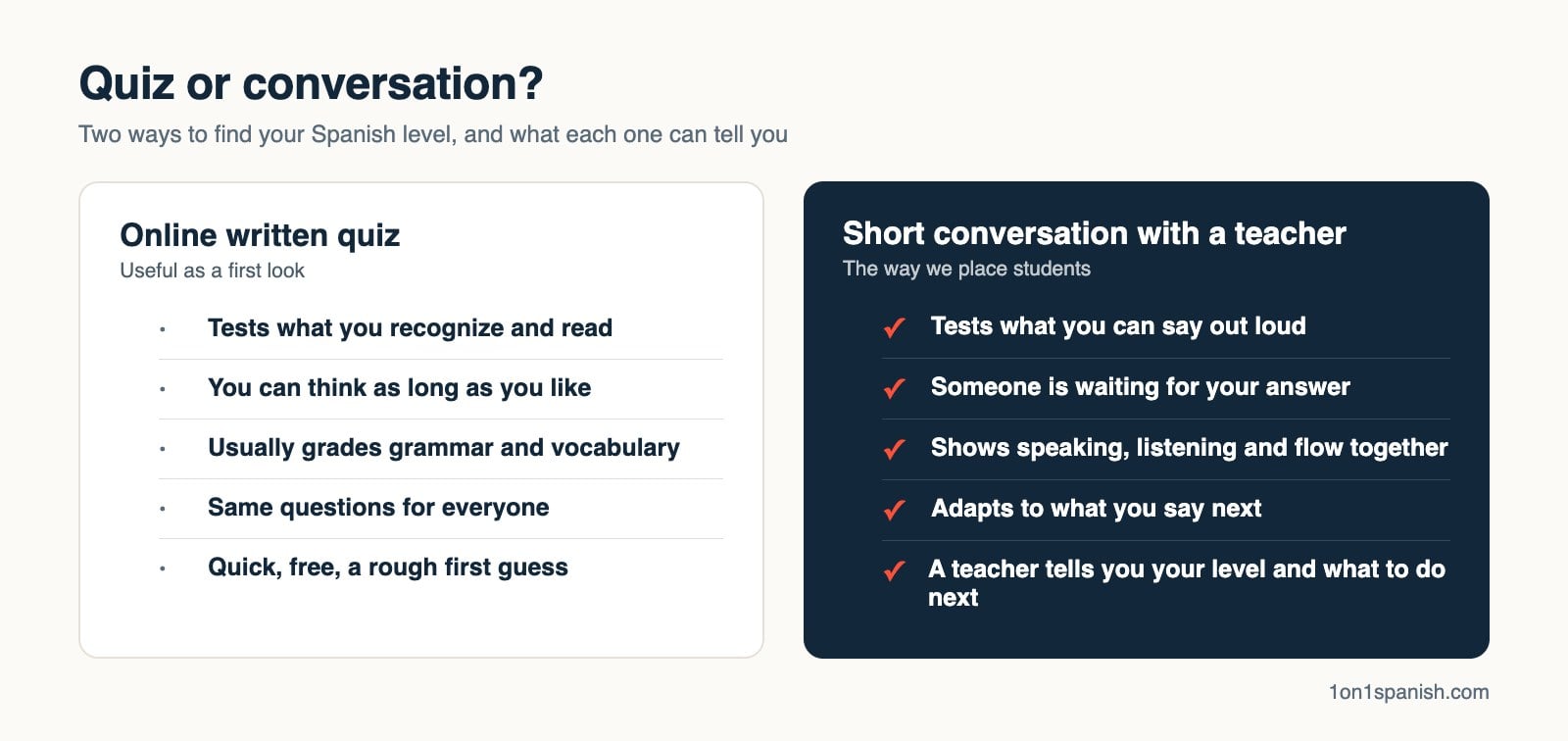
That is why we place students through a conversation, not a multiple-choice test. For a precise answer, take the free level test: you talk with a teacher online for a short stretch, with no credit card needed, and you leave knowing your level and how often to practice. If you are choosing a teacher, these nine questions are worth asking in any trial lesson.
What to work on at each level
Every level has its own bottleneck. The table gives the one most students hit and a good place to start. It is a map for the next step, not a promise of how quickly you will take it.
| Level | The usual bottleneck | Where to start |
|---|---|---|
| Novice | Too few words, and not saying them out loud | Common phrases and pronunciation |
| Intermediate | Past tenses, and sentences that stop after one idea | Preterite vs imperfect and ser vs estar |
| Advanced | Abstract vocabulary, and the subjunctive under pressure | Subjunctive and real conversation practice |
| Superior | Register, nuance and the occasional slip | Specialized topics and a teacher who corrects as you speak |
Two points hold at every level. First, speaking out loud with someone who corrects you moves you faster than any amount of silent study, which is the thread running through our guide on how to learn Spanish fast. Second, you will not climb at a steady pace. The first steps feel quick, the middle of Intermediate can feel like a plateau, and that is the normal shape of the road, not a sign that something is wrong.
Which level do you need?
The Spanish level you need depends on what you will use the language for. For travel, Novice High to Intermediate Mid is enough to order, ask for directions and chat with people you meet. For family and friends, Intermediate Mid to Advanced Low is where most conversations stop feeling like a performance. For work with Spanish-speaking colleagues or customers, Advanced Low and above is the usual target, and teachers and nurses, among others, often need specific vocabulary on top of it.
For a university program or an official diploma, the exam board names the level, and you can find the main ones, including the DELE, AP Spanish and CLEP, on our Spanish exams page.
Because these aims differ, so should the lessons. Our teachers build each plan from your current level and your goal, which is what one-on-one Spanish lessons are for. If you are not sure which row you are on, the quickest way to find out is to take your free level test: one short conversation with a teacher.
Common questions
What are the Spanish levels?
The ACTFL scale used in the United States has four main levels: Novice, Intermediate, Advanced and Superior. The first three are divided into Low, Mid and High, which gives ten labels in everyday use. A Distinguished level above Superior exists, but it rarely applies to adult learners. The European scale uses six levels, from A1 to C2. Both describe the same road, and teachers often use whichever one the student or the exam asks for.
What level is A2 in Spanish on the ACTFL scale?
A2 is roughly Novice High to Intermediate Low. At this point you can ask and answer simple questions about daily life, build short sentences of your own and handle predictable situations such as shopping or ordering food. The match is approximate, because the two scales were designed separately, so treat it as a guide and not an exact conversion.
Is Intermediate Mid the same as B1?
In our table, yes: Intermediate Mid lines up with B1. Both describe someone who can handle most everyday situations and keep a conversation going on familiar topics, with plenty of errors that do not stop the message. Because ACTFL and CEFR are separate systems, a test that reports one is not an official ruling on the other.
Can I figure out my Spanish level without a test?
Yes, roughly. Compare yourself to the table in this article, using your last real conversation as the measure, not your best day. For a more reliable answer, talk with a teacher: a short conversation shows your speaking level better than a written quiz does. Our free level test takes about 15 to 20 minutes, is done online and needs no credit card.
What level of Spanish counts as fluent?
There is no official level called fluent, and people use the word in different ways. Many teachers would call Advanced Mid and above comfortably fluent for everyday life, because the speaker can narrate, describe and cope with surprises. Superior describes someone whose Spanish no longer limits the conversation. What counts as enough depends on what you want the language for.
Can my reading level be higher than my speaking level?
Yes, and it is very common. ACTFL rates listening, speaking, reading and writing separately, and most adult learners read and listen at a higher level than they speak, because speaking is the skill that takes longest to build. That is why a level in a quiz and a level in conversation can differ, and why we place students by speaking.