
How to learn Spanish fast: what speeds you up and what only feels fast

Everyone who sets out to learn Spanish fast wants a number, and nobody can honestly give one. Anyone who promises a number of weeks is selling you the number, not the Spanish. What is true is that two people can put in the same hours and move at very different speeds, and the difference comes down to a handful of choices.
We are 1on1Spanish, and we teach one-on-one Spanish lessons online with native teachers across the United States, so we see these choices every day. This article is about them. What follows is what shortens the road, what only makes it feel shorter, and what a realistic first month looks like.
What “fast” actually means
Speed in a language is not how many days you have kept a streak going. It is how many hours of the right kind of practice you fit into a week, and how little of that time is wasted.
The right kind is easy to describe. You are understanding real Spanish, producing your own Spanish out loud, and finding out when it is wrong. Most of the habits that feel productive do only one of those three. That is why people can spend a year with an app and still freeze when someone asks them a question.
Spanish helps you here more than most languages would. It is written almost the way it sounds, it shares a large share of its vocabulary with English, and the Foreign Service Institute, the US government’s own language school, places it among the easiest languages for English speakers to learn. The material is not the bottleneck. How you use your hours is.
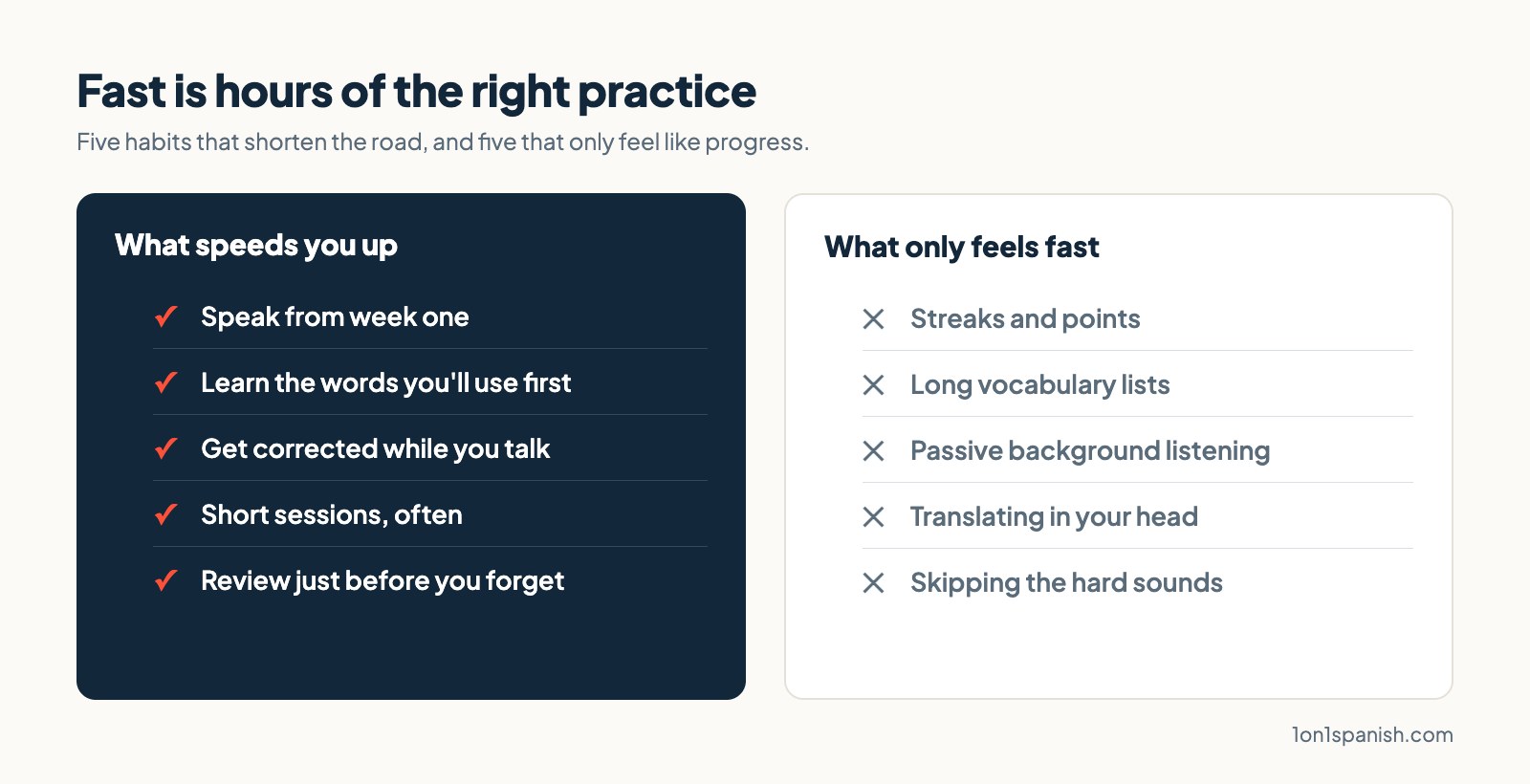
What actually speeds you up
Speak from the first week
Speaking is the skill that takes longest to build, so it is the one to start earliest. Waiting until you feel ready is the most common reason people understand a lot and say very little.
You do not need much to begin. Greetings, a few questions and about a dozen verbs are enough to hold a short exchange, and a short exchange teaches you more than another hour of recognizing words on a screen. Start with the greetings and farewells and the common phrases and say them out loud, not in your head.
Learn the words you will use first
Every language has a small core of words that does most of the work in everyday talk. A few hundred well-chosen words, learned in the order you would need them, carry you further than two thousand picked from a themed list because the topic looked interesting.
Pick words by how often a real conversation needs them. Verbs first, because a verb plus a noun is already a sentence. The verb pages are organized so you can start with the ones that come up constantly.
Get corrected while you are still talking
A mistake you repeat ten times becomes a habit, and habits are the slowest thing in a language to undo. The best time to fix an error is the moment you make it.
That is the real gap between practicing alone and practicing with someone who knows the language. Alone, you cannot hear your own wrong vowel or notice that you have used the wrong verb for “to be”. With a teacher, it is fixed in the same sentence. Our vowel sounds guide is a good example of something worth hearing corrected rather than reading about.
Short and often beats long and rare
Memory works on repetition spread over time. Four sessions of 25 minutes across a week will beat one long session on Sunday, even though the total is the same, because each session catches what the last one started to lose.
Frequency also keeps you from the restart cost. Every long gap means a warm-up lap through what you had already learned.
Review just before you forget
Spaced repetition means seeing a word again at the moment it is about to slip. Flashcards that bring words back on that schedule are one of the few study tools with a solid reason behind them.
Use them for vocabulary, not as a substitute for conversation. Twenty minutes of cards a day plus a few real conversations a week is a better mix than either one alone.
What only feels fast
Some habits give you a sense of progress without the progress. None of them is useless, but all of them are easier to enjoy than to benefit from.
- Streaks and points. They measure that you opened the app, not that you can say anything.
- Long vocabulary lists. Words learned in a list with no sentence around them fade within days.
- Listening with no effort. Background Spanish helps your ear over months, but it does not teach you to speak.
- Translating in your head. It works at the start and becomes the thing that makes you slow later.
- Skipping the hard sounds. The rolled r and the five vowels are quick to fix early and expensive to fix after a year of the wrong version.
If you want the wider picture of which methods suit which kind of learner, our guide to the best way to learn Spanish goes through the four main routes and where each one stops working.
A realistic first month
This is a shape, not a promise. Nobody can say where you will be in 30 days, but this order uses the habits above without wasting a week.
| Week | Focus | What you do |
|---|---|---|
| 1 | Sounds and survival phrases | Five vowels, greetings, introduce yourself, say it out loud every day |
| 2 | The first verbs | Ser, estar, tener, ir and querer in the present tense, in short real sentences |
| 3 | Questions and answers | Ask and answer simple questions about yourself, family, work and plans |
| 4 | Your own topic | Learn the words for what you actually talk about, and hold a full five-minute exchange |
The structure behind weeks two and three is the difference between ser and estar, which is the first real wall for English speakers. If you want to get ahead of it, start with ser vs estar.
Where a teacher shortens the road
We teach Spanish one-on-one, so weigh this accordingly. Of the five things above, a teacher directly covers three: you speak from week one, you are corrected in real time, and you have a fixed time that makes frequency automatic. The other two, vocabulary choice and review, a good teacher builds around what you personally need to say.
You do not have to pay to find out whether that works for you. A short conversation with a teacher tells you your level and where the next few weeks should go, and it costs nothing. If you prefer to start on your own first, that is a reasonable choice too, and our guide to learning Spanish for free shows how far it takes you.
Common questions
Can I learn Spanish in a month?
You can learn a useful amount in a month: greetings, introductions, simple questions and a first set of verbs. You will not be fluent, and a number of weeks to fluency cannot be promised by anyone because it depends on your starting point and your hours. Plan for a month to get to a first real conversation, and treat it as the start.
How many hours a day do I need to practice?
Consistency matters more than length. Twenty to thirty minutes a day with real speaking in it will serve you better than a two-hour weekend session. If you can only do four days a week, that is still enough to make steady progress.
Is it faster to learn Spanish by living in a Spanish-speaking country?
It can be, but only if you are actually using the language. Plenty of people live abroad for years and keep speaking English, because it is easier. Being surrounded by Spanish helps when you speak it, ask for corrections and read what is around you. You can get a large part of that effect at home by speaking regularly with a teacher.
Is Spanish easy for English speakers?
It is one of the easier ones. The spelling is regular, many words share roots with English, and the grammar has familiar parts. The hard parts are verb forms, the two verbs for “to be”, and understanding fast speech. All of them respond well to speaking practice.
What is the fastest way to learn Spanish vocabulary?
Learn words in context, in the order you will need them, and bring them back on a schedule. A word learned inside a sentence you said out loud is remembered much longer than the same word on a list. Spaced-repetition flashcards for review and conversation for use is the combination that holds up.