
Spanish-speaking countries: the full list, and what changes between them
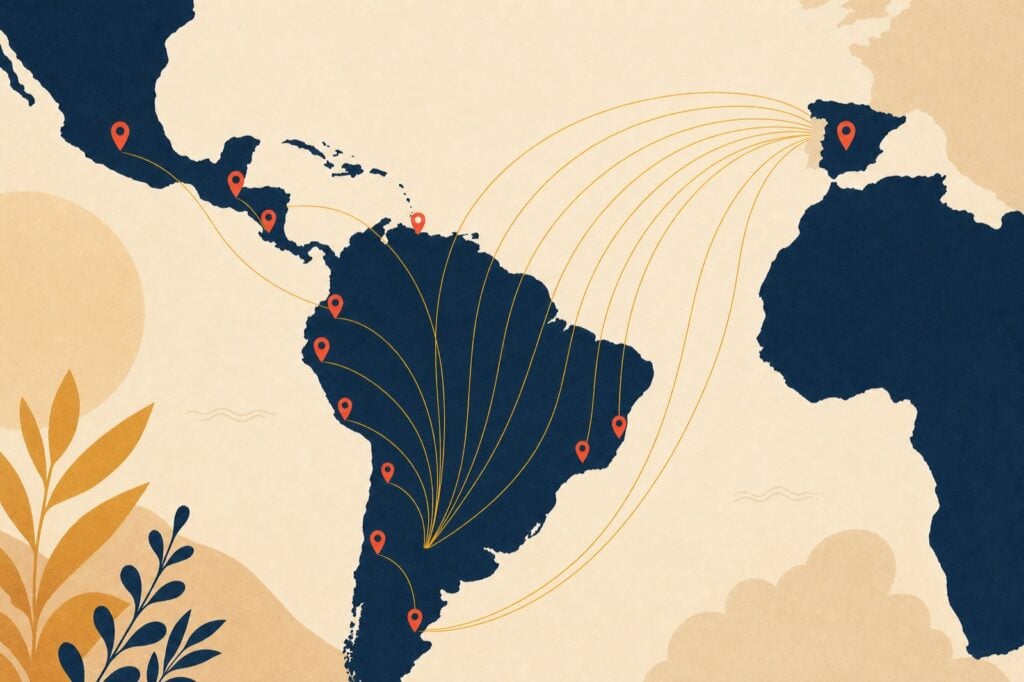
There are 21 Spanish-speaking countries and territories where Spanish is an official or de facto official language: 20 sovereign countries plus Puerto Rico, a US territory. That’s the list, and it’s also the least useful thing on this page.
If you’re an American learning Spanish, the better question is which Spanish you’re going to hear at work, at your in-laws’ table, or on the street in your own city, and whether the differences are big enough to change what you study. They aren’t. Three of them are still worth knowing before you open your mouth.
The 21 countries and territories where Spanish is official
Grouped by region. Native-speaker figures come from the Instituto Cervantes’ 2025 yearbook; see the note under the table.
| Country or territory | Region | Native Spanish speakers |
|---|---|---|
| Mexico | North America | 130.0 million |
| Guatemala | Central America | 13.7 million |
| Honduras | Central America | 9.5 million |
| El Salvador | Central America | 6.4 million |
| Nicaragua | Central America | 7.0 million |
| Costa Rica | Central America | 5.5 million |
| Panama | Central America | 3.9 million |
| Cuba | Caribbean | 10.0 million |
| Dominican Republic | Caribbean | 10.3 million |
| Puerto Rico (US territory) | Caribbean | 2.8 million |
| Colombia | South America | 52.1 million |
| Venezuela | South America | 28.6 million |
| Ecuador | South America | 17.0 million |
| Peru | South America | 29.6 million |
| Bolivia | South America | 9.2 million |
| Chile | South America | 19.3 million |
| Argentina | South America | 46.9 million |
| Paraguay | South America | 5.2 million |
| Uruguay | South America | 3.6 million |
| Spain | Europe | 47.3 million |
| Equatorial Guinea | Africa | 1.2 million |
Two entries on that list usually raise an eyebrow. Equatorial Guinea is the only African country where Spanish is official, a result of Spanish colonial rule that ended in 1968. Puerto Rico isn’t a country: it’s an unincorporated US territory whose residents are US citizens, and Spanish and English are both official there. Lists that claim 20 countries are counting sovereign states only; lists that claim 21 are including Puerto Rico. Both are defensible, which is why the number moves depending on who’s counting.
Where the United States fits
English is designated the official language of the United States at the federal level, so the country isn’t on the list above. It’s also home to one of the largest Spanish-speaking populations anywhere: the Instituto Cervantes counts 45.5 million native Spanish speakers in the US, plus roughly 20 million more who speak it with limited proficiency — around 65 million in total, a Spanish-speaking population second only to Mexico’s (El español en el mundo 2025). That’s the practical reason most Americans start learning: not a trip to Madrid, but a neighbor, a colleague, a patient, a customer, or a family they married into.
That changes what you should study. If your Spanish is for use inside the US, the variety you’ll meet most is Mexican and Caribbean Spanish, not the Peninsular Spanish that most American textbooks were written around.
The three differences that actually matter
Spanish is one language with one shared grammar. A speaker from Bogotá and a speaker from Seville understand each other completely, the way a Texan and a Scot do, with occasional friction over individual words. Three differences are worth knowing early because they affect what you say, not just what you hear.
Ustedes and vosotros
Spain uses vosotros for informal “you all” and reserves ustedes for formal situations. Every Latin American country uses ustedes for both, formal and informal. This is the biggest grammatical split in the language, and it works in your favor: if you learn Latin American Spanish you never use vosotros at all, and Spaniards will understand you without blinking. See Spanish pronouns for the full set.
Voseo
Argentina, Uruguay and Paraguay use vos instead of tú, with its own verb forms: vos hablás rather than tú hablas, vos tenés rather than tú tienes. It also appears widely in Central America, particularly Costa Rica, Nicaragua, Honduras and parts of Guatemala. Nobody expects a foreign learner to use it, and tú is understood everywhere. Recognize it, don’t chase it.
Accent and vocabulary
The accent difference Americans notice first is Spain’s c and z, pronounced like the English “th” in think: gracias sounds like grathias in most of Spain and like grasias across Latin America. Caribbean Spanish, meaning Cuba, Puerto Rico, the Dominican Republic and coastal Venezuela and Colombia, can sound faster to learners and drops or softens final s. That’s why many find it harder at first, and it is also the one many Americans hear most often.
Vocabulary differences are real and mostly harmless. Everyday examples:
| Concept | Spain | Much of Latin America |
|---|---|---|
| car | coche | carro, auto |
| computer | ordenador | computadora |
| cell phone | móvil | celular |
| juice | zumo | jugo |
| bus | autobús | camión (Mexico), guagua (Caribbean), colectivo (Argentina) |
One word deserves a warning rather than a table entry: coger means “to take” or “to catch” in Spain and is vulgar in Mexico, Argentina and much of Latin America. Use tomar or agarrar instead and the problem disappears.
So which Spanish should you learn?
Learn the one spoken by the people you’re going to talk to. For most Americans that means Mexican or Caribbean Spanish, because that’s who’s nearby. If you’re learning for a specific job, for in-laws, or for a country you plan to live in, match that.
What you shouldn’t do is treat this as a fork in the road. The core grammar is shared across all of them. The differences that do exist sit mostly in the pronouns: vos replaces tú in Argentina, Uruguay and much of Central America (vos sos rather than tú eres — see how to conjugate ser), and Spain uses vosotros for a plural “you” that the rest of the Spanish-speaking world covers with ustedes.
Vocabulary gaps close in days once you’re exposed. Accents stop being an obstacle after a few weeks of listening to one. Choosing a variety is a matter of exposure rather than a curriculum decision, and it isn’t worth the weeks some learners spend on it. If you want a plan instead of a debate, start with how to learn Spanish.
Talk to someone from one of those 21 countries
Reading about accents isn’t the same as understanding one. At 1on1Spanish you get 25-minute private lessons with a qualified native teacher, exercises built from the mistakes you make in class, and AI practice between lessons. Every teacher is a native speaker, so you practice with the real thing. If you want to build fluency by speaking rather than studying, that’s what conversational Spanish lessons are for.
First month $1. No contracts, cancel anytime.
Built on RingTeacher’s method — 700,000+ classes delivered since 2017.
Frequently asked questions
How many countries speak Spanish as an official language?
Twenty sovereign countries have Spanish as an official or de facto official language, and the number becomes 21 if you count Puerto Rico, a US territory where Spanish and English are both official. Lists differ because some count only sovereign states. Spanish is official on four continents: Europe, North America, South America and Africa, where Equatorial Guinea is the only Spanish-speaking country.
Is Mexican Spanish very different from Spain’s Spanish?
They differ the way American and British English do: same grammar, different accent, some different vocabulary. Spain pronounces c and z like the English “th” and uses vosotros for informal “you all”; Mexico does neither. Words differ too: coche versus carro, ordenador versus computadora. Speakers from both countries understand each other without effort.
What is voseo and do I need to learn it?
Voseo is the use of vos instead of tú, with its own verb endings: vos hablás rather than tú hablas. It’s standard in Argentina, Uruguay and Paraguay and common in parts of Central America. You don’t need to produce it. Tú is understood in every Spanish-speaking country, and nobody expects a learner to use vos unless they live somewhere that uses it.
Which Spanish accent is easiest for English speakers to understand?
There is no objective ranking, and the honest answer is that familiarity matters more than the country. Learners often find accents that pronounce syllables fully and keep a steadier pace easier to follow at the start, and some Caribbean varieties harder, because sounds such as final s can be weakened or dropped. None of that makes one variety better Spanish. Whichever accent you hear regularly becomes the easy one within a few weeks.
Is Spanish an official language in the United States?
No. Since March 2025 English is designated the official language of the United States at the federal level, and Spanish has no federal official status, even though a very large population speaks it and Puerto Rico recognizes it officially alongside English. Some states and territories have their own language legislation, which varies. For learners the practical point stands: Spanish is a working language across much of the country.