
The Spanish subjunctive: when to use it and what triggers it
Use the subjunctive in the second half of a sentence when the first half reacts to that second half instead of stating it as a fact — when it wants it, doubts it, judges it or projects it into something that hasn’t happened yet. Sé que viene states a fact and takes the indicative. Espero que venga wants one and takes the subjunctive. English lost most of its subjunctive centuries ago, which is why there is nothing to translate and everything to rebuild. 1on1Spanish works through it in 25-minute one-on-one lessons with qualified native teachers, online across the United States.
Reviewed by María Jiménez — Licenciada en Filología Hispánica (BA in Hispanic Philology) · Updated Sep 2026
How the present subjunctive is formed
Start from the yo form of the present indicative, drop the -o, and add the opposite vowel: -ar verbs take e endings, -er and -ir verbs take a endings.
Hablo → hable, hables, hable, hablemos, habléis, hablen. Como → coma, comas, coma, comamos, comáis, coman.
The yo-form shortcut is what makes irregular verbs behave. Tengo → tenga. Hago → haga. Digo → diga. Salgo → salga. Conozco → conozca. If the irregularity is in the yo form, the whole subjunctive inherits it. Hacer shows it cleanly — hago → haga, hagas, haga — and the full set of forms is on the hacer conjugation chart.
Six verbs sit outside the system and have to be learned: dar (dé), estar (esté), haber (haya), ir (vaya), saber (sepa), ser (sea). They cover a large share of real sentences, so they pay for themselves fast. Ir and ser are the two you’ll need first, because vaya and sea turn up in ojalá, cuando and no creo que sentences every day. Their full forms are on the ir chart and the ser chart.
Where WEIRDO breaks
The acronym is worth its first month and misleading after that. Four honest problems with it.
It lists meanings, not structures. Quiero is a wish either way, but quiero ir takes an infinitive and quiero que vayas takes a subjunctive. The trigger is not the verb, it’s the verb plus que plus a second subject.
“Impersonal expressions” is the leaky letter. Es importante que vengas takes the subjunctive; es verdad que vienes and es obvio que vienes do not. Impersonal expressions that assert a fact behave like facts. The letter I covers both and tells you nothing.
Doubt is a switch, not a category. Creo que es buena idea is indicative. No creo que sea buena idea is subjunctive. The same verb flips depending on whether you’re affirming or denying, and no dudo que es flips back again.
It only covers one of three families. WEIRDO describes noun clauses and ignores the other two places the subjunctive lives. Time and purpose clauses pointing at something unrealized: Cuando me jubile, viajaremos, Te llamo en cuanto llegue, Ahorro para que mis hijos estudien. And descriptions of something you’re not sure exists: Busco un contable que hable español — if you already have him, que habla español.
One question replaces the whole acronym: does the main clause present the second clause as a fact? If it does, indicative. If it wants it, doubts it, judges it or waits for it, subjunctive.
Reference chart
| Trigger type | Main clause | Example | English |
|---|---|---|---|
| Wish, want | quiero que, espero que | Espero que el seguro lo cubra. | I hope the insurance covers it. |
| Emotion, judgment | me alegra que, es una pena que | Me alegra que estés mejor. | I’m glad you’re better. |
| Impersonal + opinion | es importante que, es mejor que | Es mejor que hablemos mañana. | It’s better if we talk tomorrow. |
| Impersonal + fact | es verdad que, es obvio que | Es verdad que cuesta caro. | It’s true that it’s expensive. → indicative |
| Recommendation | recomiendo que, sugiero que | El médico sugiere que descanses. | The doctor suggests you rest. |
| Doubt, denial | dudo que, no creo que | Dudo que llegue a tiempo. | I doubt he’ll get there on time. |
| Belief affirmed | creo que, estoy seguro de que | Creo que llega a las tres. | I think he arrives at three. → indicative |
| Ojalá | — | Ojalá no haya tráfico. | I hope there’s no traffic. |
| Unrealized time | cuando, en cuanto, hasta que | Te llamo cuando salga del trabajo. | I’ll call you when I get off work. |
| Purpose | para que, a fin de que | Ahorro para que mis hijos estudien. | I save so my kids can study. |
| Unknown antecedent | busco … que | Busco un apartamento que tenga garaje. | I’m looking for an apartment with a garage. |
| Always subjunctive | antes de que, sin que | Firmé antes de que cerraran. | I signed before they closed. |
Same sentence, two moods
The pairs below differ by one vowel and mean different things. This is where the mood stops being a rule and starts being information.
| Indicative | Subjunctive |
|---|---|
| Cuando llego a casa, ceno — habit, every day | Cuando llegue a casa, cenaré — not home yet |
| Creo que es buena idea — I think it is | No creo que sea buena idea — I don’t think so |
| Busco al contable que habla español — a specific one | Busco un contable que hable español — any one |
| Aunque es caro, lo compro — it is expensive | Aunque sea caro, lo compro — even if it turns out to be |
| Es evidente que está enfermo — a stated fact | Es una pena que esté enfermo — a reaction to it |
| Dice que viene — reporting | Dice que venga — passing on an order |
Common mistakes English speakers make
One subject means no que and no subjunctive. Spanish only splits the sentence when two different people are involved.
Esperar que never takes an indicative. English “I hope it covers” gives no signal, so this one has to be built by habit.
With cuando pointing at something that hasn’t happened, Spanish switches mood. English marks it with the plain present and lets the future verb do the work.
Negating a belief turns it into doubt. The affirmative version, creo que es, stays indicative.
The overcorrection: once people learn “impersonal expression takes subjunctive” they apply it to expressions that assert facts.
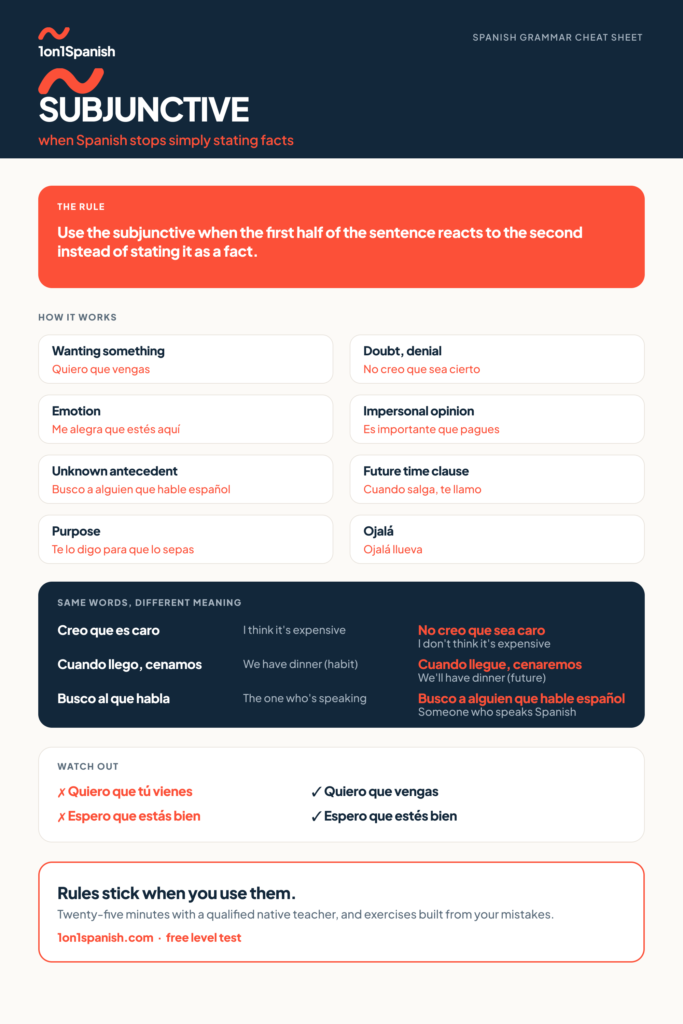
Take the chart with you
The chart is free to view and share. Drop your email and we’ll send the print-ready US Letter PDF — the version you stick on the fridge.
Practice
Practice the subjunctive with a real teacher
Charts get you halfway. The other half is saying it out loud to someone who corrects you on the spot. At 1on1Spanish you get 25-minute private lessons with a qualified native teacher, exercises built from the mistakes you make in class, and AI practice between lessons.
First month $1. No contracts, cancel anytime.
These guides are free. When you want someone correcting you out loud, learn Spanish online with a qualified native teacher.
Take your free level testBuilt on RingTeacher's method — 700,000+ classes delivered since 2017, teaching English to Spanish speakers. Now in the other direction.
Frequently asked questions
When do you use the subjunctive instead of the indicative in Spanish?
Use the subjunctive when the main clause doesn’t present the second clause as a fact: it wants it, doubts it, judges it, or waits for it. Sé que viene is a fact and stays indicative. Espero que venga, dudo que venga and cuando venga are all wish, doubt and anticipation, so they take the subjunctive.
Is WEIRDO a reliable way to learn the Spanish subjunctive?
Only as a first pass. WEIRDO lists meanings (wishes, emotions, impersonal expressions, recommendations, doubt, ojalá), but the subjunctive is triggered by structure: a main clause plus que plus a second subject. It also misses time clauses like cuando salga and descriptions like un apartamento que tenga garaje, which are just as common.
What’s the easiest way to remember the Spanish subjunctive?
Ask one question before the second verb: is the sentence telling me this happened, or reacting to it? Telling takes the indicative, reacting takes the subjunctive. Creo que es tells. No creo que sea reacts. That single test covers wishes, doubt, emotion and unrealized time without memorizing any list.
Do native speakers actually use the subjunctive in conversation?
Constantly, and without thinking about it. It isn’t formal or literary Spanish — ojalá llueva, cuando pueda, que te mejores and no creo que sea are everyday speech. Skipping it doesn’t sound casual, it sounds like a mistake, because the indicative version usually means something different rather than nothing.
What’s the most common mistake with the Spanish subjunctive?
Leaving the second verb in the indicative after espero que and quiero que, as in espero que el seguro cubre. English gives no signal there, so nothing prompts the switch. The second most common is the opposite: using the subjunctive after expressions that state facts, like es verdad que or creo que.