
Spanish conditional tense: how and when to use it
Use the conditional to say what would happen, to soften a request into a polite one, or to report what someone said would happen later. It’s built like the future tense in reverse — same twelve shortened stems, different endings — so if you already know one, you’re most of the way to the other. English collapses all three jobs into “would”, which is why the tense feels optional until you notice how often “would” shows up in a normal week. At 1on1Spanish we teach it in 25-minute one-on-one lessons with qualified native teachers, online across the United States.
Reviewed by María Jiménez — Licenciada en Filología Hispánica (BA in Hispanic Philology) · Updated Sep 2026
Forming the conditional
The conditional glues -ía, -ías, -ía, -íamos, -íais, -ían onto the whole infinitive for regular verbs: hablaría, comería, viviría. Those are imperfect endings, borrowed onto a different job.
The same twelve verbs that shorten their stem in the future tense shorten it here too, and the shortened stem is identical: tendr-, podr-, dir-, har-, saldr-, vendr-, pondr-, querr-, sabr-, cabr-, habr-, valdr-. Add the conditional endings to those same stems and you get tendría, podría, diría, haría, saldría, vendría, pondría, querría, sabría, cabría, habría, valdría. If a verb is irregular in one tense, it’s irregular in the other, and it’s the exact same irregularity. For the full explanation of where those twelve stems come from, see Spanish future tense.
What the conditional is actually for
Courtesy: softening a request
This is the conditional you’ll use most in daily conversation. Quisiera and querría both mean “I would like” and land far more politely than quiero: Quisiera reservar una mesa para dos. Querría hacerle una pregunta. ¿Podría ayudarme con esta factura? does the same job with poder instead of querer. English speakers already have this instinct — “could you” beats “can you” at a counter — the trick is remembering to carry it into Spanish.
Hypothetical suggestions
Use it to float an idea that isn’t a plan yet, often after yo en tu lugar or yo que tú: Yo en tu lugar hablaría con el banco antes de firmar. Yo que tú no le diría nada todavía. It’s a guess about a world that hasn’t happened, not a commitment.
The future of the past: reported speech
When a past-tense verb reports something that was future at the time, Spanish switches the reported verb to the conditional, exactly where English switches “will” to “would”. Dijo que vendría el viernes — He said he would come Friday. Me prometió que me llamaría. — He promised he would call me. The main verb sets the past; the conditional carries the promise forward from there.
Unreal conditions with si
Paired with the imperfect subjunctive in the si clause, the conditional builds a hypothetical that you don’t expect to come true: Si tuviera el dinero, viajaría más. Si ganara la lotería, dejaría el trabajo. This is different from a real, likely condition, which stays in the present on both sides: Si tengo tiempo, te llamo.
Reference chart
| What you want to say | Form | Example | English |
|---|---|---|---|
| Polite request | quisiera, querría, podría + infinitive | Quisiera pagar en efectivo. | I would like to pay in cash. |
| Hypothetical suggestion | conditional | Yo hablaría con el banco primero. | I would talk to the bank first. |
| Reported future (from the past) | conditional | Dijo que llegaría tarde. | He said he would arrive late. |
| Unreal condition | si + imperfect subjunctive, conditional | Si tuviera el dinero, viajaría más. | If I had the money, I’d travel more. |
| Softened advice | debería, podría | Deberías hablar con un abogado. | You should talk to a lawyer. |
| Guess about the past | conditional | Serían las diez cuando llegó. | It must have been ten when he arrived. |
The pair that looks alike: imperfect vs conditional
For -er and -ir verbs, the imperfect and the conditional share the exact same set of endings — -ía, -ías, -ía… — which is where most of the confusion between them comes from. The difference is what the ending attaches to. The imperfect drops the infinitive ending and adds to the stem: com-ía. The conditional keeps the whole infinitive: comer-ía. One letter, and the meaning changes completely.
| Imperfect — a past habit or state | Conditional — what would happen |
|---|---|
| Comía a las dos. — I used to eat at two. | Comería a las dos si pudiera. — I would eat at two if I could. |
| Trabajaba en un banco. — I worked at a bank. | Trabajaría en un banco si me lo ofrecieran. — I would work at a bank if they offered it. |
| Vivía en Miami. — I lived in Miami. | Viviría en Miami si el trabajo me lo permitiera. — I would live in Miami if my job allowed it. |
Common mistakes English speakers make
Dropping the -r- turns a conditional into an imperfect. It’s a one-letter mistake that flips the whole sentence from a memory into a hypothesis.
The si clause never takes the conditional. It takes the imperfect subjunctive; the conditional only goes in the other half of the sentence.
The twelve irregular stems don’t shorten on their own — they have to be memorized, the same twelve as the future tense.
When the reporting verb is in the past, the reported verb has to move from the future into the conditional. Leaving it in the present breaks the sequence of tenses.
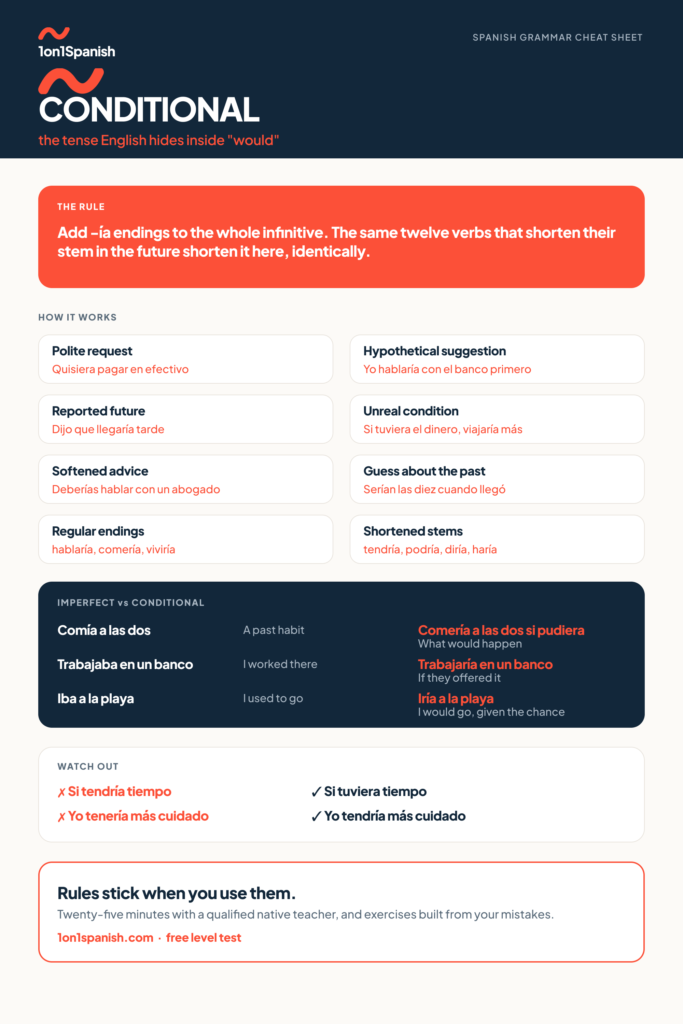
Take the chart with you
The chart is free to view and share. Drop your email and we’ll send the print-ready US Letter PDF — the version you stick on the fridge.
Practice
Practice the Spanish conditional tense with a real teacher
Charts get you halfway. The other half is saying it out loud to someone who corrects you on the spot. At 1on1Spanish you get 25-minute private lessons with a qualified native teacher, exercises built from the mistakes you make in class, and AI practice between lessons.
First month $1. No contracts, cancel anytime.
Guides help. A teacher hears what a guide cannot — Learn Spanish online with a real teacher.
Take your free level testBuilt on RingTeacher's method — 700,000+ classes delivered since 2017, teaching English to Spanish speakers. Now in the other direction.
Frequently asked questions
When do you use the conditional tense in Spanish?
Use it for polite requests (quisiera, podría), for a hypothetical suggestion (yo hablaría con el banco), for something that was future from a past point of view (dijo que vendría), and in the second half of an unreal si sentence (si tuviera tiempo, viajaría). English marks all four with “would” or “would like”.
What’s the difference between the imperfect and the conditional in Spanish?
They share the same endings on -er and -ir verbs, but attach to different pieces of the word. The imperfect attaches to the stem: comía, a past habit. The conditional attaches to the whole infinitive: comería, what would happen. Trabajaba is what you used to do; trabajaría is what you would do.
Why does Spanish use the conditional for a guess about the past?
The same way the future tense guesses about the present (serán las tres — it must be about three), the conditional guesses about the past: serían las diez cuando llegó means “it must have been around ten when he arrived”. Neither use has a clean English translation with “will” or “would”, which is why it surprises learners.
Do you need the conditional after “si” in Spanish?
No, and this is the most common trap. After si meaning “if” in an unreal condition, Spanish uses the imperfect subjunctive: si tuviera, not si tendría. The conditional belongs in the other half of the sentence: si tuviera tiempo, viajaría más.
What’s the most common mistake with the Spanish conditional?
Forgetting one of the twelve irregular stems it shares with the future tense, producing tenería instead of tendría. The second most common is putting the conditional inside the si clause itself, where Spanish requires the imperfect subjunctive instead, so si tendría comes out where si tuviera belongs. Both mistakes come from treating the conditional as more regular than it is.