
Spanish future tense: the two forms and when to use each
Spanish talks about the future two ways: ir a + infinitive for plans and things already in motion, and the simple future — one set of endings glued to the whole infinitive — for predictions, promises and commitments. There is also a third use that catches Americans off guard, where the simple future says “probably” about right now: Serán las tres means “it must be around three”. 1on1Spanish teaches all three in 25-minute one-on-one lessons with qualified native teachers, online across the United States.
Reviewed by María Jiménez — Licenciada en Filología Hispánica (BA in Hispanic Philology) · Updated Sep 2026
The simple future: one set of endings
This is the easiest conjugation in Spanish. The endings don’t attach to a stem, they attach to the complete infinitive, and they’re the same for -ar, -er and -ir verbs.
| Person | Ending | hablar | comer | vivir |
|---|---|---|---|---|
| yo | -é | hablaré | comeré | viviré |
| tú | -ás | hablarás | comerás | vivirás |
| él / ella / usted | -á | hablará | comerá | vivirá |
| nosotros | -emos | hablaremos | comeremos | viviremos |
| vosotros | -éis | hablaréis | comeréis | viviréis |
| ellos / ellas / ustedes | -án | hablarán | comerán | vivirán |
El año que viene compraremos una casa. El médico nos dirá los resultados el viernes.
Twelve verbs shorten the infinitive before adding those endings. The endings never change — only the stem does. Hacer is one of them — haré, not haceré — and the full hacer conjugation shows the same shortened stem turning up again in the conditional.
| Verb | Stem | Example |
|---|---|---|
| tener | tendr- | Tendré tiempo el jueves. |
| poner | pondr- | Pondremos el dinero en el banco. |
| salir | saldr- | El vuelo saldrá tarde. |
| venir | vendr- | Vendrán en septiembre. |
| poder | podr- | No podré ir a la reunión. |
| saber | sabr- | Lo sabremos mañana. |
| haber | habr- | Habrá mucho tráfico. |
| querer | querr- | No querrá firmar. |
| hacer | har- | Haré la transferencia hoy. |
| decir | dir- | Te diré lo que pasó. |
| caber | cabr- | No cabrá en el maletero. |
| valer | valdr- | Valdrá la pena. |
Ir a + infinitive: the everyday future
Conjugate ir in the present, add a, add the infinitive. Voy a, vas a, va a, vamos a, vais a, van a. The present of ir is irregular from the first form, so keep the ir conjugation close until voy, vas, va comes out without thinking.
Voy a llamar al banco esta tarde. Vamos a mudarnos en marzo. Mi hija va a estudiar enfermería.
This is what people actually say for plans, decisions already made, and anything close in time. It maps almost perfectly onto English “going to”, which for once makes an American’s instinct correct.
Spanish also uses the plain present for scheduled events, exactly like English: Mañana trabajo desde casa, El lunes tengo cita con el médico.
The future of probability
Here the simple future stops being about the future. Spanish uses it to guess about the present.
¿Dónde estará mi marido? — Where can my husband be? Estará en el gimnasio — He’s probably at the gym. Serán las tres — It must be about three. Tendrá unos cincuenta años — He must be around fifty.
The English equivalent is “must be” or “probably”, never “will”. This is common in speech and missing from most classroom lists, so it gets learned the hard way, mid-conversation.
Reference chart
| What you want to say | Form | Example | English |
|---|---|---|---|
| Plan, decision made | ir a + infinitive | Voy a llamar al seguro. | I’m going to call the insurer. |
| Near future | present | Mañana trabajo desde casa. | Tomorrow I work from home. |
| Prediction | simple future | Habrá mucho tráfico. | There’ll be a lot of traffic. |
| Promise, commitment | simple future | Te lo pagaré el viernes. | I’ll pay you back on Friday. |
| Formal or written plan | simple future | La reunión comenzará a las nueve. | The meeting will begin at nine. |
| Guess about now | simple future | Serán las tres. | It must be about three. |
| After cuando, si | subjunctive / present | Cuando llegue, te llamo. | When I get there, I’ll call you. |
When each one sounds natural
Both futures are correct in most sentences, so the question is which one a native speaker would pick.
Voy a comprar el boleto esta noche and Compraré el boleto esta noche both work. The first is a plan you already have; the second is a commitment made as you speak, or written Spanish.
For everyday speech, ir a carries most of the load. The simple future dominates in three places: predictions (lloverá), formal or written announcements (el banco cerrará a las dos), and probability (estará en casa).
Two structures refuse the future outright. In a future time clause with cuando or another time word pointing forward, Spanish uses the subjunctive: Cuando me jubile, viajaremos. For habits and questions, cuando takes the indicative as normal: Cuando llego a casa, ceno. And in a real future condition with si meaning “if”, Spanish uses the present: Si tengo tiempo, te llamo. The forms you need for that are on the present subjunctive page.
Common mistakes English speakers make
The a is not optional. It’s the piece that turns ir into a future.
Twelve verbs shorten the stem. The endings are regular, which is why the irregular half hides.
English says “when I get home” and thinks future; Spanish uses the subjunctive after cuando for anything not yet done.
Same trap with si. The present tense does the job, exactly as English does with “if I have time”.
English uses “will you” for polite requests. In Spanish that future sounds like an accusation about the person’s intentions. Requests go in the present.
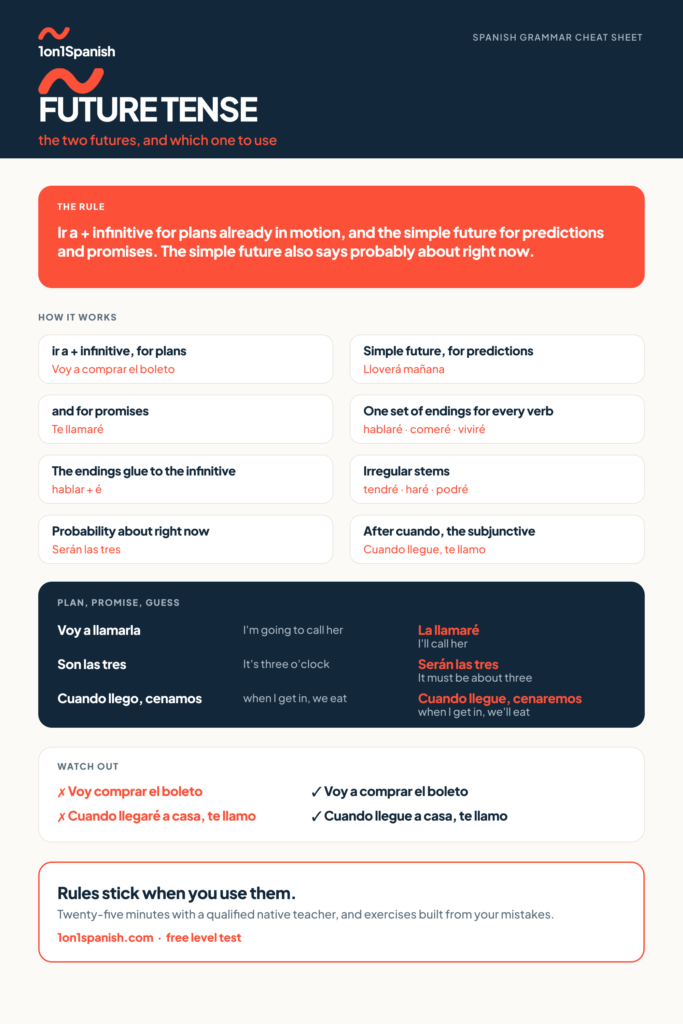
Take the chart with you
The chart is free to view and share. Drop your email and we’ll send the print-ready US Letter PDF — the version you stick on the fridge.
Practice
Practice the Spanish future tense with a real teacher
Charts get you halfway. The other half is saying it out loud to someone who corrects you on the spot. At 1on1Spanish you get 25-minute private lessons with a qualified native teacher, exercises built from the mistakes you make in class, and AI practice between lessons.
First month $1. No contracts, cancel anytime.
Reading about it only gets you so far. Learn Spanish online in 25-minute conversations and use it.
Take your free level testBuilt on RingTeacher's method — 700,000+ classes delivered since 2017, teaching English to Spanish speakers. Now in the other direction.
Frequently asked questions
What’s the difference between “voy a comer” and “comeré”?
Voy a comer is a plan already in place, the way English says “I’m going to eat”. Comeré is a prediction or a commitment made at the moment of speaking, closer to “I will eat”. In everyday conversation ir a covers most plans, while the simple future shows up in forecasts, written announcements and promises.
How do you conjugate the future tense in Spanish?
Add -é, -ás, -á, -emos, -éis, -án to the full infinitive, whatever the ending: hablaré, comeré, viviré. Twelve verbs shorten the stem first — tendré, pondré, saldré, vendré, podré, sabré, habré, querré, haré, diré, cabré, valdré — but they take the same endings as everything else.
Why do Spanish speakers use the future tense to talk about the present?
Because the simple future doubles as a way to guess. Serán las tres means “it must be around three”, and estará en el gimnasio means “he’s probably at the gym”. English does this with “must be” rather than “will”, so the structure has no equivalent to copy and has to be learned as its own use.
Do you use the future tense after “cuando” in Spanish?
No. After cuando, en cuanto, hasta que and similar time words pointing forward, Spanish uses the present subjunctive: Cuando me jubile, viajaremos. The future verb goes in the other half of the sentence. The same applies after si meaning “if”, where Spanish uses the present: Si tengo tiempo, te llamo.
What’s the most common mistake with the Spanish future?
Dropping the a in ir a + infinitive, as in voy comprar. It disappears in fast speech and learners stop writing it. The other frequent error is putting a future verb after cuando or si, where Spanish requires the subjunctive or the present instead.