
Spanish demonstrative adjectives: este, ese and aquel
Spanish splits “this” and “that” into three distances — este for what’s next to you, ese for what’s next to the person you’re talking to, and aquel for what’s far from you both — and each one agrees in gender and number with the noun it points at. English has two words for the job, so the third slot is the one that goes unused for years. 1on1Spanish drills this in 25-minute one-on-one lessons with qualified native teachers, online across the United States.
Reviewed by María Jiménez — Licenciada en Filología Hispánica (BA in Hispanic Philology) · Updated Sep 2026
Three distances, not two
The system is physical before it’s grammatical. Picture the room you’re in.
Este is what you can touch: este teléfono, esta silla. It pairs with aquí.
Ese covers what’s near the other person, or a few steps away: ese documento que tienes ahí, esa tienda de la esquina. Its adverb is ahí.
Aquel is far from both of you, often visible but out of reach: aquel edificio al final de la calle, aquellas montañas. The adverb is allí or allá.
American English maps “this” onto este and dumps everything else into “that”. That’s why learners say ese for absolutely everything not in their hand. It’s understood, but it flattens a distinction native speakers hear immediately.
The same three words for time
Distance in Spanish works on the calendar as well as the floor plan, and the mapping is the same: close to now, a step back, far back.
Este año is the year you’re in. Esta semana started on Monday. Ese día is the day you were just talking about, usually recent or specific: Ese lunes llegué tarde. Aquellos años is a distant, closed period, and it carries a note of nostalgia or historical distance: aquella época, aquel verano en México.
Because of that emotional weight, aquel shows up in storytelling far more than in everyday errands, and aquel martes would be an odd way to refer to last week.
Agreement: every demonstrative has four forms
They match the noun in gender and number, exactly like adjectives. If you already know the four-form pattern regular adjectives follow, this chart holds no surprises.
| Distance | Masc. sing. | Fem. sing. | Masc. pl. | Fem. pl. |
|---|---|---|---|---|
| Here (aquí) | este | esta | estos | estas |
| There (ahí) | ese | esa | esos | esas |
| Over there (allí) | aquel | aquella | aquellos | aquellas |
Note the shapes that trip people up: the masculine singular is este and ese, not esto and eso. And aquel has no final -o at all, while its feminine is aquella with a double L.
Agreement only works if you know the noun’s gender, and the ending sometimes lies: día, mapa and problema are masculine. Our page on which Spanish nouns are masculine or feminine covers the endings that predict it and the short list that doesn’t.
| Example | English |
|---|---|
| Este contrato vence en marzo. | This contract expires in March. |
| Esta reunión es obligatoria. | This meeting is mandatory. |
| Esos precios subieron otra vez. | Those prices went up again. |
| Esa carta llegó ayer. | That letter arrived yesterday. |
| Aquel hospital cerró hace años. | That hospital over there closed years ago. |
| Aquellas vacaciones fueron las mejores. | Those vacations were the best. |
The neuters: esto, eso, aquello
Esto, eso and aquello are a separate set with no gender and no plural, and they never sit in front of a noun. They point at something unnamed: an idea, a situation, or an object you can’t identify yet.
¿Qué es esto? — you’re holding something and you don’t know what it is. Once you name it, the neuter is gone: ¿Qué es esta pieza?
Eso no me parece bien — “that”, meaning the whole thing the other person just said. Eso is the workhorse of Spanish conversation for referring back to a statement.
Aquello fue un desastre — that whole business, back then, was a disaster.
A quick test: if you can’t put a noun after it, you need the neuter. If you can, you need este, esa, aquellos and the rest.
Exceptions and edge cases
The accent marks are gone. Older textbooks write éste, ésa, aquéllos with an accent when the word stands alone without a noun. The Real Academia Española removed that requirement in its 2010 spelling reform, and current Spanish writes este, esa, aquellos in both roles. You’ll still see the accented spelling in books printed before then; it isn’t a mistake, just an older convention.
Ese can turn dismissive. Applied to a person, ese often carries contempt: ese tipo, esa mujer. It’s the tone of “that guy”. Not a rule, but the connotation is real: think twice before using it about your boss.
Aquel is often paired, but doesn’t need to be. Aquel is at its clearest against a nearer thing: Este carro es mío, aquel es de mi hermano. It stands perfectly well on its own too — Aquella casa era de mis abuelos needs no contrast. What is true for your Spanish is that across much of Latin America ese covers a broader range in everyday speech, so aquel comes up less often than a textbook suggests.
Common mistakes English speakers make
Esto is the neuter and can’t take a noun. Before a masculine singular noun the form is este.
Ciudad is feminine singular, so the demonstrative has to be too. Gender agreement doesn’t pause for demonstratives.
Día ends in -a but is masculine, and the demonstrative follows the noun’s real gender, not its ending.
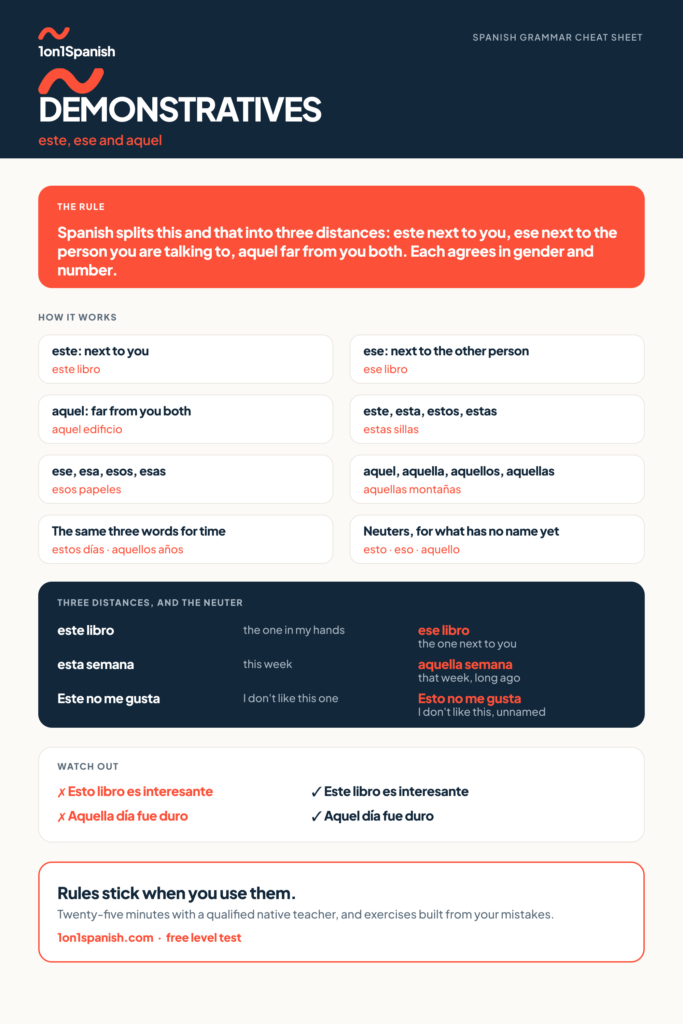
Take the chart with you
The chart is free to view and share. Drop your email and we’ll send the print-ready US Letter PDF — the version you stick on the fridge.
Practice
Practice demonstrative adjectives with a real teacher
Charts get you halfway. The other half is saying it out loud to someone who corrects you on the spot. At 1on1Spanish you get 25-minute private lessons with a qualified native teacher, exercises built from the mistakes you make in class, and AI practice between lessons.
First month $1. No contracts, cancel anytime.
Prefer to practice with a person? Take one-on-one Spanish lessons online with a qualified native teacher.
Take your free level testBuilt on RingTeacher's method — 700,000+ classes delivered since 2017, teaching English to Spanish speakers. Now in the other direction.
Frequently asked questions
What’s the difference between ese and aquel in Spanish?
Ese points at something near the person you’re speaking to, or a short distance from you both: ese vaso que tienes ahí. Aquel points at something far from both of you, visible but out of reach: aquel edificio al fondo. In time, ese refers to a specific day or moment already mentioned, while aquel refers to a distant, closed period: aquellos años.
Do I really need aquel, or can I just use ese?
You’ll be understood using only ese, and plenty of learners do. But aquel is alive in everyday speech, especially for contrast — este o aquel — and for talking about the past with distance. Native speakers use it without thinking, so skipping it means missing part of what you hear rather than failing to be understood.
When do you use esto instead of este in Spanish?
Use esto when there’s no noun. It points at something unnamed: an object you can’t identify, or an entire idea. ¿Qué es esto?, Esto no funciona, Esto de la mudanza me agota. The moment you name the thing, you switch to the gendered form: este paquete, esta situación. The same logic governs eso and aquello.
Do Spanish demonstratives still take accent marks?
Not since 2010, when the Real Academia Española dropped the requirement. Este, esa and aquellos are written without an accent whether they sit before a noun or stand alone. Books published earlier use éste, ésa, aquéllos in the standalone role, so you’ll see both spellings in the wild. The neuters esto, eso and aquello never took an accent.
What’s the most common mistake with Spanish demonstratives?
Using esto or eso in front of a noun — esto libro, eso problema. English speakers hear “this” and reach for the form that sounds like it, but esto is the neuter and can only stand alone. Before a noun you need este libro, ese problema, with agreement in gender and number.