
Spanish adjective agreement: matching gender and number
A Spanish adjective copies the gender and number of the noun it describes. Adjectives ending in -o change for both (alto, alta, altos, altas); adjectives ending in -e or in a consonant change only for number (verde, verdes), except those ending in -or, -ón or -án and the nationalities, which do have a feminine (trabajador → trabajadora). A group mixing masculine and feminine nouns takes the masculine plural. English adjectives never change shape at all, so this is pure extra bookkeeping until it becomes automatic. 1on1Spanish teaches this in 25-minute one-on-one lessons with qualified native teachers, online across the United States.
Reviewed by María Jiménez — Licenciada en Filología Hispánica (BA in Hispanic Philology) · Updated Sep 2026
Adjectives with four forms
If the masculine singular ends in -o, the adjective has all four forms: -o, -a, -os, -as.
Un carro nuevo, una casa nueva, unos carros nuevos, unas casas nuevas. The adjective doesn’t care what it means or where it sits — it takes its shape from the noun it belongs to, and in Spanish it usually sits after that noun.
This group includes most descriptive adjectives you’ll use daily: caro, barato, largo, corto, alto, bajo, frío, seco, tranquilo, cansado.
Adjectives with two forms
If the masculine singular ends in -e, in -ista, or in a consonant, gender doesn’t change anything. Only the plural does. Two families of consonant endings escape this rule and do take a feminine: the ones in -or, -ón and -án (trabajador → trabajadora, dormilón → dormilona, holgazán → holgazana) and the nationalities, which get their own section below.
Un problema grave / una situación grave. Un cliente realista / una clienta realista. Un examen difícil / una prueba difícil. Plural: graves, realistas, difíciles.
Forming that plural follows three rules. Ends in a vowel, add -s: verde → verdes. Ends in a consonant, add -es: fácil → fáciles, joven → jóvenes. Ends in -z, swap it for -ces: feliz → felices, capaz → capaces.
Those are the same three rules nouns follow, so once you have the plural of Spanish nouns down, the adjective plural comes for free: papeles azules, luces verdes.
Watch the written accent while you’re at it: it comes and goes to keep the stress where it already was. Joven picks one up in the plural (jóvenes), while inglés and alemán drop theirs: ingleses, alemanes.
Nationalities, which break the consonant rule
Nationality adjectives ending in a consonant do have a separate feminine, which makes them the main exception to the section above.
Español → española, francés → francesa, alemán → alemana, inglés → inglesa, japonés → japonesa, portugués → portuguesa. Plurals: españoles, españolas, franceses, francesas.
The ones ending in -e or -a behave normally and don’t change for gender: estadounidense, canadiense, nicaragüense, belga. So un compañero canadiense and una compañera canadiense are both correct. Those ending in stressed -í don’t change for gender either, but their plural takes -es or -s: israelí → israelíes / israelís.
And nationalities are written in lowercase in Spanish: soy estadounidense, not Estadounidense. The same goes for languages, days and months; the list of what Spanish keeps lowercase is longer than most learners expect, and the demonym for every country is on the nationalities in Spanish page.
Reference chart
| Type | Masculine sing. | Feminine sing. | Masculine pl. | Feminine pl. |
|---|---|---|---|---|
| Ends in -o | alto | alta | altos | altas |
| Ends in -e | grande | grande | grandes | grandes |
| Ends in -ista | optimista | optimista | optimistas | optimistas |
| Ends in consonant | difícil | difícil | difíciles | difíciles |
| Ends in -z | feliz | feliz | felices | felices |
| Nationality, consonant | español | española | españoles | españolas |
| Nationality, -e / -a | canadiense | canadiense | canadienses | canadienses |
| Ends in -or | trabajador | trabajadora | trabajadores | trabajadoras |
| Ends in -ón | dormilón | dormilona | dormilones | dormilonas |
| Ends in -án | holgazán | holgazana | holgazanes | holgazanas |
Mixed groups, shortened forms and other edge cases
A masculine and a feminine noun together take the masculine plural. El contrato y la factura están firmados. Mi hermano y mi hermana son altos. It doesn’t matter which one comes first or how many of each there are — one masculine noun in the group is enough.
Some adjectives lose their ending in front of a singular noun. Bueno, malo, primero and tercero drop the -o before a masculine singular: un buen día, mal tiempo, el primer trimestre. Grande becomes gran before any singular noun, masculine or feminine: un gran problema, una gran oportunidad.
A few color words don’t move at all. When the color comes from a noun — naranja, rosa, violeta — it usually stays fixed: unas camisas naranja. And when you say color café or color crema, nothing changes either.
The pairs where the ending changes the meaning
Position and shortening aren’t decoration here. They change what the sentence says.
| Sentence | What it means |
|---|---|
| Un gran hombre. | A great man. |
| Un hombre grande. | A big man. |
| Un viejo amigo. | An old friend — you’ve known him for years. |
| Un amigo viejo. | An elderly friend. |
| Una nueva casa. | A different house, new to me. |
| Una casa nueva. | A newly built house. |
| Medio litro. | Half a liter. |
| Un litro medio lleno. | A half-full liter. |
| Cien clientes. | A hundred clients. |
| Ciento veinte clientes. | A hundred and twenty clients. |
| Es una mujer pobre. | She has no money. |
| Es una pobre mujer. | Poor woman — said with pity. |
Common mistakes English speakers make
English adjectives never change, so the default form gets copied straight from the dictionary. The adjective takes its ending from casa, not from the sentence.
Number is forgotten more often than gender, especially with ser in between, because the plural feels like it’s already marked on the noun.
Nationalities ending in a consonant do have a feminine form, which contradicts the rule learners just memorized for difícil and fácil.
A consonant ending takes -es, not -s. The same applies to azul → azules and gris → grises.
Grande shortens in front of any singular noun. Leaving it whole isn’t unintelligible, but it marks the sentence as non-native immediately.
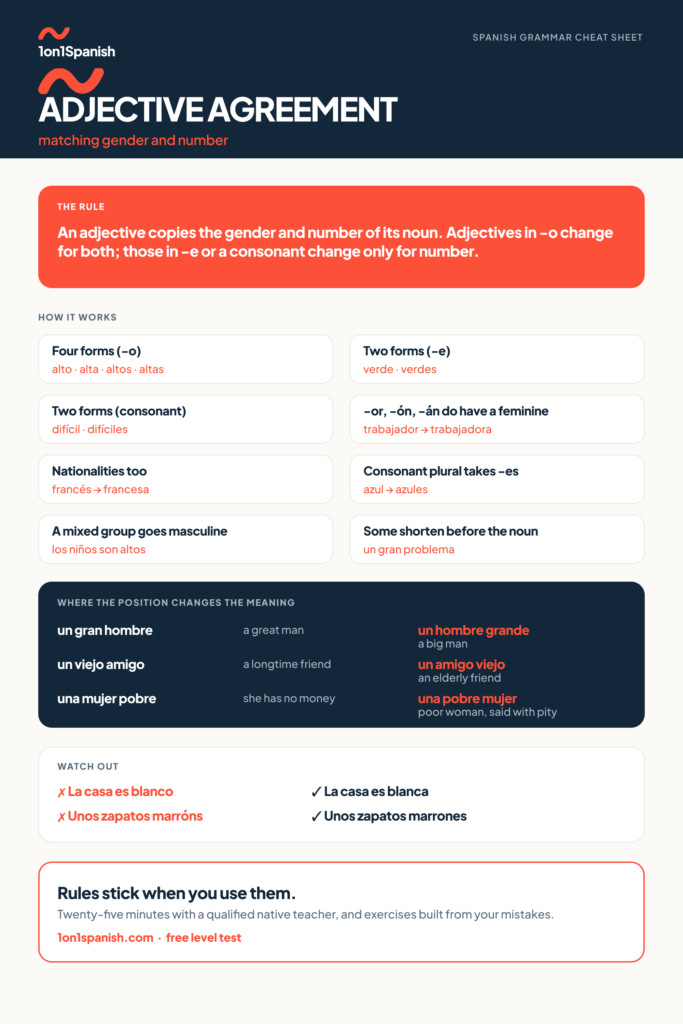
Take the chart with you
The chart is free to view and share. Drop your email and we’ll send the print-ready US Letter PDF — the version you stick on the fridge.
Practice
Practice adjective agreement with a real teacher
Charts get you halfway. The other half is saying it out loud to someone who corrects you on the spot. At 1on1Spanish you get 25-minute private lessons with a qualified native teacher, exercises built from the mistakes you make in class, and AI practice between lessons.
First month $1. No contracts, cancel anytime.
These guides are free. When you want someone correcting you out loud, learn Spanish online with a qualified native teacher.
Take your free level testBuilt on RingTeacher's method — 700,000+ classes delivered since 2017, teaching English to Spanish speakers. Now in the other direction.
Frequently asked questions
How do Spanish adjectives agree with nouns?
They copy the noun’s gender and number. Adjectives ending in -o have four forms: alto, alta, altos, altas. Those ending in -e or a consonant have only two, one singular and one plural: grande / grandes, difícil / difíciles. The noun decides, not the speaker and not the verb, so la casa forces blanca even when ser sits between them.
Which adjective do I use with a masculine and a feminine noun?
The masculine plural. El contrato y la carta están firmados, mi padre y mi madre son altos. One masculine noun in the group is enough, regardless of order or how many feminine nouns there are. When every noun is feminine, the adjective is feminine plural: la carta y la factura están firmadas.
Do nationality adjectives change for gender in Spanish?
The ones ending in a consonant do, even though other consonant-ending adjectives don’t: español / española, francés / francesa, alemán / alemana. The ones ending in -e or -a stay the same for both: canadiense, estadounidense, belga. All of them are written in lowercase, unlike in English.
When does grande become gran?
Immediately before a singular noun of either gender: un gran problema, una gran oportunidad. After the noun it stays whole — un problema grande — and it means something different: gran is great, grande is big. Bueno, malo, primero and tercero shorten too, but only before masculine singular nouns: un buen día, el primer mes.
What’s the most common mistake with Spanish adjective agreement?
Leaving the adjective in its dictionary form: la casa es blanco. English speakers have no habit of changing adjectives at all, so the ending is the first thing that drops under pressure in conversation. Plural agreement goes second — los carros son rojo — because the noun already looks plural and the adjective feels like it doesn’t need to repeat it.