
Spanish gerund and present progressive: -ando, -iendo and estar
Form the Spanish gerund by adding -ando to -ar verbs and -iendo to -er and -ir verbs, then pair it with estar to build the present progressive: trabajando, comiendo, viviendo, estoy trabajando. The real trap isn’t the ending — it’s that English “-ing” does two extra jobs Spanish never lets the gerund do: mark a scheduled future plan, and act as a noun. At 1on1Spanish we correct exactly this in 25-minute one-on-one lessons with qualified native teachers, online across the United States.
Reviewed by María Jiménez — Licenciada en Filología Hispánica (BA in Hispanic Philology) · Updated Sep 2026
Forming the gerund
Regular verbs are mechanical: drop the ending, add -ando for -ar verbs or -iendo for -er and -ir verbs. Hablar → hablando. Comer → comiendo. Vivir → viviendo.
Stem-changing -ir verbs carry a second, smaller change into the gerund: e becomes i, and o becomes u. Pedir → pidiendo. Dormir → durmiendo. Sentir → sintiendo. Servir → sirviendo. -Ar and -er stem changers don’t do this — pensar stays pensando, poder stays pudiendo only because of a different rule below.
When the verb stem ends in a strong vowel, the -iendo ending swaps its i for a y so the vowels don’t collide: Leer → leyendo. Creer → creyendo. Oír → oyendo. Traer → trayendo. Ir → yendo. Construir → construyendo.
Estar + gerund: the present progressive
Estar conjugated in the present, plus the gerund, describes an action happening right now, in progress, more emphatic than the plain present. Estoy trabajando ahora mismo. Está lloviendo. Estamos esperando el autobús.
Other verbs replace estar to add a shade of meaning. Seguir + gerund means “still”: Sigo buscando trabajo. Llevar + gerund marks how long something has been going on: Llevo dos horas esperando al médico — I’ve been waiting for the doctor for two hours. Ir + gerund shows gradual change: Va mejorando poco a poco.
The trap: Spanish doesn’t use the gerund for the future
English uses “-ing” for a plan that’s already arranged: “I’m working tomorrow,” “We’re flying to Miami next week.” Spanish never does this. You cannot say Estoy trabajando mañana to announce a shift you’re scheduled for — it reads as something happening this instant, colliding with the word “tomorrow.” For a scheduled plan, Spanish uses the plain present or ir a + infinitive instead: Mañana trabajo, or Mañana voy a trabajar. Full detail on choosing between those two at Spanish future tense.
The gerund isn’t a noun in Spanish
English lets “-ing” work as the subject of a sentence: “Swimming is healthy,” “I love running.” Spanish reaches for the infinitive for that job, never the gerund: Nadar es sano, not Nadando es sano. Me encanta correr, not me encanta corriendo. The gerund in Spanish only ever describes an action in progress — it’s never a thing you can be the subject of a sentence about.
Reference chart
| Use | Form | Example | English |
|---|---|---|---|
| Action happening right now | estar + gerund | Estoy escribiendo un correo. | I’m writing an email. |
| Ongoing weather or state | estar + gerund | Está lloviendo. | It’s raining. |
| Action in progress for a while | llevar + gerund | Llevo una hora esperando al médico. | I’ve been waiting for the doctor for an hour. |
| Gradual change | ir + gerund | Va mejorando poco a poco. | He’s gradually getting better. |
| Scheduled future plan | present, or ir a + infinitive | Mañana trabajo desde casa. | I’m working from home tomorrow. |
| Activity as subject or object | infinitive | Nadar es bueno para la salud. | Swimming is good for your health. |
Same verb, two scopes
Estar + gerund narrows the scope of an action to right now, or to something temporary. Drop estar and the plain verb describes a permanent fact or a habit instead — the same pair of sentences can mean two different things depending on which one you pick.
| Plain present — a fact or habit | Estar + gerund — right now, or temporary |
|---|---|
| Trabajo en un banco. — I work at a bank. | Estoy trabajando en un banco. — I’m working at a bank right now (this job, this project). |
| Vivo en Miami. — I live in Miami. | Estoy viviendo en Miami. — I’m living in Miami (for now, not necessarily for good). |
| Estudio español. — I study Spanish. | Estoy estudiando español. — I’m studying Spanish (right now, this term). |
Common mistakes English speakers make
The progressive can’t point at the future in Spanish, even with a time word attached. Use the present or ir a.
The gerund can’t be the subject of a sentence. Whenever English “-ing” is doing a noun’s job, Spanish switches to the infinitive.
State verbs like tener, ser, saber and conocer rarely take the progressive in Spanish, even though English “I’m having” sounds natural. The plain present already covers the state.
Regular -iendo gets applied to a stem-changing -ir verb. Pedir, dormir, sentir and servir shift a vowel in the gerund and the regular ending alone doesn’t fix it.
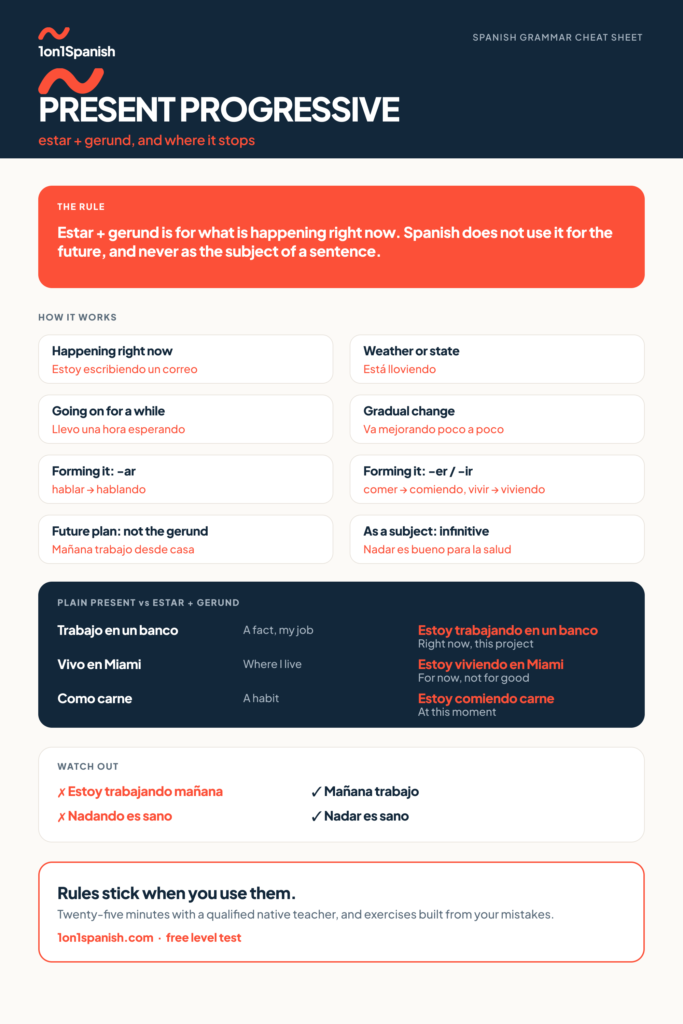
Take the chart with you
The chart is free to view and share. Drop your email and we’ll send the print-ready US Letter PDF — the version you stick on the fridge.
Practice
Practice the Spanish present progressive with a real teacher
Charts get you halfway. The other half is saying it out loud to someone who corrects you on the spot. At 1on1Spanish you get 25-minute private lessons with a qualified native teacher, exercises built from the mistakes you make in class, and AI practice between lessons.
First month $1. No contracts, cancel anytime.
Prefer to practice with a person? Take one-on-one Spanish lessons online with a qualified native teacher.
Take your free level testBuilt on RingTeacher's method — 700,000+ classes delivered since 2017, teaching English to Spanish speakers. Now in the other direction.
Frequently asked questions
What’s the difference between the gerund and the present progressive in Spanish?
The gerund is just the -ando / -iendo form of the verb — trabajando, comiendo — on its own it isn’t a full verb. The present progressive is estar conjugated plus that gerund: estoy trabajando. You’ll also see the gerund after seguir, llevar and ir for slightly different shades of “still doing” or “gradually doing”.
Can you use the gerund for future plans in Spanish?
No. English says “I’m working tomorrow” using “-ing” for a scheduled plan, but Spanish never extends the progressive into the future. For a plan, use the plain present (mañana trabajo) or ir a + infinitive (mañana voy a trabajar). Estoy trabajando mañana reads as a contradiction, not a plan.
Why can’t “nadando” be the subject of a sentence?
Because the Spanish gerund only describes an action in progress — it never functions as a noun. English “-ing” can be both a verb form and a noun (“swimming is healthy”), but Spanish keeps those jobs separate and gives the noun role to the infinitive: nadar es bueno para la salud.
Which verbs have irregular gerunds in Spanish?
Two groups. Stem-changing -ir verbs shift a vowel: pedir → pidiendo, dormir → durmiendo, sentir → sintiendo, servir → sirviendo. Verbs whose stem ends in a strong vowel swap the i of -iendo for a y: leer → leyendo, oír → oyendo, traer → trayendo, ir → yendo.
What’s the most common mistake with the Spanish present progressive?
Using it for a scheduled future plan, as in estoy trabajando mañana instead of mañana trabajo. The second most common is applying it to state verbs like tener or saber, which almost always stay in the plain present in Spanish even where English naturally says “I’m having” or “I’m knowing”.