
Spanish negation: how double negatives work
In Spanish, two negatives don’t cancel each other out — they agree. No tengo nada means “I don’t have anything”, and it’s the only correct way to say it: no tengo algo isn’t a more polite version, it’s simply wrong. English speakers spend years suppressing “I don’t have anything” back into a form Spanish requires, which is why this is one of the most constant errors in this language. At 1on1Spanish we correct it in 25-minute one-on-one lessons with qualified native teachers, online across the United States.
Below is the full list of negative words, the one rule that decides whether no shows up at all, and the double and triple negatives that are completely normal in a Spanish sentence.
Reviewed by María Jiménez — Licenciada en Filología Hispánica (BA in Hispanic Philology) · Updated Sep 2026
The negative words
Spanish has a small, fixed set of negative words, and each one answers a specific question: who, what, when, which, and “me too” turned into “me neither”.
- nada — nothing, not anything
- nadie — nobody, not anyone
- nunca / jamás — never, not ever (jamás is stronger and slightly more formal)
- ninguno / ninguna — none, not any (agrees in gender with the noun)
- tampoco — neither, not either
- ni… ni — neither… nor
Each one pairs naturally with a verb the way “some-” words pair with a verb in English — algo becomes nada, alguien becomes nadie, siempre becomes nunca — but unlike English, the Spanish verb doesn’t switch to a positive form once the negative word shows up.
The rule that decides everything: where’s the negative word?
Spanish negation runs on a single rule, and once it clicks, the whole system stops feeling random. If the negative word comes before the verb, no disappears — the negative word alone carries the negation. If the negative word comes after the verb, no has to appear before the verb to open the sentence.
Negative word before the verb: no no needed
Nadie llamó — nobody called. Nunca voy a esa tienda — I never go to that store. The negative word is already doing the job, so adding no in front of it would be redundant, not extra correct.
Negative word after the verb: no is required
No llamó nadie — same meaning, same sentence, reordered. No voy nunca a esa tienda — same meaning again. Here no sits right before the verb and the negative word moves after it. Both versions are equally correct and native speakers use both, often depending on what they want to emphasize: putting the negative word first gives it more weight. Putting the subject after the verb is ordinary Spanish, not a negation trick, and the Spanish sentence order page shows how far that flexibility goes.
Stacking negatives: the part that looks wrong and isn’t
A Spanish sentence can carry two, three, even four negative words at once, and every one of them adds emphasis instead of flipping the meaning back to positive. No le dije nada a nadie nunca — I never told anyone anything — has three negative words after no and stays fully negative from start to finish. This is the opposite of English, where a second “not” would create a positive: “I didn’t say nothing to nobody” reads as broken English, while its exact Spanish mirror is the only grammatical option.
Reference chart
| Negative word | Meaning | Preverbal | Postverbal |
|---|---|---|---|
| nada | nothing | Nada me sorprende. | No me sorprende nada. |
| nadie | nobody | Nadie sabe la respuesta. | No sabe la respuesta nadie. |
| nunca / jamás | never | Nunca como carne. | No como carne nunca. |
| ninguno/a | none, not any | Ninguna funciona. | No funciona ninguna. |
| tampoco | neither | Tampoco quiero ir. | No quiero ir tampoco. |
| ni… ni | neither… nor | Ni como ni bebo. | — |
Where English speakers actually agree with the rule
Ni… ni behaves closer to English than the rest of the list, which trips people up in the opposite direction. No como carne ni pescado — I don’t eat meat or fish — keeps no even though ni comes after the verb, because ni isn’t strong enough to open the sentence on its own the way nadie or nunca can. The safe version, Ni como carne ni pescado, drops the no and repeats ni before each item instead: that’s the form that behaves like the rest of the negative words.
Common mistakes English speakers make
Once a sentence is negative, every indefinite word inside it has to switch to its negative form too. Algo, alguien and alguno can’t survive next to no.
Adding no in front of a negative word that already opens the sentence doesn’t add emphasis, it produces a double negative that cancels out — the one place where English logic would actually apply, and Spanish doesn’t allow it.
Once no opens the sentence, every indefinite word downstream — including the ones tucked after a preposition — has to flip to its negative form. Stacking several negative words in one sentence is normal, not a sign something went wrong.
Agreeing with a negative statement (“I don’t like it either”) needs tampoco on its own or with a subject, never paired with sí, which only answers positive statements.
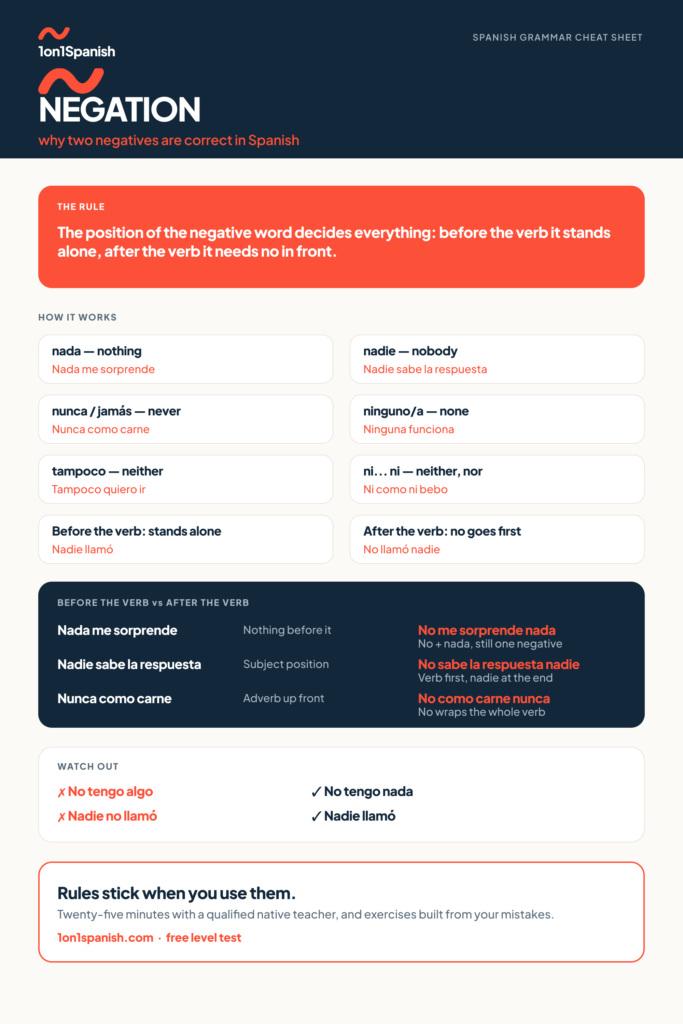
Take the chart with you
The chart is free to view and share. Drop your email and we’ll send the print-ready US Letter PDF — the version you stick on the fridge.
Practice
Practice Spanish negation with a real teacher
Charts get you halfway. The other half is saying it out loud to someone who corrects you on the spot. At 1on1Spanish you get 25-minute private lessons with a qualified native teacher, exercises built from the mistakes you make in class, and AI practice between lessons.
First month $1. No contracts, cancel anytime.
You can go further with someone listening: Learn Spanish with 1on1Spanish, 25 minutes at a time.
Take your free level testBuilt on RingTeacher's method — 700,000+ classes delivered since 2017, teaching English to Spanish speakers. Now in the other direction.
Frequently asked questions
Why are double negatives correct in Spanish?
Because Spanish negative words agree with each other instead of canceling out. No tengo nada — I don’t have anything — needs both no and nada to be grammatical; dropping either one breaks the sentence. English treats a second negative as a logic error, but Spanish treats it as required agreement, the same way adjectives agree in gender with the noun they describe.
When do you drop no in a Spanish negative sentence?
When the negative word comes before the verb. Nadie llamó doesn’t need no because nadie already opens the sentence negatively. The moment the negative word moves after the verb — No llamó nadie — no has to come back in front of the verb to keep the sentence negative.
What’s the difference between nunca and jamás?
Both mean “never”, and they follow the same placement rules. Jamás is stronger and a little more formal or dramatic — closer to “never ever” — while nunca is the everyday, neutral choice. In most conversation, nunca is far more common, and swapping in jamás mostly just adds emphasis.
Can you use more than one negative word in the same Spanish sentence?
Yes, and it’s completely normal, not an exception. No le dije nada a nadie nunca stacks three negative words after no — nothing, nobody, never — and the sentence stays fully negative the whole way through. Native speakers do this constantly without thinking about it.
What’s the most common negation mistake English speakers make?
Reaching for algo, alguien or alguno inside a negative sentence out of habit, instead of switching them to nada, nadie or ninguno. No tengo algo is the classic version of this error; the fix is that once a sentence goes negative, every indefinite word inside it goes negative too.