
Spanish word order: rules for adjectives and verbs
Spanish word order is flexible, not free. The default is subject-verb-object, the same as English, but Spanish bends that order for reasons English doesn’t: to skip a subject that’s already obvious, to put an object pronoun before the verb instead of after it, and to move an adjective before the noun on purpose, changing what it means. None of this is optional style — each shift follows a rule. At 1on1Spanish we work through it in 25-minute one-on-one lessons with qualified native teachers, online across the United States.
Below are the four places Spanish word order departs from English, in the order a learner actually runs into them.
Reviewed by María Jiménez — Licenciada en Filología Hispánica (BA in Hispanic Philology) · Updated Sep 2026
Adjectives go after the noun — usually
Un carro rojo, not un rojo carro. Descriptive adjectives — color, size, shape, nationality — follow the noun in Spanish by default, the reverse of English. Una casa grande, un libro interesante, una mujer mexicana all keep the adjective second. This isn’t a stylistic option: una grande casa sounds foreign to a native ear the same way “a house big” sounds foreign in English.
When the adjective moves before the noun, the meaning shifts
A handful of common adjectives can go either side of the noun, and the position isn’t interchangeable — it changes what’s being said. Un hombre grande is a man who is physically big; un gran hombre is a great man, admired for who he is, not his size. Grande shortens to gran before a singular noun of either gender when it moves in front. The same pattern shows up with viejo (un amigo viejo, an elderly friend, versus un viejo amigo, a longtime friend) and pobre (un hombre pobre, someone without money, versus un pobre hombre, someone to be pitied). The complete list of position-sensitive adjectives, plus the agreement rules that travel with them, is on the common Spanish adjectives page.
The subject often disappears
Spanish verb endings already say who’s doing the action, so the subject pronoun is usually dropped: Trabajo en un hospital means “I work at a hospital” with no yo anywhere in the sentence, because the -o ending on trabajo can only mean “I”. English can’t do this — verb endings don’t carry enough information, so the subject has to stay. Spanish keeps the subject pronoun mainly for contrast or emphasis: Yo trabajo, tú descansas — I work, you rest — where the pronouns are doing the job of pointing out the difference between two people.
Object pronouns go before the conjugated verb
This is the reordering that trips up English speakers the most, because English never does it. Lo tengo — I have it — puts the object pronoun lo before the verb, not after, the way “I have it” puts “it” after “have”. La veo mañana — I’ll see her tomorrow — same pattern. The full mechanics of which pronoun to use and where exactly it lands with compound verbs and commands live on their own page; here, the rule that matters is placement: with a conjugated verb, the pronoun comes first. Start with Spanish direct object pronouns, which is where lo and la live.
Questions move the verb before the subject
A yes-or-no question in Spanish can simply raise the pitch of a statement, but a question that asks for information — who, what, where, when, why, how — typically puts the verb before the subject: ¿Dónde vive tu hermana?, not ¿Dónde tu hermana vive? English does something similar with “does” and “is”, but Spanish has no auxiliary to insert; the verb itself moves. The full list of question words and how they work is covered on its own page. That list — qué, cuál, dónde, cuándo and the rest — is the Spanish question words page.
Reference chart
| Rule | English order | Spanish order | Example |
|---|---|---|---|
| Adjective placement | adjective + noun | noun + adjective | una casa blanca |
| Subject with clear ending | subject stated | subject dropped | Vivo en Texas. |
| Object pronoun | verb + pronoun | pronoun + verb | La quiero. |
| Information question | subject + verb | verb + subject | ¿Cuándo llega el vuelo? |
The cases that change meaning by moving
The clearest proof that Spanish order isn’t decoration is a short list of adjectives that flip meaning depending on which side of the noun they land on.
| Before the noun | After the noun |
|---|---|
| un gran hombre — a great man | un hombre grande — a big man |
| un viejo amigo — a longtime friend | un amigo viejo — an elderly friend |
| un pobre hombre — a pitiable man | un hombre pobre — a man with no money |
| una única solución — the only solution | una solución única — a unique, one-of-a-kind solution |
Common mistakes English speakers make
Translating adjective-noun order directly from English is the single most common word order error, and it’s the fastest tell of a non-native speaker in writing.
Leaving the subject before the verb in an information question copies English syntax where Spanish inverts it.
Placing the object pronoun after the verb, the way English places “it” after “have”, produces a sentence no native speaker would say.
Repeating yo in every clause isn’t wrong, just unnatural: once the verb ending already carries the subject, dropping the pronoun reads as more native, and keeping it constantly starts to sound like emphasis that isn’t there.
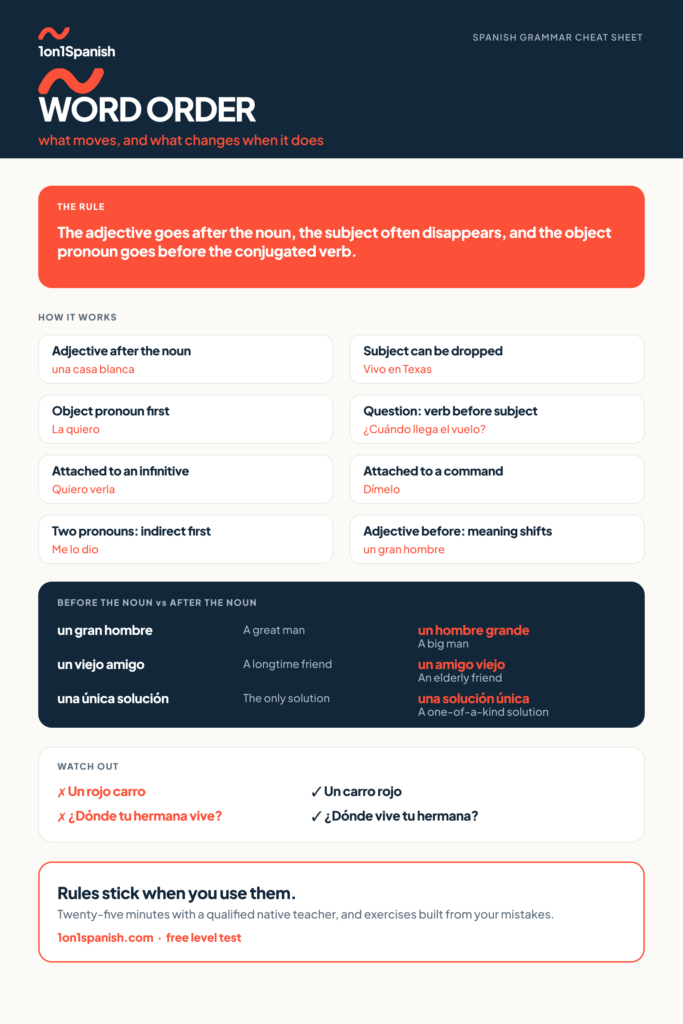
Take the chart with you
The chart is free to view and share. Drop your email and we’ll send the print-ready US Letter PDF — the version you stick on the fridge.
Practice
Practice Spanish word order with a real teacher
Charts get you halfway. The other half is saying it out loud to someone who corrects you on the spot. At 1on1Spanish you get 25-minute private lessons with a qualified native teacher, exercises built from the mistakes you make in class, and AI practice between lessons.
First month $1. No contracts, cancel anytime.
Grammar you can read. Speaking you cannot. Learn Spanish online and practice it live.
Take your free level testBuilt on RingTeacher's method — 700,000+ classes delivered since 2017, teaching English to Spanish speakers. Now in the other direction.
Frequently asked questions
Is Spanish word order the same as English?
Close but not the same. Both default to subject-verb-object, but Spanish puts descriptive adjectives after the noun instead of before it, drops the subject pronoun when the verb ending already identifies it, and moves object pronouns before a conjugated verb instead of after it. Information questions also invert verb and subject.
Why does the subject disappear in Spanish sentences?
Because Spanish verb endings already say who’s acting. Trabajo can only mean “I work” — no other subject fits that ending — so adding yo in front is redundant most of the time. Spanish keeps the subject pronoun mainly to contrast two people or add emphasis, not as a default habit.
Where does the adjective go in a Spanish sentence?
After the noun, by default: una casa blanca, not una blanca casa. A short list of adjectives — grande, viejo, pobre, único — can move in front of the noun instead, and doing so changes the meaning rather than just the style: un gran hombre (a great man) versus un hombre grande (a big man).
Do object pronouns always go before the verb in Spanish?
With a conjugated verb, yes: lo tengo, la veo, nos escriben. The pronoun attaches to the end instead when it’s paired with an infinitive, a gerund or a command, which is covered in depth on the direct object pronouns page. The core rule with a conjugated verb never changes: pronoun first.
How do you ask an information question in Spanish?
By moving the verb in front of the subject: ¿Dónde vive tu hermana?, not ¿Dónde tu hermana vive? Spanish has no equivalent of “do” or “does” to insert, so the verb itself does the moving. The full set of question words — qué, cuál, dónde, cuándo and the rest — is covered on its own page.