
Spanish present perfect: how to form it and when to use it
Use the present perfect — haber conjugated in the present, plus the past participle — for something that happened and still matters right now, the same way English reaches for “have done” instead of “did”. Formation is fast once you know the participle. The real work is knowing when Spanish uses this tense and when it reaches for the simple past instead, because that split changes depending on which country you’re talking to. At 1on1Spanish we work through both in 25-minute one-on-one lessons with qualified native teachers, online across the United States.
Reviewed by María Jiménez — Licenciada en Filología Hispánica (BA in Hispanic Philology) · Updated Sep 2026
Conjugating haber
Haber is the auxiliary that carries the person and number. The participle never changes: he, has, ha, hemos, habéis, han — always plus the same fixed form of the verb that follows.
He trabajado aquí cinco años. ¿Has hablado con el banco? Mi hija ha terminado la universidad. Hemos vivido en tres estados distintos.
The participle itself has its own rules — the regular -ado / -ido endings, nine irregular forms like escrito and hecho, and when it agrees with a noun instead of staying fixed. That’s covered in full at Spanish past participle; here it’s enough to know that after haber it locks into the masculine singular, no matter what comes next.
When English and Spanish line up
For recent actions with an open connection to now, both languages use the present perfect the same way. He vivido aquí desde 2020. — I’ve lived here since 2020. ¿Has probado los tamales de mi suegra? — Have you tried my mother-in-law’s tamales? Nunca he estado en Argentina. — I’ve never been to Argentina. Words like ya, todavía no, nunca and alguna vez usually signal this use in both languages.
When they don’t
Two traps run in opposite directions, and both come from assuming the two languages match by default.
English keeps the perfect where Spanish switches to the present. For an action that started in the past and is still going on, Spanish generally prefers the plain present with desde hace or llevar + gerund: Trabajo aquí desde hace cinco años, not he trabajado. English says “I have worked here for five years”; Spanish just says “I work here since five years ago.”
Spanish uses the perfect where English drops it for “just.” For something that happened seconds or minutes ago, Spanish often prefers acabar de + infinitive over the present perfect: Acabo de firmar el contrato — I just signed the contract. He firmado el contrato is also correct, but it reads as a broader “I have signed it” rather than “I just did.”
Spain vs Latin America
This is the split that decides whether the present perfect sounds natural or overused. In Spain, the present perfect covers most of today’s events: Hoy he hablado con el banco, Esta mañana he desayunado tarde. Any action inside a time period that hasn’t closed — today, this week, this year — tends to take the perfect.
In Latin America, the preterite takes over most of that ground. The same ideas come out as Hoy hablé con el banco, Esta mañana desayuné tarde. The present perfect survives for life experience without a specific time (He estado en México, Nunca he probado el mole) and for things whose result is still visibly true right now (Se ha roto la lavadora — the washer is broken, right now, because of what happened). This site defaults to Latin American Spanish, so the examples above lean that way — but both patterns are correct Spanish, and a speaker from either region understands the other without trouble.
Reference chart
| What you want to say | Form | Example | English |
|---|---|---|---|
| Recent action, present relevance | he/has/ha + participle | He terminado el informe. | I have finished the report. |
| Life experience, no specific time | he/has/ha + participle | He visitado México dos veces. | I’ve visited Mexico twice. |
| Never / ever | nunca / alguna vez + perfect | Nunca he probado el mole. | I’ve never tried mole. |
| Ongoing since a point in the past | present + desde hace | Trabajo aquí desde hace cinco años. | I have worked here for five years. |
| Today’s event, Spain | he/has/ha + participle | Hoy he hablado con el banco. | I talked to the bank today. |
| Today’s event, Latin America | preterite | Hoy hablé con el banco. | I talked to the bank today. |
The pair that trips people up: acabar de vs the present perfect
Both describe something recent, and English speakers reach for the present perfect in both cases — but Spanish separates them by how recent “recent” actually is.
| Acabar de + infinitive — this second | Present perfect — recently, still relevant |
|---|---|
| Acabo de llegar. — I just arrived. | He llegado hace media hora. — I arrived half an hour ago. |
| Acabo de firmar el contrato. — I just signed the contract. | He firmado el contrato esta semana. — I’ve signed the contract this week. |
| Acaba de salir de la reunión. — He just left the meeting. | Ha salido de tres reuniones hoy. — He’s left three meetings today. |
Common mistakes English speakers make
Hay (there is) and he (I have) both come from haber, and beginners mix them up because they sound close in fast speech. Only he builds the perfect.
After haber the participle never agrees, even when the noun it points to is feminine or plural. Agreement only happens with estar or ser.
A direct calque of “for five years” using por. Spanish marks ongoing duration with desde hace or llevar + gerund, not with por.
Swapping the participle for the gerund. Haber only ever takes the participle — the -ado / -ido form, never -ando / -iendo.
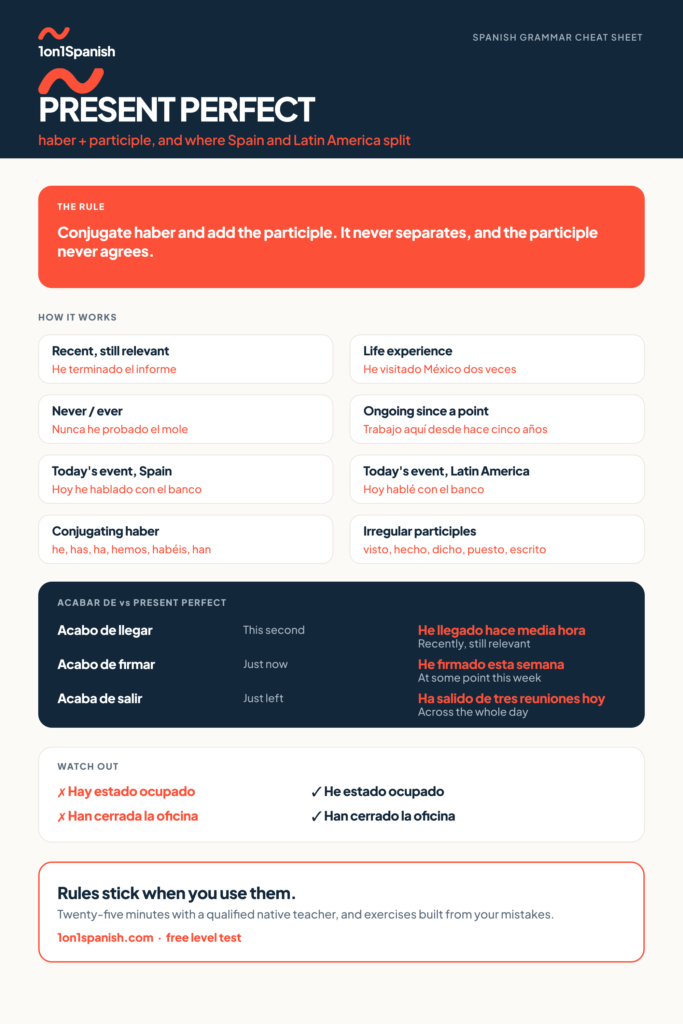
Take the chart with you
The chart is free to view and share. Drop your email and we’ll send the print-ready US Letter PDF — the version you stick on the fridge.
Practice
Practice the Spanish present perfect with a real teacher
Charts get you halfway. The other half is saying it out loud to someone who corrects you on the spot. At 1on1Spanish you get 25-minute private lessons with a qualified native teacher, exercises built from the mistakes you make in class, and AI practice between lessons.
First month $1. No contracts, cancel anytime.
Prefer to practice with a person? Take one-on-one Spanish lessons online with a qualified native teacher.
Take your free level testBuilt on RingTeacher's method — 700,000+ classes delivered since 2017, teaching English to Spanish speakers. Now in the other direction.
Frequently asked questions
When do you use the present perfect in Spanish?
Use haber in the present plus the past participle for something that happened and still matters now: a recent event, a life experience without a specific time, or a result still visible today. He terminado el informe, Nunca he estado en Argentina. For an action still ongoing since a past point, Spanish usually switches to the plain present with desde hace instead.
How do you conjugate haber for the present perfect?
He, has, ha, hemos, habéis, han, followed by the past participle, which never changes: he hablado, has comido, ha vivido. The participle only agrees with a noun when it’s working as an adjective, with estar or ser — never after haber.
Is the Spanish present perfect used differently in Spain and Latin America?
Yes, and it’s the biggest source of confusion with this tense. Spain uses the present perfect for most of today’s events: Hoy he comido en casa. Latin America generally prefers the preterite for the same idea, Hoy comí en casa, and keeps the perfect mostly for life experience and results still visible now. Both are correct, and both are understood everywhere.
Why does “trabajo aquí desde hace cinco años” use the present tense instead of the perfect?
Because Spanish treats an action that’s still going on as a present fact, not a completed one, even if it started years ago. English marks the same idea with “have worked… for”, which is why learners default to the perfect and produce he trabajado desde hace by mistake.
What’s the most common mistake with the Spanish present perfect?
Translating “for” with por instead of using desde hace or llevar + gerund to mark duration: trabajo aquí por cinco años instead of trabajo aquí desde hace cinco años. The second most common is letting the participle agree after haber, as in han cerrada la oficina.