
Spanish past participle: how to form it and how to use it
Replace -ar with -ado and -er or -ir with -ido, then use the result with haber for compound tenses, where it never changes, or as an adjective, where it agrees with the noun in gender and number. English works the same way in outline — “spoken”, “eaten”, “written” — so the work is the short list of irregulars and one rule about when the ending moves. 1on1Spanish covers this in 25-minute one-on-one lessons with qualified native teachers, online across the United States.
Reviewed by María Jiménez — Licenciada en Filología Hispánica (BA in Hispanic Philology) · Updated Sep 2026
Forming the regular participle
Hablar → hablado. Comer → comido. Vivir → vivido. That’s the whole regular pattern, and it holds for stem-changing verbs too: pensar → pensado, dormir → dormido, pedir → pedido. Nothing in the stem shifts.
One spelling detail catches people out. When the -er or -ir stem ends in a strong vowel, the i of -ido takes a written accent to keep its own syllable: leer → leído, caer → caído, oír → oído, traer → traído, creer → creído. Without the accent the word reads as one syllable and sounds like a different word. It’s the ordinary hiatus rule — two vowels that would otherwise fuse get an accent to stay apart — and the accent and stress rules page covers it in full.
The nine irregular participles
Nine verbs have participles that don’t come from the infinitive, and they cover most of what you say in a day:
Escribir → escrito. Decir → dicho. Hacer → hecho. Ver → visto. Poner → puesto. Volver → vuelto. Morir → muerto. Romper → roto. Abrir → abierto.
Anything built on those verbs inherits the irregular form: describir → descrito, devolver → devuelto, componer → compuesto, deshacer → deshecho, descubrir → descubierto, resolver → resuelto, cubrir → cubierto. Learn the nine and you get around thirty for free.
Reference chart
| Infinitive ending | Participle ending | Example | Translation |
|---|---|---|---|
| -ar | -ado | trabajar → trabajado | worked |
| -er | -ido | comer → comido | eaten |
| -ir | -ido | salir → salido | gone out |
| -er/-ir after strong vowel | -ído | leer → leído | read |
| Irregular | Verb | In a sentence |
|---|---|---|
| escrito | escribir | He escrito el informe. |
| dicho | decir | No he dicho nada. |
| hecho | hacer | ¿Has hecho la reserva? |
| visto | ver | No lo he visto hoy. |
| puesto | poner | Han puesto una multa. |
| vuelto | volver | Ya hemos vuelto del viaje. |
| muerto | morir | Su padre ha muerto este año. |
| roto | romper | Se me ha roto el celular. |
| abierto | abrir | El banco ya está abierto. |
When it agrees, and when it never does
This is the part that decides whether your Spanish sounds finished. The same word behaves in two different ways depending on what it sits next to.
| With haber — never changes | As an adjective — agrees |
|---|---|
| He escrito las cartas. — I’ve written the letters. | Las cartas están escritas. — The letters are written. |
| Hemos abierto la tienda. — We’ve opened the store. | La tienda está abierta. — The store is open. |
| Han roto las ventanas. — They’ve broken the windows. | Las ventanas están rotas. — The windows are broken. |
| Ha hecho los cambios. — He’s made the changes. | Los cambios están hechos. — The changes are made. |
After haber the participle is locked in the masculine singular no matter what follows it. As an adjective it behaves like rojo or alto and copies the noun. Two other uses take the adjective behavior: the passive with ser, El contrato fue firmado por el director, and the participle placed straight onto a noun, un informe escrito, unas reglas establecidas. The auxiliary itself — he, has, ha, hemos, habéis, han — is on the haber conjugation page, and the tense they build together is the Spanish present perfect.
Common mistakes English speakers make
The regular ending gets applied to an irregular verb, exactly the way English learners produce “writed”. The nine irregulars have to be memorized; there is no pattern behind them.
English says “I have paid” with nothing agreeing, and then Spanish agreement rules leak backwards into the compound tense. After haber, never touch the ending.
The mirror-image error. With estar the participle is an adjective and has to match, and here the noun is feminine.
Dropping the accent is invisible in speech and obvious in writing, and it affects a handful of very common verbs: leído, oído, traído, caído, creído.
Volver is irregular and so is everything built on it, so devolver gives devuelto, not devolvido.
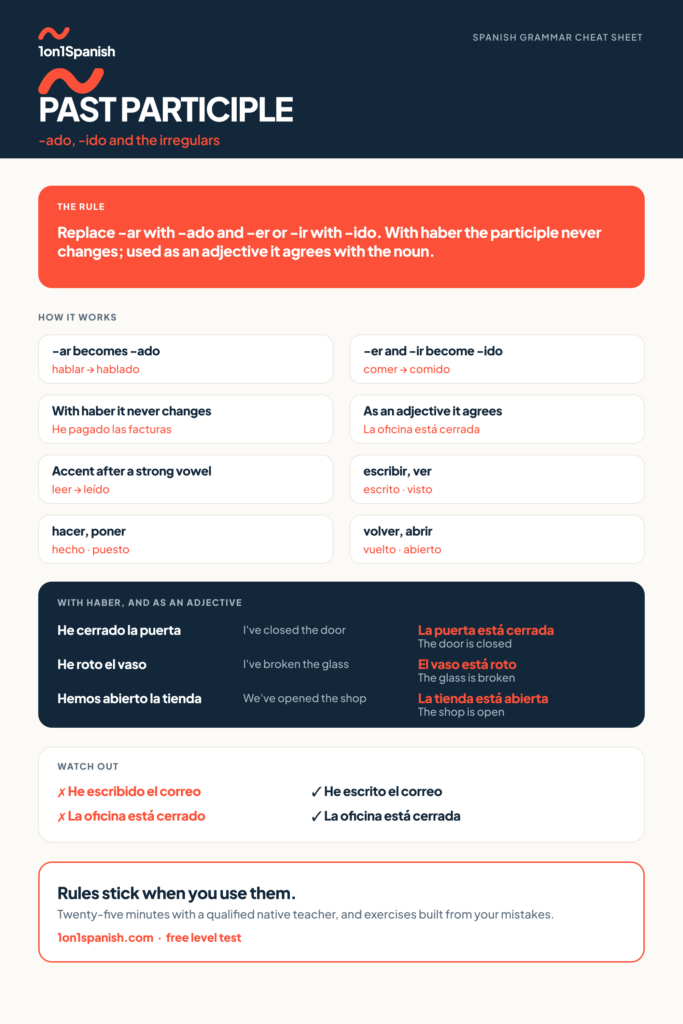
Take the chart with you
The chart is free to view and share. Drop your email and we’ll send the print-ready US Letter PDF — the version you stick on the fridge.
Practice
Practice the past participle with a real teacher
Charts get you halfway. The other half is saying it out loud to someone who corrects you on the spot. At 1on1Spanish you get 25-minute private lessons with a qualified native teacher, exercises built from the mistakes you make in class, and AI practice between lessons.
First month $1. No contracts, cancel anytime.
Want a teacher listening while you practice? Learn Spanish online with us, one lesson at a time.
Take your free level testBuilt on RingTeacher's method — 700,000+ classes delivered since 2017, teaching English to Spanish speakers. Now in the other direction.
Frequently asked questions
How do you form the past participle in Spanish?
Drop the infinitive ending and add the participle ending: -ar verbs take -ado and -er and -ir verbs take -ido. Trabajar gives trabajado, comer gives comido, vivir gives vivido. Stem changes disappear, so pensar is pensado and dormir is dormido. If the stem ends in a strong vowel, the i takes an accent: leído, oído, traído.
What are the irregular past participles in Spanish?
Nine core ones: escrito, dicho, hecho, visto, puesto, vuelto, muerto, roto and abierto. Every verb built on those follows the same shape, so describir gives descrito, devolver gives devuelto and componer gives compuesto. A few verbs, like freír and imprimir, accept two forms: frito or freído, impreso or imprimido.
Does the Spanish past participle agree with the noun?
It depends on what it’s attached to. After haber in a compound tense it never changes: he escrito las cartas, not escritas. Used as an adjective (with estar, with ser in the passive, or directly on a noun), it agrees in gender and number: las cartas están escritas, un informe escrito, unas normas establecidas.
What’s the difference between the past participle and the preterite?
The preterite is a finished past tense that stands on its own: escribí el correo, I wrote the email. The past participle is not a tense at all: it needs haber to make one, as in he escrito el correo, or it works as an adjective, un correo escrito. If a form can be the only verb in the sentence, it isn’t a participle.
Do Spanish speakers use the present perfect the way English speakers do?
Not identically. In Spain he comido covers today’s events where American English would say “I ate”. Across Latin America and among Spanish speakers in the United States, the simple preterite comí takes over most of that ground, and the present perfect is kept for things still connected to now. Both are correct everywhere and understood everywhere.