
Spanish reflexive pronouns: me, te, se and where they go
A reflexive pronoun — me, te, se, nos, os, se — sends the action of a verb back to the person doing it, and once you can pick the right one, the only real decision left is where it goes: before a conjugated verb, or glued onto an infinitive, a gerund, or an affirmative command. English marks the same idea with “myself”, “yourself”, “himself”, which is why the pronoun feels optional to a beginner — in Spanish it never is.
At 1on1Spanish we work through placement in 25-minute one-on-one lessons with qualified native teachers, online across the United States. For the conjugation of reflexive verbs themselves and the full list of which ones need a pronoun, see Spanish reflexive verbs — this page is about the pronoun, not the verb.
Reviewed by María Jiménez — Licenciada en Filología Hispánica (BA in Hispanic Philology) · Updated Sep 2026
The six pronouns and how they match the subject
Each subject has its own reflexive pronoun, and it has to match no matter which verb it’s attached to: yo me, tú te, él/ella/usted se, nosotros nos, vosotros os, ellos/ustedes se. Me levanto a las seis. ¿A qué hora te acuestas? Mi abuela se cuida mucho. Nos preocupamos por su salud. Notice that se covers three different subjects — third person singular, formal usted, and third person plural — so context, not the pronoun, tells you who’s doing the action.
Placement: before the verb, or attached to it
With a conjugated verb, the pronoun goes right before it: Me despierto temprano., ¿Te preocupas mucho por el trabajo? With an infinitive or a gerund, it can either stay in front of the whole phrase or attach to the end, and both are correct: Me tengo que levantar temprano and Tengo que levantarme temprano mean exactly the same thing, and so do Se está bañando and Está bañándose — note the accent added to keep the stress in the right place once the pronoun attaches.
With an affirmative command, the pronoun has to attach: ¡Levántate!, ¡Siéntense, por favor! With a negative command, it moves back in front: ¡No te levantes todavía! The same flip applies to every attached pronoun, not just reflexive ones, so this rule is worth memorizing on its own.
The impersonal and passive se
Se also shows up in constructions that have nothing to do with reflecting an action back onto a subject. The impersonal se means “one” or “people in general”, with no specific subject at all: Se dice que va a llover., Aquí se come muy bien. The passive se lets the thing acted on take the subject position while nobody in particular does the acting, common on signs and instructions: Se vende esta casa., Se habla español. Both use the exact same word as the reflexive pronoun, and telling them apart comes down to context: a reflexive se always has a subject doing something to itself; the impersonal and passive ones don’t. Signs, menus and instructions lean heavily on the passive se precisely because it drops the actor and keeps the sentence short and neutral.
Reference chart
| Subject | Pronoun | Example | English |
|---|---|---|---|
| yo | me | Me lavo las manos. | I wash my hands. |
| tú | te | Te preparas rápido. | You get ready fast. |
| él / ella / usted | se | Se viste solo. | He gets dressed by himself. |
| nosotros/-as | nos | Nos cuidamos mucho. | We take good care of ourselves. |
| vosotros/-as | os | Os levantáis temprano. | You (all) get up early. |
| ellos / ellas / ustedes | se | Se acuestan tarde. | They go to bed late. |
Three jobs, one word: reflexive, impersonal and passive se
The word se does three unrelated jobs, and only the sentence around it tells you which one you’re looking at.
| Use of se | What’s happening | Example |
|---|---|---|
| Reflexive | The subject acts on itself | Ella se lava la cara. — She washes her own face. |
| Impersonal | No specific subject; “people/one” in general | Se vive bien aquí. — People live well here. |
| Passive | The object takes the subject slot; no actor named | Se necesitan empleados. — Employees are needed. |
Common mistakes English speakers make
With a gerund, the pronoun has to either come before the whole verb phrase or attach to the end — it can never sit in the middle, between estoy and the gerund.
Dropping the pronoun on a reflexive verb changes the meaning entirely: levantar without me means “to lift something”, not “to get (myself) up.”
With an affirmative command the pronoun attaches once, at the end — it doesn’t also get repeated as a separate word before the verb.
With a conjugated verb the pronoun has to sit immediately before it, never after — this one comes from applying the attached-pronoun rule of infinitives and commands where it doesn’t belong.
Se lo is a stacked object-pronoun combination (indirect + direct), not a reflexive construction. Adding lo here is confusing the reflexive se with the object pronoun system covered at Spanish reflexive verbs.
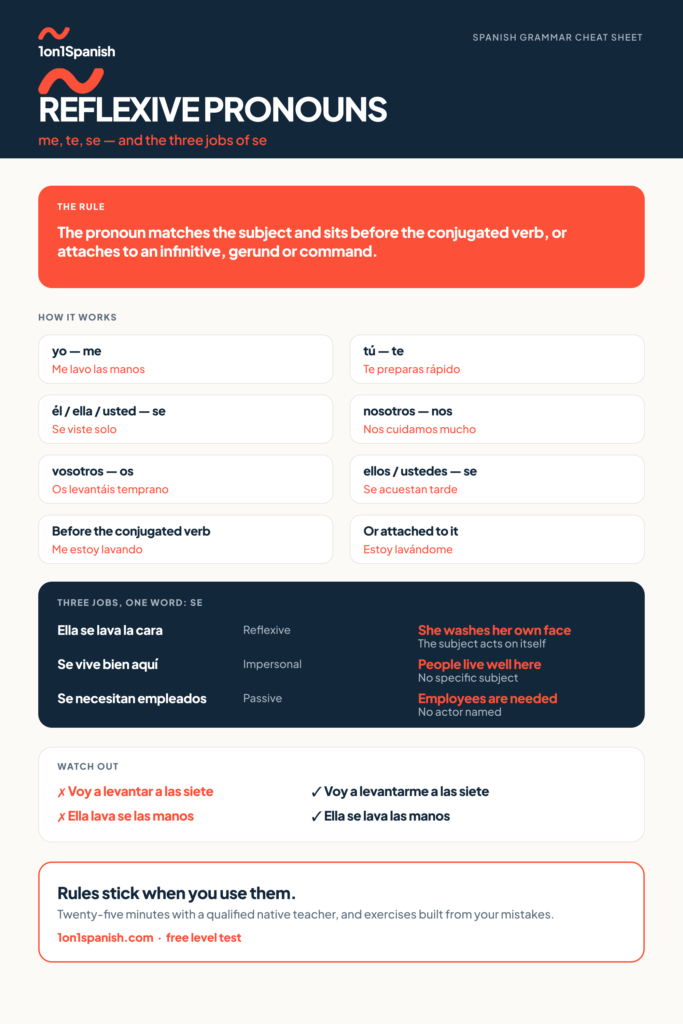
Take the chart with you
The chart is free to view and share. Drop your email and we’ll send the print-ready US Letter PDF — the version you stick on the fridge.
Practice
Practice Spanish reflexive pronouns with a real teacher
Charts get you halfway. The other half is saying it out loud to someone who corrects you on the spot. At 1on1Spanish you get 25-minute private lessons with a qualified native teacher, exercises built from the mistakes you make in class, and AI practice between lessons.
First month $1. No contracts, cancel anytime.
Guides help. A teacher hears what a guide cannot — Learn Spanish online with a real teacher.
Take your free level testBuilt on RingTeacher's method — 700,000+ classes delivered since 2017, teaching English to Spanish speakers. Now in the other direction.
Frequently asked questions
What are the Spanish reflexive pronouns?
Me, te, se, nos, os, se, each matching a subject: yo me, tú te, él/ella/usted se, nosotros nos, vosotros os, ellos/ustedes se. They mark that the subject is doing the action to itself, the way English uses “myself” or “yourself” — but in Spanish the pronoun is required, not optional.
Where does the reflexive pronoun go in a Spanish sentence?
Right before a conjugated verb: Me levanto. With an infinitive or a gerund, it can go before the whole phrase or attach to the end, and both are correct: Me voy a bañar and Voy a bañarme mean the same thing. With an affirmative command it has to attach: ¡Báñate!
What’s the difference between the reflexive se and the impersonal se?
The reflexive se means a subject is acting on itself: Se lava. — He washes himself. The impersonal se has no specific subject at all; it means “one” or “people in general”: Se vive bien aquí. — People live well here. Only the surrounding sentence tells them apart, since the word itself is identical.
Is the reflexive pronoun the same as an object pronoun in Spanish?
No, even though some forms overlap. Reflexive pronouns show the subject acting on itself. Object pronouns (lo, la, le, los, las, les) replace the person or thing receiving the action from someone else. Se lava is reflexive; lo lava — she washes it — uses a direct object pronoun instead.
What’s the most common mistake with Spanish reflexive pronouns?
Placing the pronoun in the middle of a verb phrase with a gerund, producing something like estoy me lavando instead of me estoy lavando or estoy lavándome. The second most common mistake is dropping the pronoun altogether on a reflexive verb, which usually changes the meaning of the verb rather than just sounding informal.