
Spanish reflexive verbs: the pronouns and when you need them
A Spanish verb is reflexive when the action lands back on the person doing it, and that is why it always carries a pronoun — me, te, se, nos, os, se — matching the subject. Lavo el carro is something I do to the car; me lavo is something I do to myself. English marks this with “myself” only when it has to, so the Spanish pronoun looks optional to an American ear and never is. 1on1Spanish drills reflexives in 25-minute one-on-one lessons with qualified native teachers, online across the United States.
Reviewed by María Jiménez — Licenciada en Filología Hispánica (BA in Hispanic Philology) · Updated Sep 2026
The six pronouns and where they go
Every reflexive verb is listed in the dictionary with -se stuck to the infinitive: levantarse, ducharse, jubilarse. You conjugate the verb as usual and swap that -se for the pronoun that matches your subject.
| Subject | Pronoun | Example |
|---|---|---|
| yo | me | Me levanto a las seis. |
| tú | te | Te levantas tarde. |
| él / ella / usted | se | Se levanta con el niño. |
| nosotros | nos | Nos levantamos temprano. |
| vosotros | os | Os levantáis a la vez. |
| ellos / ellas / ustedes | se | Se levantan a las siete. |
Placement follows one rule with one alternative. The pronoun goes right before the conjugated verb: Me ducho, No me ducho, ¿Te duchas?. When the verb is an infinitive, a gerund or an affirmative command, it can instead attach to the end: Voy a ducharme, Estoy duchándome, Dúchate. With infinitives and gerunds both positions are correct — me voy a duchar and voy a ducharme are the same sentence. Those are the same placement rules every object pronoun follows, which is why the five sets of Spanish pronouns are worth seeing side by side at least once.
What “reflexive” actually covers
The label hides four different jobs, and only the first one is reflexive in the literal sense.
The action really does come back to you. Me afeito los sábados. Se cortó con un cuchillo. You are both the one doing it and the one it happens to. With body parts the pronoun does the possessive’s job too — me lavo las manos, not mis manos — which is one of the places Spanish uses an article where English doesn’t, the same rule behind me duele la cabeza.
Two people doing it to each other. Nos vemos los domingos — we see each other. Se escriben todas las semanas. Only plural subjects can do this, and context tells you which reading applies.
A change of state — the English “get” verbs. Me enfadé con el seguro (I got angry), Se cansó de esperar (he got tired), Nos mudamos a Austin (we moved). This is the biggest group by far and the one English speakers under-use.
Verbs that simply exist with the pronoun. Quejarse, atreverse, arrepentirse, darse cuenta. Nothing comes back to anyone; the pronoun is part of the word. Me quejé al banco — I complained to the bank.
Reference chart
| Verb | Meaning | Example | English |
|---|---|---|---|
| levantarse | to get up | Me levanto a las seis. | I get up at six. |
| despertarse | to wake up | Se despierta con el niño. | She wakes up with the baby. |
| ducharse | to shower | Me ducho antes de trabajar. | I shower before work. |
| vestirse | to get dressed | Se viste en cinco minutos. | He gets dressed in five minutes. |
| acostarse | to go to bed | Nos acostamos tarde. | We go to bed late. |
| sentarse | to sit down | Siéntese, por favor. | Have a seat, please. |
| preocuparse | to worry | Me preocupo por la factura. | I worry about the bill. |
| enfadarse | to get angry | Se enfadó conmigo. | He got angry with me. |
| jubilarse | to retire | Mi marido se jubila en junio. | My husband retires in June. |
| mudarse | to move house | Nos mudamos a Texas. | We moved to Texas. |
| darse cuenta | to realize | Me di cuenta tarde. | I realized too late. |
| quejarse | to complain | Se quejó al seguro. | She complained to the insurer. |
Common mistakes English speakers make
Without the pronoun you’re lifting something else. English drops “myself” here, Spanish never drops me.
The reflexive pronoun already says the hands are yours, so the possessive turns into a duplicate. Body parts and clothing take el, la, los, las.
The pronoun has to agree with the subject, not with the dictionary form llamarse. First person means me, always.
A pronoun never sits between the conjugated verb and the infinitive. It goes before the whole block or glued to the end.
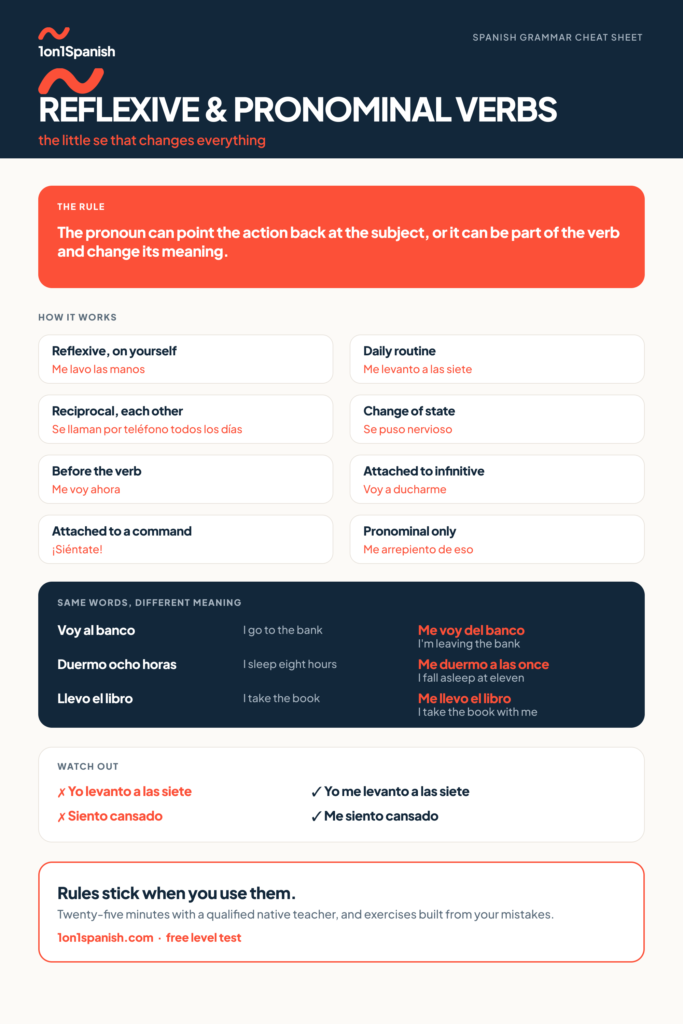
Take the chart with you
The chart is free to view and share. Drop your email and we’ll send the print-ready US Letter PDF — the version you stick on the fridge.
Practice
Practice reflexive verbs with a real teacher
Charts get you halfway. The other half is saying it out loud to someone who corrects you on the spot. At 1on1Spanish you get 25-minute private lessons with a qualified native teacher, exercises built from the mistakes you make in class, and AI practice between lessons.
First month $1. No contracts, cancel anytime.
Grammar you can read. Speaking you cannot. Learn Spanish online and practice it live.
Take your free level testBuilt on RingTeacher's method — 700,000+ classes delivered since 2017, teaching English to Spanish speakers. Now in the other direction.
Frequently asked questions
How do you know if a Spanish verb is reflexive?
Check the infinitive in the dictionary: if it ends in -se, it takes a pronoun. Levantarse, quejarse, irse. Many verbs appear both ways with different meanings, like dormir and dormirse, so the entry lists both. Once you know the form, the conjugation is ordinary — only the pronoun is added.
Where does the reflexive pronoun go in a Spanish sentence?
Before the conjugated verb in normal sentences and negatives: me ducho, no me ducho. Attached to the end with infinitives, gerunds and affirmative commands: voy a ducharme, estoy duchándome, dúchate. With an infinitive or gerund you can also put it in front of the whole group, so me voy a duchar is equally correct.
Why do Spanish speakers say “me comí” instead of “comí”?
The pronoun there isn’t reflexive, it’s emphatic. Comí el plato reports the fact; me comí el plato entero stresses that you finished the whole thing. Spanish adds this pronoun to verbs of consuming and taking — beberse, leerse, saberse — to signal that the action was completed in full.
Are reflexive verbs different in Latin America and Spain?
The rule is identical. The only visible difference is vosotros: Spain uses os laváis, Latin America uses se lavan for the same group of people. In parts of Latin America you’ll also hear vos te levantás. None of that changes when a verb needs a pronoun or where the pronoun sits.
What’s the most common mistake with Spanish reflexive verbs?
Dropping the pronoun on daily-routine verbs, so me levanto becomes levanto and me acuesto becomes acuesto. English hides the reflexive in “I get up”, so there’s nothing to translate. The second most common is doubling ownership with body parts, as in me lavo mis manos instead of me lavo las manos.