
Spanish words with diphthongs: how they work
A Spanish diphthong is two vowels pronounced together in a single syllable, gliding from one into the other without a break. It happens when a weak vowel — i or u — sits next to a strong vowel — a, e or o — and neither one carries the word’s stress. Bien, cielo and agua are all one syllable shorter than they look, because the vowel pair inside each one fuses instead of splitting. Miss that fusion and a two-syllable word turns into three, which is one of the more subtle ways an accent shows up in otherwise correct Spanish. At 1on1Spanish we work on this in 25-minute one-on-one lessons with qualified native teachers, online across the United States.
Below is which vowels count as strong or weak, the mechanics of when they fuse and when they don’t, and the role a written tilde plays in breaking a diphthong apart on purpose.
Reviewed by María Jiménez — Licenciada en Filología Hispánica (BA in Hispanic Philology) · Updated Sep 2026
Strong vowels and weak vowels
Spanish sorts its five vowels into two groups, and the whole diphthong rule depends on which group each vowel belongs to:
- Strong vowels: a, e, o
- Weak vowels: i, u
Two strong vowels next to each other never fuse — they always split into separate syllables: ca-os (chaos), le-o (I read) are two syllables each, no exceptions. A weak vowel next to a strong one, or two weak vowels next to each other, is where diphthongs happen.
When two vowels fuse into a diphthong
A diphthong forms in two situations:
- Weak + strong, or strong + weak, in the same syllable, with the weak vowel unstressed. bien (bi-EN sound, but one syllable: bien), cielo (cie-lo, two syllables total, not three), agua (a-gua, two syllables, not three).
- Weak + weak. ciudad (ciu-dad, two syllables), cuidado (cui-da-do, three syllables, with cui fused into one).
The full pattern covers six combinations: ai, au, ei, eu, oi, ou (strong first) and ia, ie, io, ua, ue, uo (weak first), plus iu and ui (weak + weak). Spanish vowel sounds themselves — why each one stays pure instead of gliding the way English vowels do — are covered on their own page; this page is about how two of those pure sounds combine into one syllable. Start there if the vowels themselves still drift toward English: the five Spanish vowel sounds are the raw material every diphthong is built from.
Two strong vowels: always a hiato, never a diphthong
When two strong vowels land next to each other, Spanish always breaks them into separate syllables, a pattern called hiato. Poeta (po-e-ta), teatro (te-a-tro), aéreo (a-é-re-o) all split every strong vowel pair, with no fusion possible. This is a fixed rule, not a stylistic choice: strong vowels are simply too far apart in the mouth to glide together the way a weak vowel can glide into a strong one.
When a tilde breaks a diphthong on purpose
Here’s where accent marks change the pronunciation, not just the emphasis. A written tilde on the weak vowel of what would otherwise be a diphthong forces a hiato instead — it tells the reader the weak vowel gets its own full syllable and carries the stress:
- día (day): without the tilde, dia would be one syllable; with it, dí-a is two, and the stress lands on the í.
- río (river): rí-o, two syllables, not one.
- maíz (corn): ma-íz, two syllables.
- frío (cold): frí-o, two syllables.
Compare that to a word where the same letters stay a diphthong because there’s no tilde: diario (daily) keeps dia fused into one syllable, di-a-rio, because nothing marks the i for a separate beat.
The rest of what a tilde does — marking which syllable carries the stress, not just splitting vowels — is on the Spanish accent marks page, along with how to type them on a US keyboard.
Reference chart
| Vowel pair | Type | Example | Syllables |
|---|---|---|---|
| strong + weak (unstressed) | diphthong | agua | a-gua |
| weak + strong (unstressed) | diphthong | bien | bien |
| weak + weak | diphthong | ciudad | ciu-dad |
| strong + strong | hiato | poeta | po-e-ta |
| weak (tilde) + strong | hiato | día | dí-a |
| strong + weak (tilde) | hiato | maíz | ma-íz |
The words where it changes the syllable count
Getting this wrong doesn’t usually change meaning the way a minimal pair does, but it does change how many syllables a word actually has — which matters for rhythm, for reading poetry or lyrics out loud, and for typing the right word at all when a tilde is involved.
| Fused (diphthong) | Split (hiato) |
|---|---|
| diario — daily, di-a-rio | día — day, dí-a |
| continuo — continuous, con-ti-nuo | continúo — I continue, con-ti-nú-o |
| rio (from reír, he/she laughed) — rio, one syllable | río — river, rí-o |
Common mistakes English speakers make
✗ Adding an extra syllable to a diphthong. Agua pronounced as three syllables, “AH-goo-ah”, instead of two, “AH-gwa”, is one of the most common giveaways of a non-native speaker — the u should glide, not stand alone.
✗ Fusing a hiato that should stay split. Poeta read as “PWE-ta” collapses two strong vowels that Spanish never lets merge. Strong-strong is always two syllables.
✗ Ignoring the tilde in words like día or río. Reading día as one syllable erases the accent mark’s whole job, which is to force the split and move the stress onto the weak vowel.
✗ Mixing up rio and río. Rio, no tilde, is a form of the verb reír (to laugh) and one syllable. Río, with a tilde, means “river” and is two syllables. The tilde is the only thing that tells them apart in writing, and it changes the pronunciation, not just the stress.
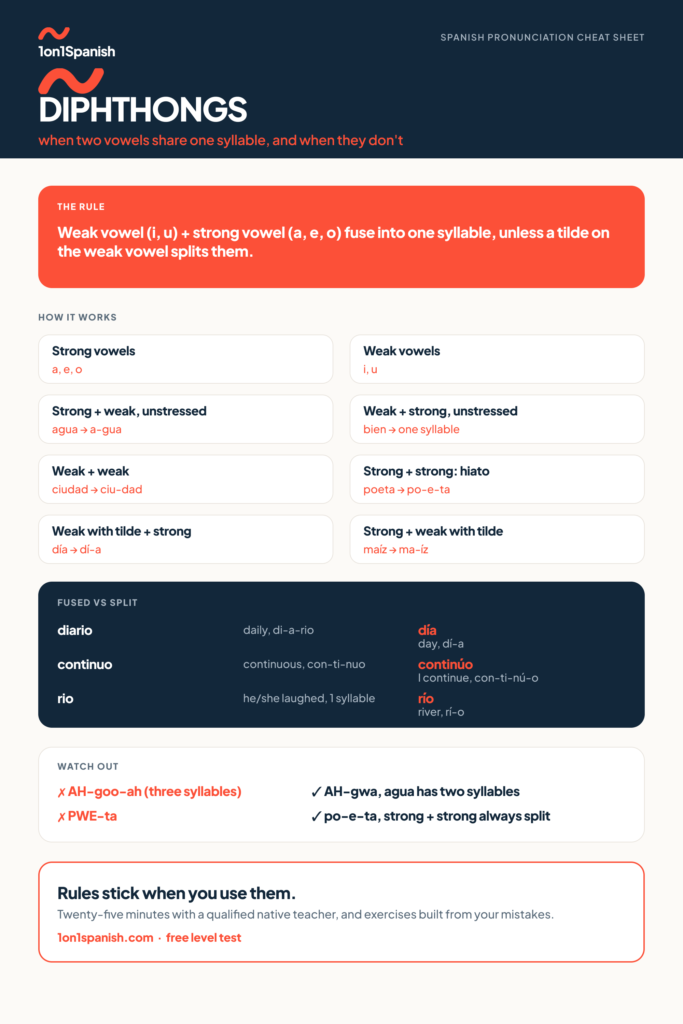
Take the chart with you
The chart is free to view and share. Drop your email and we’ll send the print-ready US Letter PDF — the version you stick on the fridge.
Practice
Practice Spanish pronunciation with a real teacher
Charts get you halfway. The other half is saying it out loud to someone who corrects you on the spot. At 1on1Spanish you get 25-minute private lessons with a qualified native teacher, exercises built from the mistakes you make in class, and AI practice between lessons.
First month $1. No contracts, cancel anytime.
When you are ready to speak it out loud, try online Spanish lessons with a native teacher.
Take your free level testBuilt on RingTeacher's method — 700,000+ classes delivered since 2017, teaching English to Spanish speakers. Now in the other direction.
Frequently asked questions
What is a diphthong in Spanish?
Two vowels pronounced together in a single syllable, formed when a weak vowel (i or u) combines with a strong one (a, e, o), or when two weak vowels combine with each other, and neither one is stressed. Bien, agua and ciudad each pack a vowel pair into one syllable instead of two.
How do you know if two vowels form a diphthong or a hiato?
Two strong vowels (a, e, o) next to each other always split into separate syllables — a hiato — with no exceptions. A weak vowel (i, u) next to a strong one, or two weak vowels together, fuse into one syllable — a diphthong — unless a written tilde on the weak vowel forces a split, as in día or río.
Why does día have two syllables but diario has one fewer split?
Because día carries a tilde on the í, which forces the i to break away from the a and take its own syllable and its own stress: dí-a. Diario has no tilde, so the i and the a stay fused into a single syllable, dia-rio, following the normal diphthong rule.
Does a diphthong ever change the meaning of a Spanish word?
Yes, in a small number of pairs where a tilde is the only difference. Rio (no tilde, one syllable) is a form of the verb reír, “he/she laughed.” Río (with a tilde, two syllables) means “river.” The tilde changes both the pronunciation and the meaning at once.
What are the weak and strong vowels in Spanish?
A, e and o are strong; i and u are weak. A diphthong needs at least one weak, unstressed vowel next to another vowel — weak plus strong, strong plus weak, or weak plus weak all count. Two strong vowels together never form a diphthong; they always split into separate syllables, a pattern called hiato, no matter which two strong vowels are involved.