
Spanish vowels: 5 pure sounds, no gliding
Spanish has exactly five vowel sounds — a, e, i, o, u — and every one of them stays exactly the same every time, in every word, stressed or not. English has roughly fifteen vowel sounds, and most of them glide: the tongue and lips move mid-sound, so “no” drifts toward “noh-oo” and “day” drifts toward “deh-ee”. Carry that habit into Spanish and no stops sounding like no — it sounds like an English speaker reading it.
Below is what each vowel actually does, why English vowels move and Spanish ones don’t, and the fix for both the gliding and the flattening of unstressed syllables that give away an American accent fastest. 1on1Spanish works on this in 25-minute one-on-one lessons with qualified native teachers, online across the United States.
Reviewed by María Jiménez — Licenciada en Filología Hispánica (BA in Hispanic Philology) · Updated Sep 2026
The sound you already have, held still
You already make every one of these five sounds in English — the difference is that English never lets them sit still. Say the following English words slowly and stop the sound the instant it starts to move, and you have the Spanish vowel:
- a → the ah in father, stopped before it moves
- e → the eh in bet, which English already keeps short and doesn’t glide much
- i → the ee in see, held level instead of trailing off
- o → close to the o in “more” said without the w at the end — English almost always adds that w glide to a long o, and Spanish never does
- u → the oo in food, held level
The exercise that works: say no in English, notice it becomes two sounds by the end (“noh-oo”), then say Spanish no and cut it off the instant the vowel starts. That’s the whole difference.
Why English vowels move and Spanish ones don’t
English is a language of diphthongized long vowels — most of what sound like single vowel sounds in English (“say”, “go”, “boot”) are actually two sounds glued together, gliding from one mouth position to another inside a single syllable. Spanish vowels are monophthongs: one mouth position, held, then released. Nothing shifts mid-sound. That’s also why Spanish spelling reads so predictably — a vowel letter always maps to the same static sound, never to a moving target. It’s the same reason a word from the Spanish alphabet can be read out loud correctly the first time you see it.
The five vowels, side by side
| Vowel | Sound | English anchor | Common English-speaker mistake |
|---|---|---|---|
| a | ah | father | Using the flat a of “cat” instead |
| e | eh | bet | Gliding it toward the ay of “day” |
| i | ee | see | Shortening it toward the ih of “bit” |
| o | oh, no glide | close to “more” without the w | Adding the English w glide: “noh-oo” |
| u | oo | food | Shortening it toward the uh of “put” |
Unstressed vowels keep their full sound
This is the second habit that marks an accent, and it’s less obvious than gliding. English collapses unstressed vowels into a mumble called a schwa — the a in “about” or the second a in “banana” barely register as vowels at all. Spanish never does this. Every vowel keeps its full, clear sound whether it’s stressed or not: banana in Spanish is ba-na-na, three identical, clean ah sounds, none of them reduced. Say an unstressed Spanish vowel the way you’d say an unstressed English one, and it disappears into a schwa that native listeners have to work to reconstruct.
Diphthongs and the hiato, briefly
Two vowels next to each other in Spanish either blend into one syllable or stay split into two, and the rule is which vowels are involved. A strong vowel (a, e, o) next to a weak one (i, u) blends into a single syllable called a diphthong: bien, cuatro, agua, deuda are each one syllable with two vowel letters. Two strong vowels never blend: caos, poeta stay two syllables.
When a word needs to keep a weak and a strong vowel apart on purpose, Spanish marks it with a written accent, called a hiato — día, país, María are each read as two full syllables because of that mark. The rules for exactly when that accent is required belong to Spanish stress patterns rather than to vowel quality, and get their own full treatment elsewhere.
Both topics have their own page: Spanish diphthongs for which vowel pairs blend and how to say them, and accent marks and stress for when the written accent is required.
Common mistakes English speakers make
✗ Gliding the vowel at the end of a word. No, sí, tú all become two-sound words in an American accent (“noh-oo”, “see-ee”) when they should stop dead. This is the single most audible marker of a foreign accent in Spanish, more than any consonant.
✗ Reducing unstressed vowels to schwa. Elefante said with English rhythm turns the first and last vowels into a mumble. Spanish wants all four vowels clear: e-le-fan-te.
✗ Lengthening vowels that should be short and clipped. English stretches stressed vowels (“noooo”). Spanish vowels are uniformly short, stressed or not — length isn’t part of how Spanish marks stress, pitch and clarity are.
✗ Importing English diphthongs where Spanish has none. The Spanish o in solo is one flat sound from start to finish. Adding the English w glide turns solo into something closer to “soh-woh” and marks the accent instantly.
✗ Avoiding words with several vowels in a row. Fui, veíamos, aéreo look intimidating on paper. Slowing down and hitting each vowel cleanly, without gliding between them, solves them.
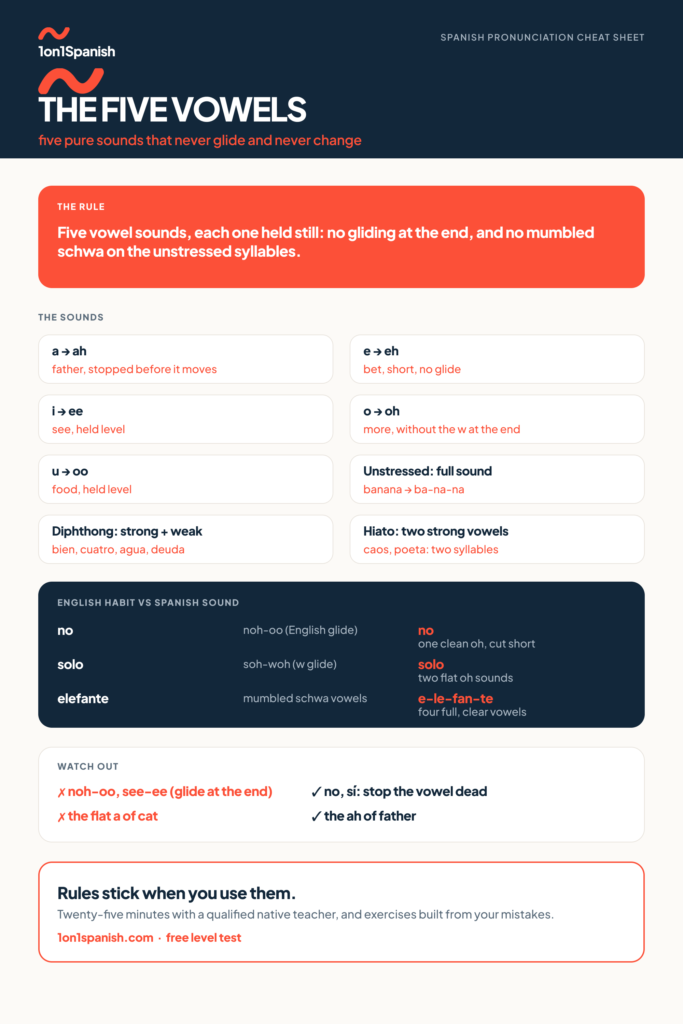
Take the chart with you
The chart is free to view and share. Drop your email and we’ll send the print-ready US Letter PDF — the version you stick on the fridge.
Practice
Practice Spanish vowels with a real teacher
Charts get you halfway. The other half is saying it out loud to someone who corrects you on the spot. At 1on1Spanish you get 25-minute private lessons with a qualified native teacher, exercises built from the mistakes you make in class, and AI practice between lessons.
First month $1. No contracts, cancel anytime.
Guides help. A teacher hears what a guide cannot — Learn Spanish online with a real teacher.
Take your free level testBuilt on RingTeacher's method — 700,000+ classes delivered since 2017, teaching English to Spanish speakers. Now in the other direction.
Frequently asked questions
How many vowel sounds does Spanish have?
Five: a, e, i, o, u, each with exactly one sound that never changes, whether the vowel is stressed or not. English, by contrast, has roughly fifteen distinct vowel sounds depending on the accent, and most of them glide from one mouth position to another inside a single syllable, which Spanish vowels never do.
Why do Spanish vowels sound different from English vowels, even the ones that look similar?
Because English vowels are usually diphthongized — two sounds glued together and pronounced as a glide, like the ay in “day” or the oh-oo in “go”. Spanish vowels are monophthongs: one steady mouth position held from start to finish. The letters look the same, but the motion behind them is different.
What is a diphthong in Spanish?
Two vowels in the same syllable, where a strong vowel (a, e, o) sits next to a weak one (i, u) and they blend together: bien, cuatro, agua. Two strong vowels never blend into one syllable — caos and poeta stay as two separate syllables each.
Do unstressed vowels change sound in Spanish?
No, and that’s one of the biggest differences from English. Spanish keeps every vowel’s full, clear sound whether it carries the stress or not — banana is three identical ah sounds. English collapses unstressed vowels into a mumble called a schwa, and carrying that habit into Spanish is one of the fastest ways to sound foreign, even in otherwise correct sentences.
Is the Spanish o the same as the English o?
Close, but not identical. The Spanish o is a single, flat sound held from start to finish. Most American English long o sounds, as in “go” or “no”, add a w glide at the end that Spanish never has. Cutting that glide off is one of the fastest single fixes for sounding more natural in Spanish.