
Ser conjugation in Spanish: every tense you need, with examples
Ser means “to be”, and it’s the most irregular verb in Spanish — soy, eres, es share almost nothing with the infinitive. You use it for identity, origin, profession, material and time, while estar handles states and locations. Every tense is below, followed by the rules that decide which “to be” you need. 1on1Spanish teaches this in 25-minute one-on-one lessons with qualified native teachers, online across the United States.
Reviewed by María Jiménez — Licenciada en Filología Hispánica (BA in Hispanic Philology) · Updated Aug 2026
What ser means
Ser is one of the two Spanish verbs that translate as “to be”. It answers what something is, not how it happens to be right now: Soy profesora (I’m a teacher), Es de Madrid (He’s from Madrid), La mesa es de madera (The table is wooden), Son las tres (It’s three o’clock).
It’s irregular in almost every tense you need, and it borrows its preterite from ir: fui means both “I was” and “I went”, and only context tells them apart. The participle is sido and the gerund is siendo.
Ser conjugation: present tense
| Form | Example | |
|---|---|---|
| yo | soy | Soy de Chicago. (I’m from Chicago.) |
| tú | eres | ¿Eres nueva aquí? (Are you new here?) |
| él / ella / usted | es | Mi jefe es colombiano. (My boss is Colombian.) |
| nosotros | somos | Somos cuatro en casa. (There are four of us at home.) |
| vosotros | sois | Sois muy amables. (You’re very kind.) |
| ellos / ellas / ustedes | son | Son las ocho y media. (It’s eight thirty.) |
Ser conjugation: preterite
Identical to the preterite of ir. Used for what something was during a closed period.
| Form | |
|---|---|
| yo | fui |
| tú | fuiste |
| él / ella / usted | fue |
| nosotros | fuimos |
| vosotros | fuisteis |
| ellos / ellas / ustedes | fueron |
Fue mi profesor durante dos años. — He was my teacher for two years.
Ser conjugation: imperfect
The one tense where ser behaves almost like a regular verb, and the one you’ll use to describe how things used to be.
| Form | |
|---|---|
| yo | era |
| tú | eras |
| él / ella / usted | era |
| nosotros | éramos |
| vosotros | erais |
| ellos / ellas / ustedes | eran |
Cuando era niño, mi abuela era la que cocinaba. — When I was a kid, my grandmother was the one who cooked.
Ser conjugation: future
Regular endings on the full infinitive.
| Form | |
|---|---|
| yo | seré |
| tú | serás |
| él / ella / usted | será |
| nosotros | seremos |
| vosotros | seréis |
| ellos / ellas / ustedes | serán |
Ser conjugation: conditional
| Form | |
|---|---|
| yo | sería |
| tú | serías |
| él / ella / usted | sería |
| nosotros | seríamos |
| vosotros | seríais |
| ellos / ellas / ustedes | serían |
Sería un placer. — It would be a pleasure.
Ser conjugation: present subjunctive
Shows up after que with wishes, doubts and opinions: Espero que sea fácil.
| Form | |
|---|---|
| yo | sea |
| tú | seas |
| él / ella / usted | sea |
| nosotros | seamos |
| vosotros | seáis |
| ellos / ellas / ustedes | sean |
Ser conjugation: imperfect subjunctive
Two sets of endings, both correct. The -ra forms are more common in speech across Latin America and Spain; the -se forms sound more formal or written.
| Form (-ra) | Form (-se) | |
|---|---|---|
| yo | fuera | fuese |
| tú | fueras | fueses |
| él / ella / usted | fuera | fuese |
| nosotros | fuéramos | fuésemos |
| vosotros | fuerais | fueseis |
| ellos / ellas / ustedes | fueran | fuesen |
Si fuera más barato, lo compraría. — If it were cheaper, I’d buy it.
Ser commands (imperative)
| Affirmative | Negative | |
|---|---|---|
| tú | sé | no seas |
| usted | sea | no sea |
| nosotros | seamos | no seamos |
| vosotros | sed | no seáis |
| ustedes | sean | no sean |
Sé puntual. — Be on time. Note the accent: sé (be) is not se (the pronoun).
Participle, gerund and compound tenses
Participle sido, gerund siendo. Compounds are built with haber:
He sido cliente suyo dos años (present perfect) · Había sido más fácil antes (past perfect) · Habré sido el último en enterarme (future perfect).
When to use ser
Identity and definition
Who or what somebody is: Es mi cuñado. Soy ingeniera. If the sentence answers “who is this” or “what is this”, it’s ser.
Origin, nationality and material
Somos de Texas. El anillo es de plata.
Time, dates and prices
Son las diez. Hoy es martes. Son veinte dólares.
The passive voice
La casa fue construida en 1970.
Events taking place
A party or a meeting “is” somewhere with ser, even though a place normally takes estar: La boda es en Miami, but El hotel está en Miami.
Ser vs estar
Same English word, different meaning in Spanish. The pairs below change meaning, not just register.
| With ser | With estar |
|---|---|
| Es aburrido — He’s a boring person | Está aburrido — He’s bored right now |
| Es listo — She’s smart | Está lista — She’s ready |
| La manzana es verde — It’s a green apple | La manzana está verde — The apple isn’t ripe |
| Es rico — He’s wealthy | Está rico — It tastes great |
The full rule, with the cases that trip people up, lives in ser vs estar.
Common mistakes English speakers make with ser
Age uses tener, not ser. English says “I am 45”, Spanish says “I have 45 years”. Same with hunger, cold and fear: tengo hambre, tengo frío, tengo miedo.
Profession is identity, so it takes ser. Estar would suggest you’re temporarily standing in as one.
Location of a person or object is always estar. The exception is an event: La reunión es en la oficina.
Ser doesn’t work with lateness. Being late is llegar tarde.
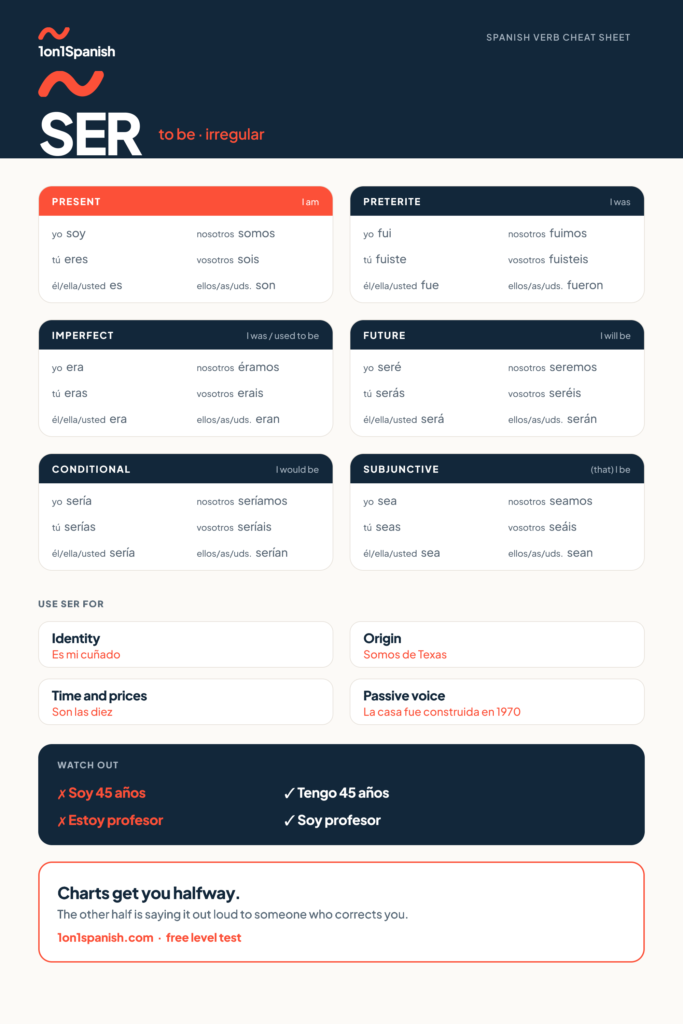
Take the chart with you
The chart is free to view and share. Drop your email and we’ll send the print-ready US Letter PDF — the version you stick on the fridge.
Practice
Practice ser and estar with a real teacher
Charts get you halfway. The other half is saying it out loud to someone who corrects you on the spot. At 1on1Spanish you get 25-minute private lessons with a qualified native teacher, exercises built from the mistakes you make in class, and AI practice between lessons.
First month $1. No contracts, cancel anytime.
When you are ready to speak it out loud, try online Spanish lessons with a native teacher.
Take your free level testBuilt on RingTeacher's method — 700,000+ classes delivered since 2017, teaching English to Spanish speakers. Now in the other direction.
Frequently asked questions
Is ser regular or irregular in Spanish?
Ser is irregular in every simple tense except the future and the conditional, where it takes regular endings on the infinitive. The present (soy, eres, es) and the preterite (fui, fuiste, fue) don’t resemble the infinitive at all, which is why they’re usually memorized as blocks rather than derived from a rule.
What’s the difference between ser and estar?
Ser describes what something is: identity, origin, profession, material, time. Estar describes how or where it is at a given moment: location, physical state, mood, and the result of a change. Es cansado means he’s a tiring person; está cansado means he’s tired today. Both translate as “to be” in English, which is why the distinction has to be learned rather than translated.
Why is the preterite of ser the same as the preterite of ir?
Both verbs share the forms fui, fuiste, fue, fuimos, fuisteis, fueron, an overlap inherited from Latin. Context resolves it without ambiguity in practice: Fui profesor is “I was a teacher”, Fui a Madrid is “I went to Madrid”. The preposition a is usually the giveaway.
How do you say your age with ser in Spanish?
You don’t. Age takes tener: Tengo treinta años, literally “I have thirty years”. Saying soy treinta años is one of the most recognizable English-speaker mistakes in Spanish. The same logic applies to tener hambre (to be hungry), tener sed (thirsty) and tener sueño (sleepy).
Do I need the subjunctive of ser in everyday conversation?
Yes, more than most learners expect. Sea appears in everyday phrases like espero que sea fácil, aunque sea tarde, lo que sea and o sea, which Spanish speakers use constantly as a filler meaning “I mean”. Learning sea and fuera early pays off quickly, because they show up in polite requests and conditional sentences.