
Spanish pronouns: the five sets and the order they go in
Spanish has five sets of personal pronouns — subject, direct object, indirect object, reflexive and prepositional — and when two of them land in the same sentence the indirect one goes first and turns into se in front of lo, la, los, las. English puts its pronouns after the verb and never reorders them, which is why se lo doy feels like three words in the wrong sequence at first. 1on1Spanish works through this in 25-minute one-on-one lessons with qualified native teachers, online across the United States.
Reviewed by María Jiménez — Licenciada en Filología Hispánica (BA in Hispanic Philology) · Updated Sep 2026
Subject pronouns, and why you rarely say them
Yo, tú, él, ella, usted, nosotros, vosotros, ellos, ellas, ustedes. Spanish verb endings already carry the person, so the subject pronoun is optional and usually left out: trabajo en Houston, not yo trabajo en Houston.
You put it back in for contrast (yo pago la cena, tú pagas el taxi) or for emphasis. Saying yo in every sentence is the single fastest way to sound like a beginner, because to a Spanish ear it reads as insisting.
Usted and ustedes are the formal you, and ustedes is the only plural you across Latin America and the United States. Vosotros is used in Spain.
Direct and indirect object pronouns
A direct object answers “what?” or “whom?”: veo el informe → lo veo. The forms are me, te, lo, la, nos, os, los, las.
An indirect object answers “to whom?” or “for whom?”: doy el informe a mi jefe → le doy el informe. The forms are me, te, le, nos, os, les. Only the third person differs from the direct set, which is why almost every mistake happens there.
Spanish routinely says the indirect pronoun and the noun in the same sentence: le di el dinero a mi hermana. That doubling is not redundant in Spanish; leaving out le sounds incomplete. That same doubling is the whole mechanism behind gustar and similar verbs: a mí me gusta el café puts the person in as an indirect object and makes the coffee the subject.
Both types go straight in front of a conjugated verb, and can either go before or attach to the end of an infinitive, a gerund or an affirmative command: lo quiero ver or quiero verlo; te estoy llamando or estoy llamándote; dímelo, never me lo di.
Each set has its own page with the full drill: direct object pronouns for lo, la, los, las, and indirect object pronouns for le and les — the pair that turns into se.
Reflexive and prepositional pronouns
The reflexive pronouns are me, te, se, nos, os, se, and they mark that the subject and the object are the same person: me levanto a las seis, se llama Marta, nos vemos el jueves. They follow the same placement rules as object pronouns.
Prepositional pronouns are the ones that come after a, de, para, por, con, sin: mí, ti, él, ella, usted, nosotros, vosotros, ellos, ustedes. Only the first two change shape, and con fuses with them: conmigo, contigo.
Three prepositions ignore the rule and take the subject forms instead: entre tú y yo, según tú, excepto yo.
Reference chart
| Person | Subject | Direct object | Indirect object | Reflexive | After a preposition |
|---|---|---|---|---|---|
| I | yo | me | me | me | mí |
| you (informal) | tú | te | te | te | ti |
| he / she / you (formal) | él, ella, usted | lo, la | le | se | él, ella, usted |
| we | nosotros, nosotras | nos | nos | nos | nosotros, nosotras |
| you all (Spain) | vosotros, vosotras | os | os | os | vosotros, vosotras |
| they / you all | ellos, ellas, ustedes | los, las | les | se | ellos, ellas, ustedes |
Order when two pronouns meet: indirect before direct, both in front of the verb, and le or les becomes se before lo, la, los, las.
The sentences where it changes
Swapping one pronoun for another rewrites the sentence rather than breaking it. These pairs are where the system shows itself.
| Sentence | What it means |
|---|---|
| Le doy el libro. | I give him or her the book. |
| Lo doy. | I give it. |
| Se lo doy. | I give it to him or her. |
| Se lo doy a ella. | I give it to her, spelled out. |
| Lo llamé. | I called him. |
| Le llamé. | I called him — standard in Spain, lo elsewhere. |
| Lavo el carro. | I wash the car. |
| Me lavo. | I wash myself. |
| Se lava el pelo. | She washes her hair. |
Se lo exists for one reason: le lo is unpronounceable in Spanish and was replaced centuries ago. And because se covers him, her, you and them at once, speakers add a él, a ella, a usted or a ellos whenever the context doesn’t make it obvious.
Common mistakes English speakers make
The rule is applied halfway: the two pronouns are in the right order but le hasn’t turned into se. It only happens in front of lo, la, los, las.
After a preposition the subject form is wrong, and mí carries an accent to separate it from the possessive mi. The same applies to ti, which never takes one.
Gustar takes an indirect object, so the person who likes something is never the subject. Emphasis is added with a mí, not with yo.
English word order puts the pronoun after the verb. In Spanish it goes in front of a conjugated verb and only attaches to an infinitive, a gerund or an affirmative command.
or No lo puedo hacer. With an infinitive you get one position or the other, not both. Doubling it is the sign of someone who has just learned the second option.
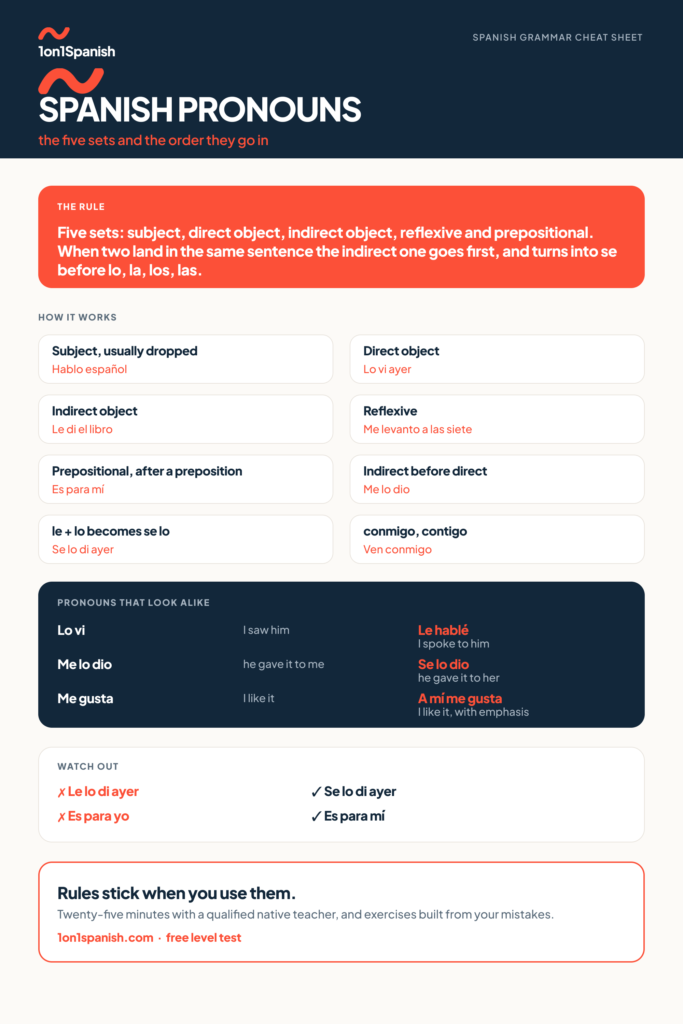
Take the chart with you
The chart is free to view and share. Drop your email and we’ll send the print-ready US Letter PDF — the version you stick on the fridge.
Practice
Practice Spanish pronouns with a real teacher
Charts get you halfway. The other half is saying it out loud to someone who corrects you on the spot. At 1on1Spanish you get 25-minute private lessons with a qualified native teacher, exercises built from the mistakes you make in class, and AI practice between lessons.
First month $1. No contracts, cancel anytime.
You can go further with someone listening: Learn Spanish with 1on1Spanish, 25 minutes at a time.
Take your free level testBuilt on RingTeacher's method — 700,000+ classes delivered since 2017, teaching English to Spanish speakers. Now in the other direction.
Frequently asked questions
What’s the difference between direct and indirect object pronouns in Spanish?
The direct object receives the action and answers “what?” or “whom?”: veo el carro becomes lo veo. The indirect object is who the action is aimed at and answers “to whom?”: escribo a mi jefe becomes le escribo. The two sets are identical except in the third person, where the direct forms are lo, la, los, las and the indirect are le, les.
Why does le lo become se lo in Spanish?
Because le lo is not pronounceable in Spanish and the language replaced it with se lo long ago. Whenever an indirect le or les sits in front of lo, la, los, las, it changes to se: le doy el libro plus lo gives se lo doy. Since se can mean to him, to her, to you or to them, speakers often add a ella or a usted to make it clear.
Where do pronouns go in a Spanish sentence?
In front of a conjugated verb: te llamo mañana. With an infinitive or a gerund you choose: lo quiero comprar or quiero comprarlo, both correct. With an affirmative command the pronoun attaches to the end and usually adds an accent: dímelo, levántate. With a negative command it goes back in front: no me lo digas.
Do you have to use yo, tú and él in Spanish?
No, and using them constantly sounds unnatural. The verb ending already tells you who’s speaking, so trabajo en Dallas is complete on its own. Add the subject pronoun when you need contrast, as in yo cocino, tú friegas, or when the verb form is ambiguous: in the imperfect, hablaba could be I, he, she or you formal.
Is leísmo wrong in Spanish?
No, it’s regional. Using le instead of lo for a male person (le vi rather than lo vi) is standard in much of Spain and accepted by the Real Academia Española for masculine people. Across Latin America and among Spanish speakers in the United States, lo is the norm. Either one is understood everywhere; pick the one your teacher uses and stay consistent.