
Aprender conjugation in Spanish: every tense you need, with examples
Aprender means “to learn”, and it’s a fully regular -er verb — every table below follows the pattern you already know from comer. The part that trips learners up isn’t the conjugation, it’s the meaning: aprender is the result, not the effort, and it needs a before an infinitive when you’re learning to do something. All nine tables are below, along with the line between aprender and estudiar. 1on1Spanish teaches this in 25-minute one-on-one lessons with qualified native teachers, online across the United States.
Reviewed by María Jiménez — Licenciada en Filología Hispánica (BA in Hispanic Philology) · Updated Sep 2026
What aprender means
Aprender is “to learn”: acquiring knowledge or a skill, regardless of how long it took or how hard you worked at it. Aprendí español en la universidad — I learned Spanish in college — states the outcome, not the process.
With a skill, it needs the preposition a before the infinitive: aprender a nadar, aprender a manejar, aprender a cocinar. English drops the equivalent word (“learn to swim” keeps “to”, but learners often skip Spanish’s a out of habit). With a subject or a fact, it takes the thing directly: aprender español, aprender la lección.
Grammatically it’s fully regular: standard -er endings throughout, no stem change, no spelling change. Participle aprendido, gerund aprendiendo.
Aprender conjugation: present tense
Fully regular. No irregular forms in this table.
| Form | Example | |
|---|---|---|
| yo | aprendo | Aprendo español con un profesor nativo. (I’m learning Spanish with a native teacher.) |
| tú | aprendes | ¿Aprendes rápido o necesitas repetir mucho? (Do you learn fast, or do you need a lot of repetition?) |
| él / ella / usted | aprende | Mi hijo aprende a leer este año. (My son is learning to read this year.) |
| nosotros | aprendemos | Aprendemos de nuestros errores. (We learn from our mistakes.) |
| vosotros | aprendéis | ¿Aprendéis mejor con clases en vivo? (Do you learn better with live classes?) |
| ellos / ellas / ustedes | aprenden | Mis compañeros aprenden francés y español a la vez. (My coworkers are learning French and Spanish at the same time.) |
Aprender conjugation: preterite
Regular -er endings, no spelling change.
| Form | |
|---|---|
| yo | aprendí |
| tú | aprendiste |
| él / ella / usted | aprendió |
| nosotros | aprendimos |
| vosotros | aprendisteis |
| ellos / ellas / ustedes | aprendieron |
Aprendí a manejar cuando tenía dieciséis años. — I learned to drive when I was sixteen.
Aprender conjugation: imperfect
Fully regular.
| Form | |
|---|---|
| yo | aprendía |
| tú | aprendías |
| él / ella / usted | aprendía |
| nosotros | aprendíamos |
| vosotros | aprendíais |
| ellos / ellas / ustedes | aprendían |
De niños, aprendíamos inglés y español en la misma escuela. — As kids, we learned English and Spanish at the same school.
Aprender conjugation: future
Regular endings on the infinitive.
| Form | |
|---|---|
| yo | aprenderé |
| tú | aprenderás |
| él / ella / usted | aprenderá |
| nosotros | aprenderemos |
| vosotros | aprenderéis |
| ellos / ellas / ustedes | aprenderán |
Aprenderé a cocinar mejor este año. — I’ll learn to cook better this year.
Aprender conjugation: conditional
| Form | |
|---|---|
| yo | aprendería |
| tú | aprenderías |
| él / ella / usted | aprendería |
| nosotros | aprenderíamos |
| vosotros | aprenderíais |
| ellos / ellas / ustedes | aprenderían |
Yo aprendería más rápido con clases privadas. — I’d learn faster with private classes.
Aprender conjugation: present subjunctive
Built on the aprendo stem, fully regular.
| Form | |
|---|---|
| yo | aprenda |
| tú | aprendas |
| él / ella / usted | aprenda |
| nosotros | aprendamos |
| vosotros | aprendáis |
| ellos / ellas / ustedes | aprendan |
Espero que los niños aprendan a nadar este verano. — I hope the kids learn to swim this summer.
Aprender conjugation: imperfect subjunctive
Built on the preterite stem aprendieron-, both forms interchangeable.
| Form (-ra) | Form (-se) | |
|---|---|---|
| yo | aprendiera | aprendiese |
| tú | aprendieras | aprendieses |
| él / ella / usted | aprendiera | aprendiese |
| nosotros | aprendiéramos | aprendiésemos |
| vosotros | aprendierais | aprendieseis |
| ellos / ellas / ustedes | aprendieran | aprendiesen |
Si aprendiera francés también, podría trabajar en Canadá. — If I also learned French, I could work in Canada.
Aprender commands (imperative)
| Affirmative | Negative | |
|---|---|---|
| tú | aprende | no aprendas |
| usted | aprenda | no aprenda |
| nosotros | aprendamos | no aprendamos |
| vosotros | aprended | no aprendáis |
| ustedes | aprendan | no aprendan |
Aprende de tus errores y sigue adelante. — Learn from your mistakes and keep going. Common advice from a parent, a coach or a mentor.
Participle, gerund and compound tenses
Participle aprendido, gerund aprendiendo. Both regular. Compounds take haber:
He aprendido mucho este año (present perfect) · Ya había aprendido a manejar antes de mudarme (past perfect) · Para diciembre habré aprendido cien palabras nuevas (future perfect).
When to use aprender
Learning a subject or language
Estoy aprendiendo español con un profesor nativo. Progressive tense with estar plus the gerund, extremely common in daily conversation about ongoing study.
Learning from experience, figuratively
Aprendimos mucho de ese error en el trabajo. No classroom involved — this is the “lesson learned” sense, just as common in Spanish as in English.
Learning from a person
Aprendí mucho de mi abuela sobre cocina. Marks the source of the knowledge with de, not con.
Aprender vs estudiar
They sit on the same timeline but describe different things, and both can appear in the same sentence without contradicting each other.
| Aprender | Estudiar |
|---|---|
| The result — what you actually retain | The activity — the time and effort you put in |
| Aprendí muy poco ese semestre | Estudié toda la noche |
| Can happen without formal study at all | Can happen without any learning happening |
Estudié toda la noche pero no aprendí nada is a perfectly natural sentence: the effort happened, the result didn’t. That gap is exactly why the two verbs aren’t interchangeable.
Common mistakes English speakers make with aprender
Aprender needs a before an infinitive. English “learned to swim” keeps its “to”, but the parallel Spanish word gets dropped constantly.
After estar, the verb needs the gerund, not the infinitive — aprendiendo, not aprender.
After espero que, the verb goes into the subjunctive: aprendas, not aprendes.
The present perfect needs the participle aprendido after haber, never the plain infinitive.
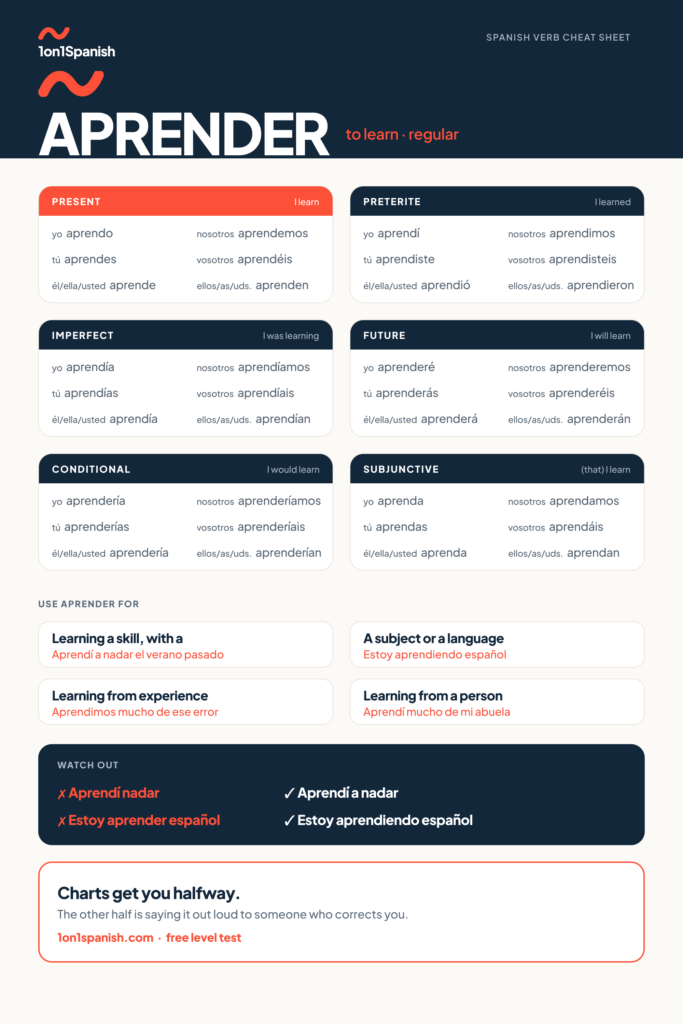
Take the chart with you
The chart is free to view and share. Drop your email and we’ll send the print-ready US Letter PDF — the version you stick on the fridge.
Practice
Practice aprender with a real teacher
Charts get you halfway. The other half is saying it out loud to someone who corrects you on the spot. At 1on1Spanish you get 25-minute private lessons with a qualified native teacher, exercises built from the mistakes you make in class, and AI practice between lessons.
First month $1. No contracts, cancel anytime.
You can go further with someone listening: Learn Spanish with 1on1Spanish, 25 minutes at a time.
Take your free level testBuilt on RingTeacher's method — 700,000+ classes delivered since 2017, teaching English to Spanish speakers. Now in the other direction.
Frequently asked questions
Is aprender regular or irregular in Spanish?
Fully regular. Aprender follows the standard -er pattern in every tense — present, preterite, imperfect, future, conditional and both subjunctives — with no stem change and no spelling change. The one thing to watch isn’t the conjugation, it’s the required a before an infinitive.
What’s the difference between aprender and estudiar?
Aprender is the result — what actually sticks. Estudiar is the effort — the time you spend with the material. You can say estudié toda la noche pero no aprendí nada (I studied all night but learned nothing), which shows clearly that studying doesn’t guarantee learning.
How do you say “learn to do something” in Spanish?
Aprender a plus an infinitive: aprender a nadar, aprender a manejar, aprender a cocinar. The a is required and can’t be dropped, even though it has no direct equivalent word in the English phrase “learn to swim”. Native speakers notice its absence immediately, the same way an English speaker notices a missing “to” — it’s a small word that carries real grammatical weight.
What is the past tense of aprender in Spanish?
Two forms depending on the shape of the action. The preterite — aprendí, aprendiste, aprendió, aprendimos, aprendisteis, aprendieron — marks a completed achievement: aprendí a nadar ese verano. The imperfect — aprendía, aprendías, aprendía, aprendíamos, aprendíais, aprendían — describes an ongoing or repeated process: aprendíamos inglés en la escuela.
Do I need the subjunctive of aprender in everyday conversation?
Yes, mostly with hopes and wishes about someone else’s progress. Aprenda appears after espero que (espero que aprendas rápido), after quiero que (quiero que los niños aprendan a nadar), and after ojalá (ojalá que aprendamos algo nuevo). It’s common in conversations about kids, students and new employees.