
Comenzar conjugation in Spanish: every tense you need, with examples
Comenzar means “to start” or “to begin”, and it carries two changes at once. The stem vowel e becomes ie under stress (comienzo, comienzas, comienza), and the z becomes a c before an e in the spelling (comencé, comience). Neither is optional, and together they explain almost every mistake made with this verb. All nine tables are below, along with the line between comenzar and empezar, which learners ask about constantly. 1on1Spanish teaches this in 25-minute one-on-one lessons with qualified native teachers, online across the United States.
Reviewed by María Jiménez — Licenciada en Filología Hispánica (BA in Hispanic Philology) · Updated Sep 2026
What comenzar means
Comenzar is “to start” or “to begin”, the more formal cousin of empezar. It shows up in announcements, ceremonies and written Spanish: La ceremonia comienza a las doce. El curso comienza en enero.
To start doing something, it takes the preposition a plus an infinitive: comencé a trabajar aquí en 2020, ha comenzado a nevar. Dropping the a is the most common slip, because English “started working” has no equivalent gap.
It also pairs with por to mark where something begins in a sequence: Comencemos por el presupuesto.
Technically it’s a stem-changing verb (e→ie) with a spelling change (z→c before e). The participle comenzado and the gerund comenzando are both regular.
Comenzar conjugation: present tense
Stem change in every form except nosotros and vosotros.
| Form | Example | |
|---|---|---|
| yo | comienzo | Comienzo mi turno a las siete. (I start my shift at seven.) |
| tú | comienzas | ¿A qué hora comienzas la dieta? (What time do you start the diet?) |
| él / ella / usted | comienza | La junta comienza puntual. (The meeting starts on time.) |
| nosotros | comenzamos | Comenzamos el trámite mañana. (We’re starting the paperwork tomorrow.) |
| vosotros | comenzáis | ¿Cuándo comenzáis las vacaciones? (When do you start vacation?) |
| ellos / ellas / ustedes | comienzan | Las clases comienzan en agosto. (Classes start in August.) |
Comenzar conjugation: preterite
No stem change here — but the first person needs a c, because z can’t sit before e in Spanish spelling.
| Form | |
|---|---|
| yo | comencé |
| tú | comenzaste |
| él / ella / usted | comenzó |
| nosotros | comenzamos |
| vosotros | comenzasteis |
| ellos / ellas / ustedes | comenzaron |
Comencé el tratamiento la semana pasada. — I started the treatment last week.
Comenzamos is identical in the present and the preterite, the same pattern as hablamos or pedimos.
Comenzar conjugation: imperfect
Fully regular, no change of any kind.
| Form | |
|---|---|
| yo | comenzaba |
| tú | comenzabas |
| él / ella / usted | comenzaba |
| nosotros | comenzábamos |
| vosotros | comenzabais |
| ellos / ellas / ustedes | comenzaban |
La reunión siempre comenzaba tarde. — The meeting always started late.
Comenzar conjugation: future
Regular endings on the infinitive.
| Form | |
|---|---|
| yo | comenzaré |
| tú | comenzarás |
| él / ella / usted | comenzará |
| nosotros | comenzaremos |
| vosotros | comenzaréis |
| ellos / ellas / ustedes | comenzarán |
El proyecto comenzará en octubre. — The project will start in October.
Comenzar conjugation: conditional
| Form | |
|---|---|
| yo | comenzaría |
| tú | comenzarías |
| él / ella / usted | comenzaría |
| nosotros | comenzaríamos |
| vosotros | comenzaríais |
| ellos / ellas / ustedes | comenzarían |
Yo comenzaría por lo más urgente. — I’d start with the most urgent thing.
Comenzar conjugation: present subjunctive
Both changes appear at once: the stem change where the vowel is stressed, and the c in every form, because every ending starts with e.
| Form | |
|---|---|
| yo | comience |
| tú | comiences |
| él / ella / usted | comience |
| nosotros | comencemos |
| vosotros | comencéis |
| ellos / ellas / ustedes | comiencen |
Espero que la obra comience a tiempo. — I hope the construction starts on time.
Comenzar conjugation: imperfect subjunctive
Built on the preterite stem, so it’s regular throughout: no stem change, no c.
| Form (-ra) | Form (-se) | |
|---|---|---|
| yo | comenzara | comenzase |
| tú | comenzaras | comenzases |
| él / ella / usted | comenzara | comenzase |
| nosotros | comenzáramos | comenzásemos |
| vosotros | comenzarais | comenzaseis |
| ellos / ellas / ustedes | comenzaran | comenzasen |
Nos pidieron que comenzáramos sin el jefe. — They asked us to start without the boss.
Comenzar commands (imperative)
Every negative form takes the c, because those endings begin with e.
| Affirmative | Negative | |
|---|---|---|
| tú | comienza | no comiences |
| usted | comience | no comience |
| nosotros | comencemos | no comencemos |
| vosotros | comenzad | no comencéis |
| ustedes | comiencen | no comiencen |
Comencemos la junta. — Let’s start the meeting. This is also how a manager opens things in Spanish, more often than the plain present tense.
Participle, gerund and compound tenses
Participle comenzado, gerund comenzando. Both regular. Compounds use haber:
He comenzado el curso de manejo (present perfect) · Ya había comenzado a llover (past perfect) · Para el viernes habré comenzado el nuevo puesto (future perfect).
When to use comenzar
Formal or scheduled starts
Ceremonies, announcements, official programs: La ceremonia comienza a las doce. El semestre comienza el 15 de enero. This is where comenzar is more natural than the everyday empezar.
Starting to do something
Comenzar a + infinitive: Comencé a ahorrar para la casa el año pasado. The a is required and can’t be skipped.
Starting from a point in a sequence
Comenzar por: Comencemos por revisar el contrato. Common in meetings, presentations and instructions.
Starting a stage of life or a project
Comenzó su carrera en Bogotá. Comenzamos un negocio juntos. This use leans slightly more formal than empezar, which is why résumés and cover letters favor it.
Comenzar vs empezar
The two verbs mean the same thing and conjugate the same way — both are e→ie with the z→c spelling change. The difference is register, not meaning, and it’s the question most learners actually have.
| Comenzar | Empezar |
|---|---|
| La ceremonia comienza a las doce — The ceremony begins at twelve | La peli empieza ya — The movie’s starting |
| Slightly formal: announcements, writing, official programs | Everyday speech, any context |
| Comenzó su carrera en Bogotá | Empecé a trabajar allí en 2019 |
Both take a before an infinitive, and both are correct everywhere. If you only learn one, learn empezar: it fits casual conversation and doesn’t sound stiff, while comenzar can feel a little formal at a dinner table.
Common mistakes English speakers make with comenzar
Comenzar always needs a before an infinitive. English “started studying” has nothing between the verbs, so learners drop the a.
Spanish doesn’t write ze. The z becomes c in comencé and throughout the subjunctive.
After espero que the verb goes into the subjunctive, and this verb’s subjunctive carries both changes at once.
The stem only changes when it’s stressed, and in comenzamos the stress falls on the ending, not the stem.
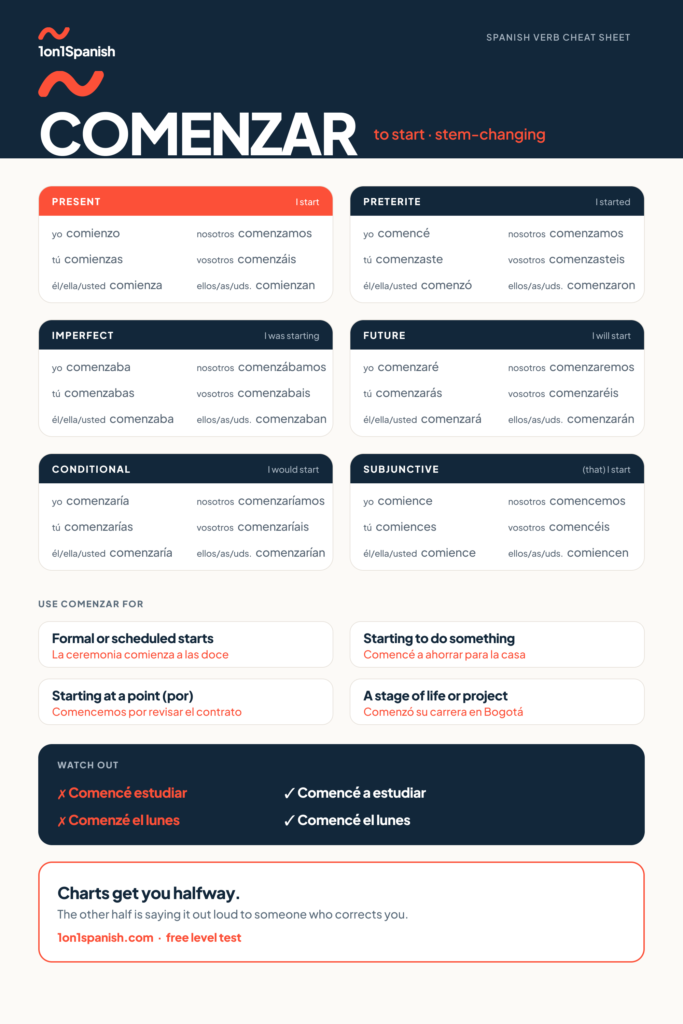
Take the chart with you
The chart is free to view and share. Drop your email and we’ll send the print-ready US Letter PDF — the version you stick on the fridge.
Practice
Practice comenzar with a real teacher
Charts get you halfway. The other half is saying it out loud to someone who corrects you on the spot. At 1on1Spanish you get 25-minute private lessons with a qualified native teacher, exercises built from the mistakes you make in class, and AI practice between lessons.
First month $1. No contracts, cancel anytime.
The fastest way to make this stick is to say it to someone. Learn Spanish online with a real teacher.
Take your free level testBuilt on RingTeacher's method — 700,000+ classes delivered since 2017, teaching English to Spanish speakers. Now in the other direction.
Frequently asked questions
Is comenzar regular or irregular in Spanish?
Comenzar is a stem-changing verb with a spelling change, not a fully irregular one. The e of the stem becomes ie when stressed: comienzo, comienzas, comienza, comienzan, but comenzamos and comenzáis keep the e. Separately, the z is written c before an e, which produces comencé in the preterite and comience, comencemos in the subjunctive.
Why is it “comencé” and not “comenzé”?
Spanish spelling doesn’t allow z before e or i in native words, so the letter is written c, which represents the same sound. The rule affects the first-person preterite comencé and the whole present subjunctive: comience, comiences, comencemos, comiencen. Every -zar verb does the same thing, including empezar, almorzar and cruzar.
What’s the difference between comenzar and empezar?
None in meaning — both mean “to begin” and both conjugate the same way, as e→ie verbs with the z→c spelling change. The difference is tone: comenzar sounds slightly more formal and shows up in ceremonies, announcements and written Spanish, while empezar is the everyday choice and fits any register. El curso comienza and el curso empieza are both correct.
How do you say “start doing something” in Spanish?
Use comenzar a plus an infinitive: comencé a correr, ha comenzado a llover, voy a comenzar a ahorrar. The preposition a is required and can’t be dropped. To start with a particular item in a list rather than an action, use comenzar por: comencemos por lo más difícil.
Do I need the subjunctive of comenzar in everyday conversation?
Yes, mainly with wishes and time expressions. Comience appears after espero que (espero que comience a tiempo), after antes de que (antes de que comience la reunión), and after cuando pointing at the future (cuando comience el nuevo año). None of this is advanced Spanish — it’s what comes out of a manager’s mouth in a normal staff meeting.