
Ayudar conjugation in Spanish: every tense you need, with examples
Ayudar means “to help”, and it’s completely regular in every tense — no stem change, no spelling change, no irregular participle or gerund. The part that actually trips learners up is the preposition: ayudar a plus an infinitive, and the personal a before a person, both of which English has no equivalent for. Every tense is below, along with the two small words that make or break a sentence with this verb. 1on1Spanish teaches this in 25-minute one-on-one lessons with qualified native teachers, online across the United States.
Reviewed by María Jiménez — Licenciada en Filología Hispánica (BA in Hispanic Philology) · Updated Sep 2026
What ayudar means
Ayudar is “to help”, in the most direct sense: te ayudo con la mudanza, mi hermano me ayudó mucho ese año. It works with people, tasks, or causes: ayudar a un vecino, ayudar con el proyecto, ayudar a la comunidad.
Two structures carry most of its use. Ayudar a plus an infinitive means to help someone do something: ayúdame a cargar las cajas. Ayudar con plus a noun means to help with a task: ¿me ayudas con la tarea? The two don’t mix — a pairs with a verb, con pairs with a noun.
There’s also the fixed customer-service phrase ¿en qué puedo ayudarle? — “how can I help you” — which is how conversations start at a bank, a clinic or a government office almost anywhere in the Spanish-speaking world.
Grammatically it’s fully regular, a standard -ar verb throughout, with participle ayudado and gerund ayudando.
Ayudar conjugation: present tense
| Form | Example | |
|---|---|---|
| yo | ayudo | Ayudo a mi mamá los fines de semana. (I help my mom on weekends.) |
| tú | ayudas | ¿Me ayudas a mover este sofá? (Can you help me move this couch?) |
| él / ella / usted | ayuda | Mi vecino nos ayuda con el jardín. (My neighbor helps us with the yard.) |
| nosotros | ayudamos | Ayudamos a los nuevos empleados a instalarse. (We help new employees get settled.) |
| vosotros | ayudáis | ¿Ayudáis con la organización del evento? (Are you helping organize the event?) |
| ellos / ellas / ustedes | ayudan | Los voluntarios ayudan tres veces por semana. (The volunteers help three times a week.) |
Ayudar conjugation: preterite
| Form | |
|---|---|
| yo | ayudé |
| tú | ayudaste |
| él / ella / usted | ayudó |
| nosotros | ayudamos |
| vosotros | ayudasteis |
| ellos / ellas / ustedes | ayudaron |
Mi hermano me ayudó a pagar la renta ese mes. — My brother helped me pay rent that month.
Ayudar conjugation: imperfect
| Form | |
|---|---|
| yo | ayudaba |
| tú | ayudabas |
| él / ella / usted | ayudaba |
| nosotros | ayudábamos |
| vosotros | ayudabais |
| ellos / ellas / ustedes | ayudaban |
De niños, siempre nos ayudábamos con la tarea. — As kids, we always used to help each other with homework.
Ayudar conjugation: future
| Form | |
|---|---|
| yo | ayudaré |
| tú | ayudarás |
| él / ella / usted | ayudará |
| nosotros | ayudaremos |
| vosotros | ayudaréis |
| ellos / ellas / ustedes | ayudarán |
Te ayudaré con el trámite mañana mismo. — I’ll help you with the paperwork first thing tomorrow.
Ayudar conjugation: conditional
| Form | |
|---|---|
| yo | ayudaría |
| tú | ayudarías |
| él / ella / usted | ayudaría |
| nosotros | ayudaríamos |
| vosotros | ayudaríais |
| ellos / ellas / ustedes | ayudarían |
Yo te ayudaría con gusto si tuviera tiempo. — I’d gladly help you if I had time.
Ayudar conjugation: present subjunctive
| Form | |
|---|---|
| yo | ayude |
| tú | ayudes |
| él / ella / usted | ayude |
| nosotros | ayudemos |
| vosotros | ayudéis |
| ellos / ellas / ustedes | ayuden |
Espero que ayudes a tu hermana con la mudanza. — I hope you help your sister with the move.
Ayudar conjugation: imperfect subjunctive
| Form (-ra) | Form (-se) | |
|---|---|---|
| yo | ayudara | ayudase |
| tú | ayudaras | ayudases |
| él / ella / usted | ayudara | ayudase |
| nosotros | ayudáramos | ayudásemos |
| vosotros | ayudarais | ayudaseis |
| ellos / ellas / ustedes | ayudaran | ayudasen |
Le pedí que me ayudara con el formulario. — I asked him to help me with the form.
Ayudar commands (imperative)
| Affirmative | Negative | |
|---|---|---|
| tú | ayuda | no ayudes |
| usted | ayude | no ayude |
| nosotros | ayudemos | no ayudemos |
| vosotros | ayudad | no ayudéis |
| ustedes | ayuden | no ayuden |
Ayúdame a bajar estas cajas, por favor. — Help me bring these boxes down, please.
Participle, gerund and compound tenses
Participle ayudado, gerund ayudando. Both regular. Compounds take haber:
Me han ayudado mucho en este trabajo (present perfect) · Ya nos había ayudado antes con el mismo trámite (past perfect) · Para el viernes te habré ayudado a terminar todo (future perfect).
When to use ayudar
Helping someone do something
Ayúdame a llenar este formulario. This is where ayudar a plus an infinitive comes in — the a is required, even though English “help me fill out” has no equivalent word there.
Helping with a task or a situation
¿Me ayudas con la tarea? Here ayudar con takes a noun, not a verb — the structure changes with what follows.
Helping a specific person
Ayudo a mi hermano con el negocio. Because the direct object is a specific person, this needs the personal a — the same a every transitive verb takes before a person.
Offering help, formally
¿En qué puedo ayudarle? The standard opening line in customer service, at a bank counter or a government office — one of the first fully useful sentences a beginner can memorize.
Common mistakes English speakers make with ayudar
Ayudar a plus an infinitive always needs the a. English “help me do this” has nothing between the two verbs, so the a is easy to drop.
When the person you’re helping is a specific individual, Spanish requires the personal a before them.
Con pairs with a noun (con la tarea), a pairs with a verb (a hacer la tarea). Mixing the two — con hacer — doesn’t work in standard Spanish.
After espero que, the verb needs the subjunctive: ayudes, not ayuda.
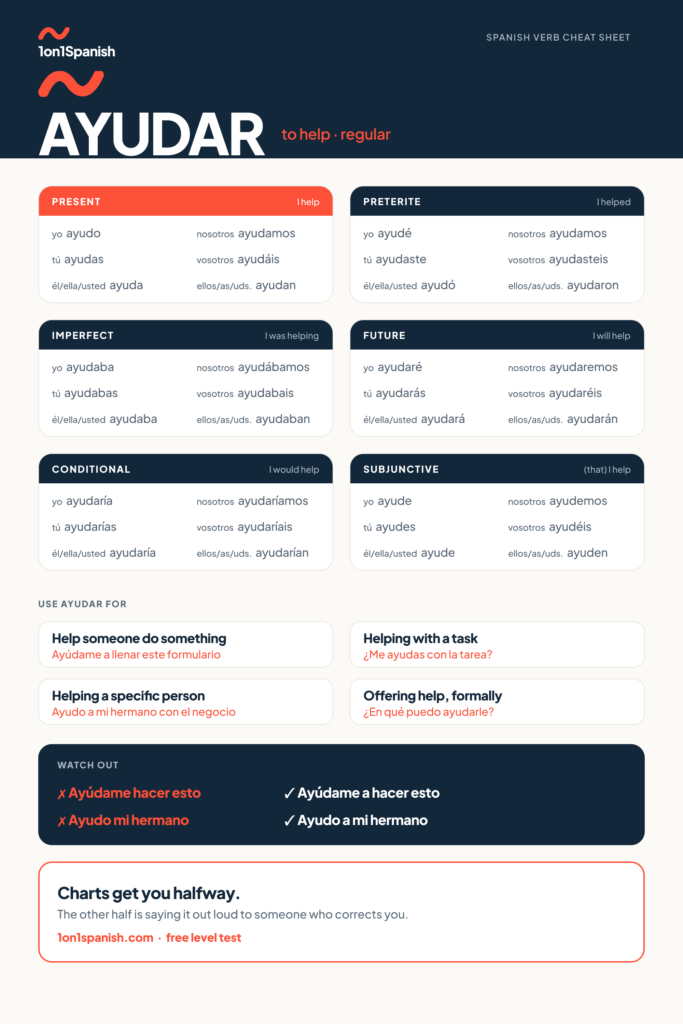
Take the chart with you
The chart is free to view and share. Drop your email and we’ll send the print-ready US Letter PDF — the version you stick on the fridge.
Practice
Practice ayudar with a real teacher
Charts get you halfway. The other half is saying it out loud to someone who corrects you on the spot. At 1on1Spanish you get 25-minute private lessons with a qualified native teacher, exercises built from the mistakes you make in class, and AI practice between lessons.
First month $1. No contracts, cancel anytime.
Prefer to practice with a person? Take one-on-one Spanish lessons online with a qualified native teacher.
Take your free level testBuilt on RingTeacher's method — 700,000+ classes delivered since 2017, teaching English to Spanish speakers. Now in the other direction.
Frequently asked questions
Is ayudar regular or irregular in Spanish?
Completely regular — a standard -ar verb with no stem change, no spelling change, and a regular participle (ayudado) and gerund (ayudando) in every tense. The challenge with this verb isn’t the forms; it’s the small words around it, especially the preposition a.
Do you need “a” after ayudar?
Yes, in two different situations. Before an infinitive, ayudar a is required: ayúdame a terminar. Before a specific person as the direct object, the personal a is also required: ayudo a mi hermano. If what follows is a noun that isn’t a person, use con instead: ayudar con la tarea.
How do you say “help me with something” in Spanish?
Ayúdame con plus the noun: ayúdame con las maletas, ayúdame con este correo. If it’s an action rather than a thing, switch to a plus the infinitive: ayúdame a escribir el correo. The two patterns don’t combine — pick one based on whether what follows is a noun or a verb.
What is the past tense of ayudar in Spanish?
Two forms. The preterite — ayudé, ayudaste, ayudó, ayudamos, ayudasteis, ayudaron — marks a specific act of help: me ayudó con la mudanza el sábado. The imperfect — ayudaba, ayudabas, ayudaba, ayudábamos, ayudabais, ayudaban — marks a habit or an ongoing arrangement: nos ayudábamos todas las semanas.
Do I need the subjunctive of ayudar in everyday conversation?
Yes, mainly after hopes and requests. Ayude appears after espero que (espero que me ayudes con esto) and after quiero que (quiero que ayudes a tu hermana). It’s a fully regular subjunctive, so it follows the exact same pattern as any other -ar verb.