
Buscar conjugation in Spanish: every tense you need, with examples
Buscar means “to look for” or “to search”, and it’s regular in meaning but not quite regular on paper: the c becomes qu any time an ending starts with e, which shows up in the preterite yo form and across the whole subjunctive. The bigger trap isn’t spelling, though — it’s that buscar never takes a preposition before what you’re looking for, unlike English “look for”. All nine tables are below, with every spelling change marked. 1on1Spanish teaches this in 25-minute one-on-one lessons with qualified native teachers, online across the United States.
Reviewed by María Jiménez — Licenciada en Filología Hispánica (BA in Hispanic Philology) · Updated Sep 2026
What buscar means
Buscar is “to look for” or “to search for”: busco trabajo, busco mis llaves, busco un apartamento cerca del trabajo. It also covers looking something up — buscar una palabra en el diccionario, buscar información en internet — and, in everyday American Spanish, picking someone up: voy a buscar a mi hijo a la escuela.
The one rule that matters most: buscar takes its object directly, with no preposition in between. Busco trabajo, never busco por trabajo. English “look for” needs “for”; Spanish buscar already carries that meaning inside the verb.
Grammatically it’s regular with a spelling change (c→qu before e). The change appears in the preterite yo form and the entire present subjunctive, because Spanish spelling never allows a c before an e or i to keep the hard “k” sound of the infinitive. Participle buscado, gerund buscando.
Buscar conjugation: present tense
Fully regular, no spelling change — the endings here start with o, a or nothing, so the c stays a c.
| Form | Example | |
|---|---|---|
| yo | busco | Busco trabajo desde enero. (I’ve been looking for a job since January.) |
| tú | buscas | ¿Buscas algo en especial? (Are you looking for something in particular?) |
| él / ella / usted | busca | Mi mamá busca su celular todos los días. (My mom looks for her phone every day.) |
| nosotros | buscamos | Buscamos un apartamento cerca del metro. (We’re looking for an apartment near the subway.) |
| vosotros | buscáis | ¿Buscáis casa en la misma zona? (Are you looking for a house in the same area?) |
| ellos / ellas / ustedes | buscan | Mis vecinos buscan un plomero de confianza. (My neighbors are looking for a reliable plumber.) |
Buscar conjugation: preterite
The yo form needs the spelling change, because the ending starts with e. Every other form is regular.
| Form | |
|---|---|
| yo | busqué |
| tú | buscaste |
| él / ella / usted | buscó |
| nosotros | buscamos |
| vosotros | buscasteis |
| ellos / ellas / ustedes | buscaron |
Busqué mis llaves por toda la casa esta mañana. — I looked for my keys all over the house this morning.
Buscar conjugation: imperfect
Fully regular, no spelling change.
| Form | |
|---|---|
| yo | buscaba |
| tú | buscabas |
| él / ella / usted | buscaba |
| nosotros | buscábamos |
| vosotros | buscabais |
| ellos / ellas / ustedes | buscaban |
De niña, siempre buscaba aventuras en el patio. — As a kid, I was always looking for adventure in the yard.
Buscar conjugation: future
Regular endings on the infinitive.
| Form | |
|---|---|
| yo | buscaré |
| tú | buscarás |
| él / ella / usted | buscará |
| nosotros | buscaremos |
| vosotros | buscaréis |
| ellos / ellas / ustedes | buscarán |
Buscaré otro trabajo si no me suben el sueldo. — I’ll look for another job if they don’t give me a raise.
Buscar conjugation: conditional
| Form | |
|---|---|
| yo | buscaría |
| tú | buscarías |
| él / ella / usted | buscaría |
| nosotros | buscaríamos |
| vosotros | buscaríais |
| ellos / ellas / ustedes | buscarían |
Yo buscaría otras opciones antes de decidir. — I’d look for other options before deciding.
Buscar conjugation: present subjunctive
Every form takes the spelling change, because every subjunctive ending for an -ar verb starts with e.
| Form | |
|---|---|
| yo | busque |
| tú | busques |
| él / ella / usted | busque |
| nosotros | busquemos |
| vosotros | busquéis |
| ellos / ellas / ustedes | busquen |
Necesito que busques el contrato antes de la junta. — I need you to look for the contract before the meeting.
Buscar conjugation: imperfect subjunctive
Built on the preterite stem buscaron-. No spelling change here — the endings start with a.
| Form (-ra) | Form (-se) | |
|---|---|---|
| yo | buscara | buscase |
| tú | buscaras | buscases |
| él / ella / usted | buscara | buscase |
| nosotros | buscáramos | buscásemos |
| vosotros | buscarais | buscaseis |
| ellos / ellas / ustedes | buscaran | buscasen |
Si buscara con más calma, lo encontraría. — If I looked more calmly, I’d find it.
Buscar commands (imperative)
Every negative form and the usted, nosotros and ustedes affirmatives take the spelling change, because they’re built on the subjunctive.
| Affirmative | Negative | |
|---|---|---|
| tú | busca | no busques |
| usted | busque | no busque |
| nosotros | busquemos | no busquemos |
| vosotros | buscad | no busquéis |
| ustedes | busquen | no busquen |
Busca bien antes de comprar, no te apures. — Look carefully before you buy, don’t rush.
Participle, gerund and compound tenses
Participle buscado, gerund buscando. Both regular, no spelling change. Compounds take haber:
He buscado ese documento por todas partes (present perfect) · Ya había buscado trabajo antes de mudarnos (past perfect) · Para el viernes habré buscado tres apartamentos (future perfect).
When to use buscar
Looking for something specific
Busco un apartamento cerca del trabajo. The direct object comes right after the verb, with no preposition.
Looking something up
Voy a buscar esa palabra en el diccionario. Just as common for online searches: lo busqué en internet.
Picking someone up
Voy a buscar a los niños a la escuela a las tres. Everyday use across Mexico and much of Latin America; note the personal a before los niños, required because it’s a specific person, not the same a English speakers mistakenly add for “for”.
Job or opportunity searching
Está buscando trabajo desde enero. The most common context for this verb outside the house.
Common mistakes English speakers make with buscar
This is the central mistake with this verb. Buscar already means “to look for” — adding por is a direct calque from English and sounds foreign to a native ear.
Spanish never writes ce with a hard “k” sound. The c becomes qu in the yo preterite: busqué, not buscé.
The present subjunctive of buscar keeps the same spelling change: busque, not busca.
When the object is a specific person, buscar takes the personal a — never por. A marks a person; por is never correct after this verb.
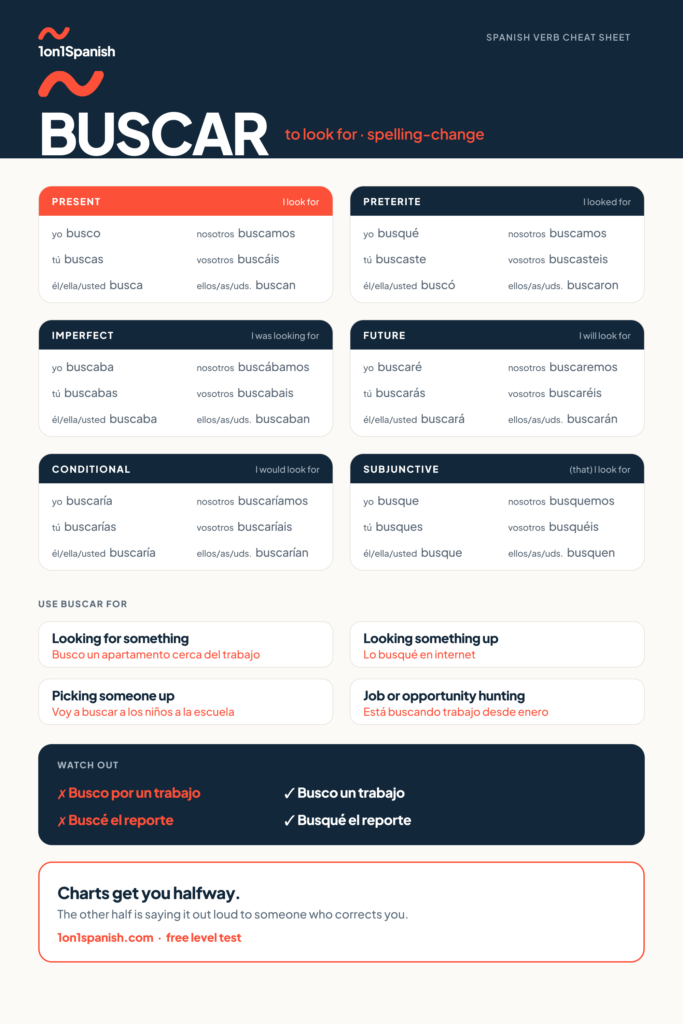
Take the chart with you
The chart is free to view and share. Drop your email and we’ll send the print-ready US Letter PDF — the version you stick on the fridge.
Practice
Practice buscar with a real teacher
Charts get you halfway. The other half is saying it out loud to someone who corrects you on the spot. At 1on1Spanish you get 25-minute private lessons with a qualified native teacher, exercises built from the mistakes you make in class, and AI practice between lessons.
First month $1. No contracts, cancel anytime.
Everything on this page is free to use. If you want feedback on your own Spanish, learn Spanish online with us.
Take your free level testBuilt on RingTeacher's method — 700,000+ classes delivered since 2017, teaching English to Spanish speakers. Now in the other direction.
Frequently asked questions
Is buscar regular or irregular in Spanish?
Regular in meaning, with one spelling change: the c becomes qu whenever the ending starts with e, to keep the hard “k” sound of the infinitive. That affects the preterite yo form (busqué) and the entire present subjunctive (busque, busques, busquemos, busquéis, busquen). Every other tense follows the standard -ar pattern with no changes at all.
Why is it “busqué” and not “buscé”?
Spanish spelling doesn’t allow c before e or i to represent the hard “k” sound — that combination would be read as an “s” sound instead. So the spelling switches to qu, which keeps the pronunciation the same as the infinitive. Every verb ending in -car does this: tocar becomes toqué, sacar becomes saqué, practicar becomes practiqué.
Do you need “for” after buscar in Spanish?
No, and this is the single most common mistake English speakers make with this verb. Buscar already carries the meaning of “for” inside it, so busco trabajo is correct and busco por trabajo is not. The only preposition that ever follows buscar is the personal a, and only when the direct object is a specific person: busco a mi hijo.
What is the past tense of buscar in Spanish?
Two forms depending on the shape of the action. The preterite — busqué, buscaste, buscó, buscamos, buscasteis, buscaron — is for a single completed search: busqué mis llaves toda la mañana. The imperfect — buscaba, buscabas, buscaba, buscábamos, buscabais, buscaban — is for a repeated or ongoing search: siempre buscaba aventuras de niña.
Do I need the subjunctive of buscar in everyday conversation?
Yes, often after expressions of need or when the thing you’re looking for isn’t specific yet. Busque appears after necesito que (necesito que busques el contrato), and in phrases like busco a alguien que hable inglés — using the subjunctive because that person, if they exist, isn’t identified yet. It’s a common, natural construction, not an advanced one.