
Cerrar conjugation in Spanish: every tense you need, with examples
Cerrar means “to close” or “to shut”, and it’s a textbook stem-changing verb: the e becomes ie wherever it’s stressed, so cierro replaces the e the infinitive predicts. Nosotros and vosotros never change, in any tense — the stress there falls on the ending, not the stem. Every tense is below, along with how this verb sounds in a business context, not just at the front door. 1on1Spanish teaches this in 25-minute one-on-one lessons with qualified native teachers, online across the United States.
Reviewed by María Jiménez — Licenciada en Filología Hispánica (BA in Hispanic Philology) · Updated Sep 2026
What cerrar means
Cerrar is “to close” or “to shut”, for doors, windows, stores and businesses: cierra la puerta, por favor, la tienda cierra a las nueve. It’s also how Spanish talks about closing a deal or an agreement, a very normal use in adult, professional conversation: cerramos el contrato la semana pasada.
Figuratively, it covers closing out a stage of life: cerrar un capítulo, cerrar una etapa — both common in conversations about a breakup, a job change or a move.
Grammatically it’s a stem-changing verb (e→ie), in the same family as pensar, empezar and perder. The change only appears where the stem carries the stress — nosotros and vosotros keep the plain e in every tense. Participle cerrado and gerund cerrando are both regular.
Cerrar conjugation: present tense
Stem change in every form except nosotros and vosotros.
| Form | Example | |
|---|---|---|
| yo | cierro | Cierro la tienda a las ocho. (I close the store at eight.) |
| tú | cierras | ¿Cierras tú la oficina hoy? (Are you closing the office today?) |
| él / ella / usted | cierra | El banco cierra temprano los viernes. (The bank closes early on Fridays.) |
| nosotros | cerramos | Cerramos el trato la semana pasada. (We closed the deal last week.) |
| vosotros | cerráis | ¿Cerráis la tienda los domingos? (Do you close the store on Sundays?) |
| ellos / ellas / ustedes | cierran | Las oficinas cierran a las cinco. (The offices close at five.) |
Cerrar conjugation: preterite
Regular endings, no stem change — the preterite of -ar stem-changing verbs never changes.
| Form | |
|---|---|
| yo | cerré |
| tú | cerraste |
| él / ella / usted | cerró |
| nosotros | cerramos |
| vosotros | cerrasteis |
| ellos / ellas / ustedes | cerraron |
Cerramos el negocio antes de lo que esperábamos. — We closed the business earlier than we expected.
Cerrar conjugation: imperfect
Fully regular.
| Form | |
|---|---|
| yo | cerraba |
| tú | cerrabas |
| él / ella / usted | cerraba |
| nosotros | cerrábamos |
| vosotros | cerrabais |
| ellos / ellas / ustedes | cerraban |
La farmacia siempre cerraba a las nueve. — The pharmacy always used to close at nine.
Cerrar conjugation: future
Regular endings on the infinitive.
| Form | |
|---|---|
| yo | cerraré |
| tú | cerrarás |
| él / ella / usted | cerrará |
| nosotros | cerraremos |
| vosotros | cerraréis |
| ellos / ellas / ustedes | cerrarán |
Cerraremos el trato en cuanto firmen los papeles. — We’ll close the deal as soon as they sign the papers.
Cerrar conjugation: conditional
| Form | |
|---|---|
| yo | cerraría |
| tú | cerrarías |
| él / ella / usted | cerraría |
| nosotros | cerraríamos |
| vosotros | cerraríais |
| ellos / ellas / ustedes | cerrarían |
Yo cerraría la cuenta antes de que cobren más comisiones. — I’d close the account before they charge more fees.
Cerrar conjugation: present subjunctive
Stem change in the stressed forms, same pattern as the indicative.
| Form | |
|---|---|
| yo | cierre |
| tú | cierres |
| él / ella / usted | cierre |
| nosotros | cerremos |
| vosotros | cerréis |
| ellos / ellas / ustedes | cierren |
Espero que cierren el trato esta semana. — I hope they close the deal this week.
Cerrar conjugation: imperfect subjunctive
Built on the regular preterite stem, no stem change.
| Form (-ra) | Form (-se) | |
|---|---|---|
| yo | cerrara | cerrase |
| tú | cerraras | cerrases |
| él / ella / usted | cerrara | cerrase |
| nosotros | cerráramos | cerrásemos |
| vosotros | cerrarais | cerraseis |
| ellos / ellas / ustedes | cerraran | cerrasen |
Si cerraran el trato hoy, empezaríamos mañana. — If they closed the deal today, we’d start tomorrow.
Cerrar commands (imperative)
| Affirmative | Negative | |
|---|---|---|
| tú | cierra | no cierres |
| usted | cierre | no cierre |
| nosotros | cerremos | no cerremos |
| vosotros | cerrad | no cerréis |
| ustedes | cierren | no cierren |
Cierra la puerta, hace frío. — Close the door, it’s cold.
Participle, gerund and compound tenses
Participle cerrado, gerund cerrando. Both regular. Compounds take haber:
Han cerrado tres sucursales este año (present perfect) · Ya había cerrado la tienda cuando llegamos (past perfect) · Para el viernes habremos cerrado el contrato (future perfect).
When to use cerrar
Closing something physical
Cierra la ventana, por favor. The literal, everyday use — doors, windows, containers.
Business hours
La tienda cierra a las nueve entre semana. One of the first practical sentences a learner needs, useful for checking a store or a clinic’s schedule.
Closing a deal or agreement
Cerramos el contrato el mes pasado. Common in workplace and business Spanish, and a good example of how far this verb reaches beyond doors.
Closing a stage of life, figuratively
Quiero cerrar ese capítulo y seguir adelante. Natural in conversations about a breakup, a job change or moving on from something difficult.
Common mistakes English speakers make with cerrar
The third-person present needs the stem change: cierra, not cerra.
Nosotros never changes, in any tense — this is the classic overcorrection once learners notice the change elsewhere.
After espero que, the verb needs the subjunctive, not the indicative.
Informal negative commands always use the subjunctive form, never the plain present indicative.
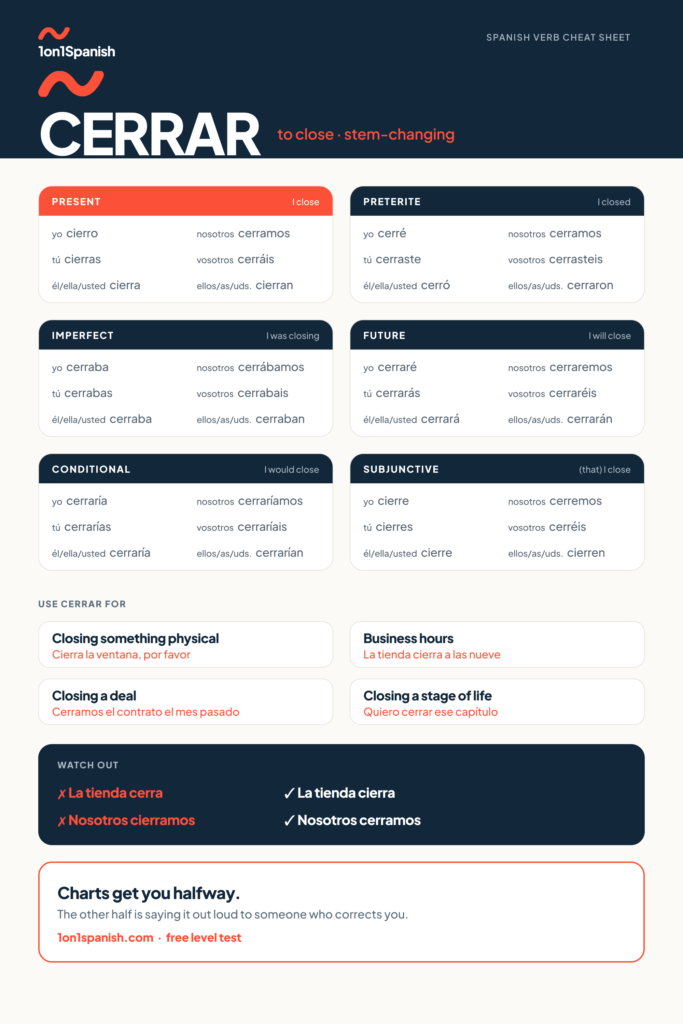
Take the chart with you
The chart is free to view and share. Drop your email and we’ll send the print-ready US Letter PDF — the version you stick on the fridge.
Practice
Practice cerrar with a real teacher
Charts get you halfway. The other half is saying it out loud to someone who corrects you on the spot. At 1on1Spanish you get 25-minute private lessons with a qualified native teacher, exercises built from the mistakes you make in class, and AI practice between lessons.
First month $1. No contracts, cancel anytime.
You can go further with someone listening: Learn Spanish with 1on1Spanish, 25 minutes at a time.
Take your free level testBuilt on RingTeacher's method — 700,000+ classes delivered since 2017, teaching English to Spanish speakers. Now in the other direction.
Frequently asked questions
Is cerrar regular or irregular in Spanish?
Irregular in one specific way: it’s a stem-changing verb, e→ie, in the same family as pensar and empezar. The e becomes ie wherever it’s stressed — present cierro, cierras, cierra, cierran, and the matching subjunctive forms. The preterite, imperfect, future, conditional and participle are all completely regular, with no trace of the change.
Why do “cerramos” and “cerráis” not change but “cierro” does?
Because the stem change in verbs like cerrar only happens when the stress falls on the stem itself. In cerramos and cerráis, the stress falls on the ending (-mos, -áis), so the e stays a plain e. In cierro, cierras and cierra, the stress lands directly on the stem vowel, which is what triggers the change to ie.
How do you say “close the deal” in Spanish?
Cerrar el trato or cerrar el contrato, depending on context. Both are standard in business Spanish: cerramos el trato la semana pasada, espero que cierren el contrato pronto. The same verb used for closing a door works perfectly well for closing a business agreement.
What is the past tense of cerrar in Spanish?
Two forms, and neither one carries a stem change. The preterite — cerré, cerraste, cerró, cerramos, cerrasteis, cerraron — marks a specific closing: cerré la tienda a las nueve. The imperfect — cerraba, cerrabas, cerraba, cerrábamos, cerrabais, cerraban — marks a habitual or repeated one: la farmacia siempre cerraba temprano.
Do I need the subjunctive of cerrar in everyday conversation?
Yes, mainly with wishes and negative commands. Cierre appears after espero que (espero que cierren el trato), and every informal negative command uses the subjunctive: no cierres la puerta. It’s one of the most practical everyday uses of the Spanish subjunctive.