
Spanish imperative: how to give commands in Spanish
Spanish builds every command from the present subjunctive except the affirmative tú and vosotros forms, which have shapes of their own. English has one command form for everybody — “call me” works for your boss, your kid and a room full of people — so the hard part in Spanish is not the endings, it’s choosing who you are talking to before you open your mouth. 1on1Spanish teaches this in 25-minute one-on-one lessons with qualified native teachers, online across the United States.
Reviewed by María Jiménez — Licenciada en Filología Hispánica (BA in Hispanic Philology) · Updated Sep 2026
The forms that come from the subjunctive
Four of the six command forms are simply the present subjunctive, and all negative commands are. Take the yo form of the present, drop the -o, and add the opposite vowel: -ar verbs take -e, -er and -ir verbs take -a. If you already have the present subjunctive forms down, most of the command system comes free.
Hablar gives hable (usted), hablemos (nosotros), hablen (ustedes). Comer gives coma, comamos, coman. Because they start from the yo form, stem changes and irregular stems come along for free: tener → tengo → tenga, tengamos, tengan.
Negative commands use the same set plus the tú and vosotros subjunctive forms: no hables, no habléis, no comas, no comáis. There is no such thing as a negative command that skips the subjunctive.
The affirmative tú form, and its eight irregulars
The affirmative tú command is the third-person singular of the present indicative, with nothing added: habla, come, escribe, cierra, vuelve. It looks like él habla and means “speak”.
Eight verbs break the pattern, and they are the eight you use every day:
Venir → ven. Decir → di. Salir → sal. Hacer → haz. Tener → ten. Ir → ve. Poner → pon. Ser → sé.
All eight are one syllable, which makes them quick to drill. Ve does double duty: it is the command of ir (“go”) and also the command of ver (“look”). Context sorts it out every time. Hacer is the one you’ll reach for first — haz la reserva, haz clic — and hacer in every tense shows how far that irregular stem travels.
The affirmative vosotros command is the easiest form in the language: take the infinitive, swap the final -r for a -d. Hablar → hablad. Comer → comed. Ir → id. No exceptions. It is used in Spain and not in Latin America, where ustedes covers every plural you.
Where the pronouns go
Object and reflexive pronouns attach to the end of an affirmative command and sit in front of a negative one: dímelo but no me lo digas, siéntate but no te sientes. The reflexive set — siéntate, levántate, vístete — follows the same rule, and the Spanish reflexive pronouns page has the six forms.
When you attach a pronoun, the stress does not move, so a written accent usually appears: di → dímelo, habla → háblame, pon → póntelo. One-syllable commands with a single pronoun need no accent: dame, dilo, ponlo.
Two small collisions to know. The -s of nosotros drops before nos: sentemos + nos = sentémonos, not sentemosnos. The -d of vosotros drops before os: sentad + os = sentaos. The single exception is irse, which keeps the d: idos.
Reference chart
| Person | Affirmative | Negative | Comes from |
|---|---|---|---|
| tú | habla · come · escribe | no hables · no comas · no escribas | 3rd person present / subjunctive |
| usted | hable · coma · escriba | no hable · no coma · no escriba | subjunctive |
| nosotros | hablemos · comamos · escribamos | no hablemos · no comamos | subjunctive |
| vosotros | hablad · comed · escribid | no habléis · no comáis | infinitive − r + d / subjunctive |
| ustedes | hablen · coman · escriban | no hablen · no coman | subjunctive |
| Irregular affirmative tú | Verb | Example |
|---|---|---|
| ven | venir | Ven a mi oficina. |
| di | decir | Di la verdad. |
| sal | salir | Sal de ahí. |
| haz | hacer | Haz la reserva. |
| ten | tener | Ten paciencia. |
| ve | ir | Ve al banco. |
| pon | poner | Pon el dinero aquí. |
| sé | ser | Sé puntual. |
The pairs that trip people up
Affirmative and negative are not the same word with no in front. Comparing them side by side is the fastest way to fix the habit.
| Affirmative | Negative |
|---|---|
| Firma el contrato. — Sign the contract. | No firmes el contrato. — Don’t sign the contract. |
| Dímelo ahora. — Tell me now. | No me lo digas ahora. — Don’t tell me now. |
| Siéntate. — Sit down. | No te sientes. — Don’t sit down. |
| Ve al médico. — Go to the doctor. | No vayas al médico. — Don’t go to the doctor. |
| Sé sincero conmigo. — Be straight with me. | No seas tan duro contigo mismo. — Don’t be so hard on yourself. |
One more distinction: vamos is the affirmative nosotros command for ir (“let’s go”), but the negative goes back to the subjunctive, no vayamos.
Common mistakes English speakers make
English adds “don’t” to the same verb form, so the affirmative tú command gets reused for the negative. In Spanish the negative always switches to the subjunctive.
English keeps the pronoun after the verb as a separate word (“tell me”), and learners split the difference. In an affirmative command the pronoun is glued on, accent included.
The pronoun jumps in front as soon as the command turns negative. Nothing else in Spanish moves pronouns around this much.
Grammatically correct, socially wrong. With a client, a doctor or anyone you haven’t been introduced to, usted is the default across the United States and Latin America.
Hacer is one of the eight irregulars, and the regular form hace means “he does”. The command sounds like you’re reporting on someone else.
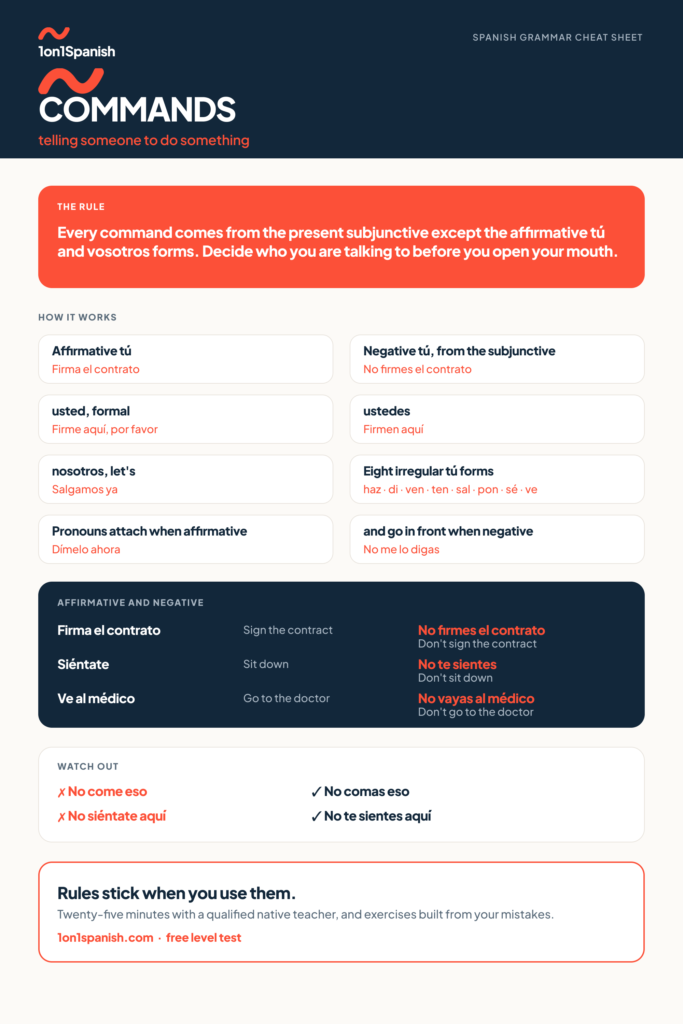
Take the chart with you
The chart is free to view and share. Drop your email and we’ll send the print-ready US Letter PDF — the version you stick on the fridge.
Practice
Practice Spanish commands with a real teacher
Charts get you halfway. The other half is saying it out loud to someone who corrects you on the spot. At 1on1Spanish you get 25-minute private lessons with a qualified native teacher, exercises built from the mistakes you make in class, and AI practice between lessons.
First month $1. No contracts, cancel anytime.
When you are ready to speak it out loud, try online Spanish lessons with a native teacher.
Take your free level testBuilt on RingTeacher's method — 700,000+ classes delivered since 2017, teaching English to Spanish speakers. Now in the other direction.
Frequently asked questions
How do you form commands in Spanish?
Start from the present subjunctive: that covers usted, nosotros, ustedes and every negative command. Two forms are different. The affirmative tú command is the third-person present indicative, habla, come, escribe. The affirmative vosotros command replaces the final -r of the infinitive with -d, hablad, comed. Everything else is subjunctive.
What are the irregular tú commands in Spanish?
There are eight: ven (venir), di (decir), sal (salir), haz (hacer), ten (tener), ve (ir), pon (poner) and sé (ser). All of them are affirmative only. The negative versions are regular subjunctive forms: no vengas, no digas, no salgas. Learning the eight covers almost every irregular command you’ll need in conversation.
Where do pronouns go with Spanish commands?
They attach to the end of an affirmative command and go before a negative one. Dámelo versus no me lo des. Levántate versus no te levantes. When you attach a pronoun to a command of two or more syllables, add a written accent to keep the original stress: habla becomes háblame, pon becomes póntelo.
Is the vosotros command used in Latin America?
No. Vosotros and its command form hablad are used in Spain. Across Latin America and among Spanish speakers in the United States, ustedes is the only plural you, so the plural command is hablen, coman, escriban. Learning vosotros is worth it for reading and for travel to Spain, not for daily use in the Americas.
Do Spanish speakers soften commands the way English does?
Yes, constantly. A bare command is normal between family and colleagues, but with strangers Spanish adds por favor, uses usted, or replaces the command with a question: ¿Me pasas la sal? or ¿Podría firmar aquí? The imperative is not rude on its own, and dropping the usted form with someone you’ve just met is what actually sounds abrupt.