
Empezar conjugation in Spanish: every tense you need, with examples
Empezar means “to start” or “to begin”, and it carries two changes at once. The stem vowel e becomes ie under stress (empiezo, empiezas, empieza), and the z becomes a c before an e in the spelling (empecé, empiece). Neither is optional, and together they account for almost every mistake made with this verb. All nine tables are below. 1on1Spanish teaches this in 25-minute one-on-one lessons with qualified native teachers, online across the United States.
Reviewed by María Jiménez — Licenciada en Filología Hispánica (BA in Hispanic Philology) · Updated Aug 2026
What empezar means
Empezar is the everyday verb for starting: a class, a movie, a job, a diet, an argument. La película empieza a las ocho. Empiezo el lunes.
To start doing something, it needs the preposition a plus an infinitive: empecé a trabajar aquí en 2019, ha empezado a llover. Leaving out the a is the most audible error with this verb, because Spanish has no bare “start doing” construction.
It also takes por to mark where you begin in a sequence: Empecemos por el principio.
Technically it’s a stem-changing verb (e→ie) with a spelling change (z→c before e). The participle empezado and the gerund empezando are both regular, which surprises people who expect trouble everywhere.
Empezar conjugation: present tense
Stem change in all forms except nosotros and vosotros.
| Form | Example | |
|---|---|---|
| yo | empiezo | Empiezo a las nueve. (I start at nine.) |
| tú | empiezas | ¿Cuándo empiezas el trabajo nuevo? (When do you start the new job?) |
| él / ella / usted | empieza | La reunión empieza tarde. (The meeting starts late.) |
| nosotros | empezamos | Empezamos las obras en marzo. (We’re starting the work in March.) |
| vosotros | empezáis | ¿A qué hora empezáis mañana? (What time do you start tomorrow?) |
| ellos / ellas / ustedes | empiezan | Las clases empiezan en septiembre. (Classes start in September.) |
Empezar conjugation: preterite
No stem change here — but the first person needs a c, because z can’t sit before e in Spanish spelling.
| Form | |
|---|---|
| yo | empecé |
| tú | empezaste |
| él / ella / usted | empezó |
| nosotros | empezamos |
| vosotros | empezasteis |
| ellos / ellas / ustedes | empezaron |
Empecé a correr el año pasado. — I started running last year.
Empezamos is the same in the present and the preterite, exactly as in hablamos or pedimos.
Empezar conjugation: imperfect
Fully regular, no change of any kind.
| Form | |
|---|---|
| yo | empezaba |
| tú | empezabas |
| él / ella / usted | empezaba |
| nosotros | empezábamos |
| vosotros | empezabais |
| ellos / ellas / ustedes | empezaban |
Las clases empezaban siempre con una canción. — Classes always started with a song. Whether you need empezaba or empezó is decided in preterite vs imperfect.
Empezar conjugation: future
Regular endings on the infinitive.
| Form | |
|---|---|
| yo | empezaré |
| tú | empezarás |
| él / ella / usted | empezará |
| nosotros | empezaremos |
| vosotros | empezaréis |
| ellos / ellas / ustedes | empezarán |
Empezar conjugation: conditional
| Form | |
|---|---|
| yo | empezaría |
| tú | empezarías |
| él / ella / usted | empezaría |
| nosotros | empezaríamos |
| vosotros | empezaríais |
| ellos / ellas / ustedes | empezarían |
Yo empezaría por el tejado. — I’d start with the roof.
Empezar conjugation: present subjunctive
Both changes appear at once here: the stem change where the vowel is stressed, and the c in every form, because every ending starts with e.
| Form | |
|---|---|
| yo | empiece |
| tú | empieces |
| él / ella / usted | empiece |
| nosotros | empecemos |
| vosotros | empecéis |
| ellos / ellas / ustedes | empiecen |
Antes de que empiece la reunión, revisa el orden del día. — Before the meeting starts, check the agenda.
Empezar conjugation: imperfect subjunctive
Built on the preterite stem, so it’s regular throughout: no stem change, no c.
| Form (-ra) | Form (-se) | |
|---|---|---|
| yo | empezara | empezase |
| tú | empezaras | empezases |
| él / ella / usted | empezara | empezase |
| nosotros | empezáramos | empezásemos |
| vosotros | empezarais | empezaseis |
| ellos / ellas / ustedes | empezaran | empezasen |
Me dijeron que empezara sin ellos. — They told me to start without them.
Empezar commands (imperative)
| Affirmative | Negative | |
|---|---|---|
| tú | empieza | no empieces |
| usted | empiece | no empiece |
| nosotros | empecemos | no empecemos |
| vosotros | empezad | no empecéis |
| ustedes | empiecen | no empiecen |
Empieza tú. — You go first. Every negative form takes the c, because the endings begin with e.
Participle, gerund and compound tenses
Participle empezado, gerund empezando. Both regular. Compounds are built with haber:
He empezado un curso de cocina (present perfect) · Había empezado a llover (past perfect) · Para el lunes ya habré empezado (future perfect).
Ha empezado a + infinitive is one of the most useful patterns in the verb: ha empezado a hacer frío, ha empezado a doler.
When to use empezar
Scheduled starts
Anything with a clock or a calendar: El partido empieza a las siete, El curso empieza en enero. This is the most frequent use by far.
Starting to do something
Empezar a + infinitive: Empecé a estudiar español después de un viaje a México. The a is obligatory.
Starting from a point
Empezar por: Empecemos por lo importante. Useful in meetings and when someone is telling a story out of order.
Starting over
Empezar de cero is the fixed phrase for starting from scratch, used about careers, cities and relationships. Se mudó a Miami y empezó de cero.
Empezar vs comenzar
The two verbs mean the same thing and conjugate the same way — comenzar is also e→ie with z→c (comienzo, comencé, comience). The difference is register, not meaning.
| Empezar | Comenzar |
|---|---|
| La peli empieza ya — The movie’s starting | La ceremonia comienza a las doce — The ceremony begins at twelve |
| Everyday speech, any context | Slightly formal: announcements, writing, ceremonies |
| Empecé a trabajar allí en 2019 | Comenzó su carrera en Bogotá |
Both take a before an infinitive. If you learn one, use empezar: it fits everywhere, while comenzar can sound stiff in casual conversation.
Common mistakes English speakers make with empezar
Empezar always needs a before an infinitive. English “started studying” has nothing between the verbs, so the a gets dropped.
Spanish doesn’t write ze. The z becomes c in empecé and in every subjunctive form.
After espero que the verb goes into the subjunctive, and the subjunctive of this verb carries both changes at once.
The stem only changes when it’s stressed, and in empezamos the stress falls on the ending.
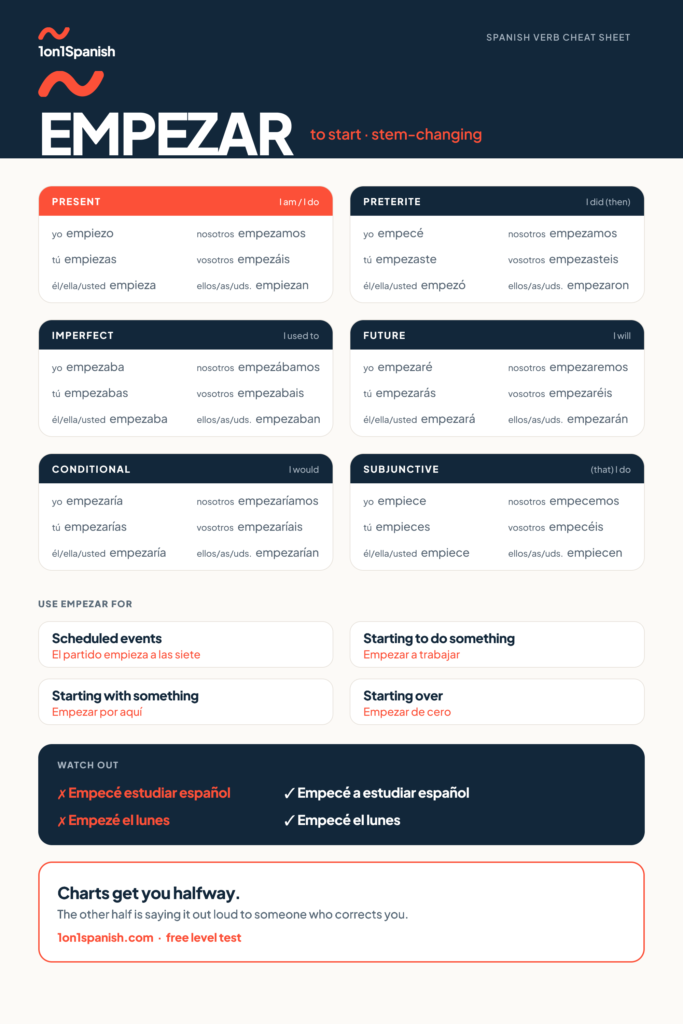
Take the chart with you
The chart is free to view and share. Drop your email and we’ll send the print-ready US Letter PDF — the version you stick on the fridge.
Practice
Practice empezar with a real teacher
Charts get you halfway. The other half is saying it out loud to someone who corrects you on the spot. At 1on1Spanish you get 25-minute private lessons with a qualified native teacher, exercises built from the mistakes you make in class, and AI practice between lessons.
First month $1. No contracts, cancel anytime.
These guides are free. When you want someone correcting you out loud, learn Spanish online with a qualified native teacher.
Take your free level testBuilt on RingTeacher's method — 700,000+ classes delivered since 2017, teaching English to Spanish speakers. Now in the other direction.
Frequently asked questions
Is empezar regular or irregular in Spanish?
Empezar is a stem-changing verb with a spelling change, not a fully irregular one. The e of the stem becomes ie when stressed: empiezo, empiezas, empieza, empiezan, but empezamos and empezáis keep the e. Separately, the z is written c before an e, which produces empecé in the preterite and empiece, empecemos in the subjunctive.
Why is it “empecé” and not “empezé”?
Spanish spelling doesn’t allow z before e or i in native words, so the letter is written c, which represents the same sound. The rule affects the first person preterite empecé and the whole present subjunctive: empiece, empieces, empecemos, empiecen. Every -zar verb does this: almorcé, crucé, organicé.
What’s the difference between empezar and comenzar?
None in meaning — both are “to begin” and both conjugate identically as e→ie verbs with the z→c spelling change. The difference is tone. Empezar is the everyday choice and fits any register; comenzar sounds slightly more formal and shows up in announcements, ceremonies and written Spanish. La reunión empieza and la reunión comienza are equally correct.
How do you say “start doing something” in Spanish?
Use empezar a plus an infinitive: empecé a estudiar, ha empezado a llover, voy a empezar a correr. The preposition a is required and can’t be dropped, which is the difference from English “start studying”. To start with a particular item rather than an action, use empezar por: empecemos por el presupuesto.
Do I need the subjunctive of empezar in everyday conversation?
Yes, mainly with time expressions and wishes. Empiece appears after antes de que (antes de que empiece la clase), after cuando pointing at the future (cuando empiece a hacer frío), and after espero que. All three come up constantly when arranging schedules, which is precisely when people need this verb.