
Comer conjugation in Spanish: every tense you need, with examples
Comer means “to eat”, and it’s the verb Spanish textbooks use as the model for the whole -er family. It has no irregularities at all. Not one form breaks the pattern. Learn these tables and you have beber, aprender, correr, vender and a few hundred more for free. The only real difficulty is choosing between comí and comía, which is a tense question rather than a comer question. 1on1Spanish teaches this in 25-minute one-on-one lessons with qualified native teachers, online across the United States.
Reviewed by María Jiménez — Licenciada en Filología Hispánica (BA in Hispanic Philology) · Updated Aug 2026
What comer means
Comer is eating in general: No he comido nada desde el desayuno. In Spain it also means specifically “to have lunch”. ¿Comemos a las dos? is an invitation to lunch, not a vague statement about food. The word for the midday meal varies by country: almorzar is the common choice across much of Latin America, while in Spain comer on its own usually means “to have lunch”.
The reflexive comerse adds the idea of finishing something off: Se comió toda la pizza. It needs a direct object, so me comí on its own doesn’t work.
Comer is a fully regular -er verb. Nothing changes: no stem shift, no spelling adjustment, no odd participle. That’s why it’s the pattern the rest of the Spanish verbs in this group are measured against. Participle comido, gerund comiendo.
Comer conjugation: present tense
| Form | Example | |
|---|---|---|
| yo | como | Como en la oficina casi todos los días. (I eat at the office most days.) |
| tú | comes | ¿Comes carne? (Do you eat meat?) |
| él / ella / usted | come | Mi hijo no come verdura. (My son doesn’t eat vegetables.) |
| nosotros | comemos | Comemos sobre las dos. (We eat around two.) |
| vosotros | coméis | ¿Coméis fuera hoy? (Are you eating out today?) |
| ellos / ellas / ustedes | comen | Comen muy tarde en Madrid. (They eat very late in Madrid.) |
Nothing is bold in this table, and that’s the point: there are no irregular forms to flag anywhere on this page.
Comer conjugation: preterite
For a meal that happened once, at a known moment. Watch the accents on comí and comió.
| Form | |
|---|---|
| yo | comí |
| tú | comiste |
| él / ella / usted | comió |
| nosotros | comimos |
| vosotros | comisteis |
| ellos / ellas / ustedes | comieron |
Ayer comí con un cliente. — Yesterday I had lunch with a client.
Comer conjugation: imperfect
For habits, routines and background. This is the tense the keyword comer imperfect is after, and the -ía endings are identical for every regular -er and -ir verb.
| Form | |
|---|---|
| yo | comía |
| tú | comías |
| él / ella / usted | comía |
| nosotros | comíamos |
| vosotros | comíais |
| ellos / ellas / ustedes | comían |
Cuando trabajaba en el centro, comía siempre en el mismo sitio. — When I worked downtown, I always ate at the same place. Choosing between this and comí is the same decision for every verb, and it’s laid out in full in preterite vs imperfect.
Comer conjugation: future
Regular endings on the full infinitive.
| Form | |
|---|---|
| yo | comeré |
| tú | comerás |
| él / ella / usted | comerá |
| nosotros | comeremos |
| vosotros | comeréis |
| ellos / ellas / ustedes | comerán |
Comeremos en el aeropuerto. — We’ll eat at the airport.
Comer conjugation: conditional
| Form | |
|---|---|
| yo | comería |
| tú | comerías |
| él / ella / usted | comería |
| nosotros | comeríamos |
| vosotros | comeríais |
| ellos / ellas / ustedes | comerían |
Yo no comería eso después de dos días en el refrigerador. — I wouldn’t eat that after two days in the fridge.
Comer conjugation: present subjunctive
Take the yo form of the present, drop the -o, add the -a endings. That rule works for every regular -er verb.
| Form | |
|---|---|
| yo | coma |
| tú | comas |
| él / ella / usted | coma |
| nosotros | comamos |
| vosotros | comáis |
| ellos / ellas / ustedes | coman |
El médico quiere que coma menos sal. — The doctor wants me to eat less salt.
Comer conjugation: imperfect subjunctive
Both sets are correct; -ra is what you’ll hear.
| Form (-ra) | Form (-se) | |
|---|---|---|
| yo | comiera | comiese |
| tú | comieras | comieses |
| él / ella / usted | comiera | comiese |
| nosotros | comiéramos | comiésemos |
| vosotros | comierais | comieseis |
| ellos / ellas / ustedes | comieran | comiesen |
Si comiera menos por la noche, dormiría mejor. — If I ate less at night, I’d sleep better.
Comer commands (imperative)
| Affirmative | Negative | |
|---|---|---|
| tú | come | no comas |
| usted | coma | no coma |
| nosotros | comamos | no comamos |
| vosotros | comed | no comáis |
| ustedes | coman | no coman |
Come algo antes de salir. — Eat something before you go out. With the reflexive attached: Cómetelo todo, with the accent added to keep the stress.
Participle, gerund and compound tenses
Participle comido, gerund comiendo. Both regular. The gerund ending -iendo is what every -er verb takes.
Hoy he comido fatal (present perfect) · Ya habíamos comido cuando llegó (past perfect) · A esa hora ya habremos comido (future perfect). Estoy comiendo is the standard way to say you’re in the middle of a meal and can’t talk.
When to use comer
Eating, in general
No como carne roja. It covers food but not drink. Drinks take tomar or beber.
Having lunch
¿Almorzamos juntos el jueves? is a lunch invitation. Almorzar is the safer default for the United States; comer also means “to have lunch” but that’s more properly Spain. Both are understood everywhere; only the default shifts.
Finishing something off, with comerse
Se comió el plato entero. The reflexive adds emphasis on the completion, and it always needs an object. Me comí un sándwich is fine; me comí alone is not.
Feeding someone, with dar de comer
Tengo que dar de comer al perro. Spanish doesn’t use comer transitively for this; the fixed phrase does the work.
Eating out
Comer fuera is eating at a restaurant. Comer en casa is the opposite, and neither takes an article.
Common mistakes English speakers make with comer
Drinks are not eaten in Spanish. Tomar covers coffee, water, wine and beer; beber also works but sounds more literal.
The meal is already inside the verb. Spanish says desayunar, comer/almorzar, cenar rather than “eat breakfast” or “eat dinner”, and it never borrows the English word for the meal itself.
Comerse needs something eaten. With a place instead of a dish, drop the pronoun.
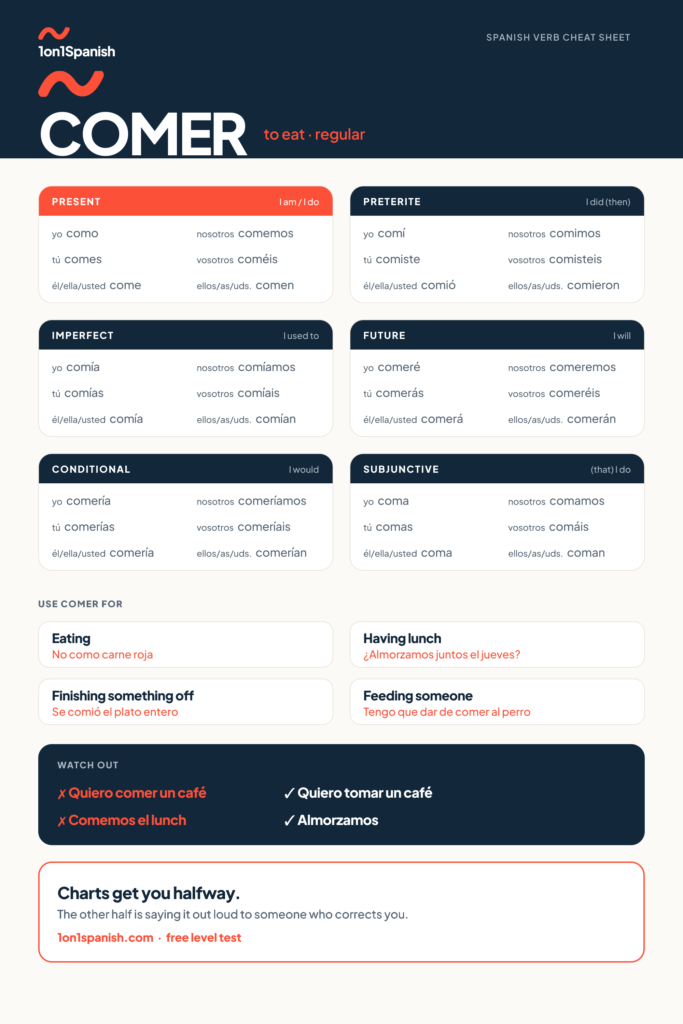
Take the chart with you
The chart is free to view and share. Drop your email and we’ll send the print-ready US Letter PDF — the version you stick on the fridge.
Practice
Practice comer with a real teacher
Charts get you halfway. The other half is saying it out loud to someone who corrects you on the spot. At 1on1Spanish you get 25-minute private lessons with a qualified native teacher, exercises built from the mistakes you make in class, and AI practice between lessons.
First month $1. No contracts, cancel anytime.
A Spanish tutor will catch the comí / comía slip the moment you make it.
Prefer to practice with a person? Take one-on-one Spanish lessons online with a qualified native teacher.
Take your free level testBuilt on RingTeacher's method — 700,000+ classes delivered since 2017, teaching English to Spanish speakers. Now in the other direction.
Frequently asked questions
Is comer a regular verb in Spanish?
Yes, completely. Comer has no stem change, no spelling change and no irregular participle, which is why it’s used as the model for the whole -er group. If you can conjugate comer, you can conjugate beber, aprender, correr, vender, deber and comprender by swapping the stem and keeping every ending identical.
What’s the difference between comí and comía?
Comí is the preterite: a single meal at a known moment. Ayer comí con un cliente. Comía is the imperfect: a habit, a routine, or the background to another event. Antes comía en casa todos los días. English uses “ate” for both, which is why the choice has to be made on meaning rather than translation. It’s the same choice with every Spanish verb.
How do you conjugate other -er verbs using comer?
Drop the -er and add the same endings. Present: -o, -es, -e, -emos, -éis, -en. Preterite: -í, -iste, -ió, -imos, -isteis, -ieron. Imperfect: -ía throughout. Future and conditional stick to the full infinitive. The regular -ir verbs share almost all of this, differing only in the nosotros and vosotros forms of the present.
What does “comerse” mean in Spanish?
Comerse is comer with a reflexive pronoun, and it stresses that the food was finished: se comió todo el pastel. It always needs a direct object, so you can’t say me comí alone. It also appears figuratively — se comió una palabra means she swallowed a word while speaking, and el tráfico se comió la mañana means traffic ate up the morning.
Do you say comer or almorzar for lunch in Spanish?
Both, depending on the country. In Spain, comer is the default word for the midday meal and almorzar usually means a lighter mid-morning bite. In Mexico and most of Latin America, almorzar is lunch and comer stays general. Both are understood everywhere, so neither will cause confusion. The word you pick just marks where you learned your Spanish.