
Preterite vs imperfect: which Spanish past tense to use
Use the preterite for an action you can put a start and an end on, and the imperfect for the situation around it — what was going on, what used to happen, what things were like. English has one simple past doing both jobs, so the sentence “I worked in Miami” gives you no clue which Spanish tense it needs. 1on1Spanish teaches this choice in 25-minute one-on-one lessons with qualified native teachers, online across the United States.
Reviewed by María Jiménez — Licenciada en Filología Hispánica (BA in Hispanic Philology) · Updated Sep 2026
The preterite: closed actions
The preterite reports events. Each one is a dot on the timeline: it happened, it finished, the story moves on.
Ayer firmé el contrato. El vuelo salió a las seis. Mi hermana se mudó a Denver en marzo. Three finished facts: the action is over, and the sentence says so.
Duration doesn’t matter. A closed block of time takes the preterite even when the block is long: Viví en Chicago cinco años, Trabajé en ese hospital toda la década. The five years ended, so it is one closed event.
Words that usually sit next to a preterite: ayer, anoche, el lunes, en 2019, hace dos semanas, de repente, por fin.
The imperfect: the background
The imperfect describes rather than reports. It answers “what was the situation?” instead of “what happened next?”.
It covers three things. Habits and repeated actions: Cuando trabajaba en Chicago, iba a la oficina en tren. Descriptions and states in the past: Mi padre tenía sesenta años y todavía trabajaba. And actions in progress: Estaba leyendo el correo — no start, no end, just underway.
Two details always take the imperfect. Time: Eran las once cuando llegamos al hospital. Age: Tenía treinta años cuando compramos la casa. Both examples lean on two verbs worth knowing cold in this tense: the imperfect of ser (era, eran) and tener in every tense (tenía).
Words that usually sit next to an imperfect: siempre, todos los días, cada verano, normalmente, mientras, de niño. More of these markers, with their meanings, are on the Spanish time expressions page.
The timeline
This is the picture that settles it. Draw a horizontal line for the imperfect and a vertical mark across it for the preterite.
──────── imperfect: what was going on ──────── ↓ preterite: what happened
Estaba en una reunión (the line) cuando me llamó el médico (the mark). The meeting was the setting; the call was the event. Native speakers build almost every past story this way: imperfect to set the scene, preterite to move it forward.
Two imperfects together mean two things happening at once: Mientras yo cocinaba, mi mujer revisaba las facturas. Two preterites together mean a sequence: Llegué, pagué y me fui.
Reference chart
| What the sentence does | Tense | Example | English |
|---|---|---|---|
| Reports a finished event | preterite | Vendí el carro. | I sold the car. |
| Closed block of time | preterite | Estudié dos horas. | I studied for two hours. |
| Sequence of events | preterite | Se levantó y salió. | He got up and left. |
| Sudden interruption | preterite | Sonó el teléfono. | The phone rang. |
| Habit, repeated action | imperfect | Íbamos cada agosto. | We used to go every August. |
| Description, state | imperfect | La casa era pequeña. | The house was small. |
| Action in progress | imperfect | Estaba trabajando. | I was working. |
| Time and age | imperfect | Eran las dos. | It was two o’clock. |
| Two things at once | imperfect + imperfect | Yo manejaba y ella dormía. | I was driving and she was sleeping. |
| Background + event | imperfect + preterite | Dormía cuando llegaron. | I was sleeping when they arrived. |
The verbs that change meaning
A handful of common verbs translate differently depending on the tense. These aren’t exceptions to the rule — they follow it exactly, which is why the English changes.
| Imperfect | Preterite |
|---|---|
| Sabía la respuesta — I knew the answer | Supe la verdad — I found out the truth |
| Conocía a tu jefe — I knew your boss | Conocí a tu jefe — I met your boss |
| Quería llamarte — I wanted to call you | Quise llamarte — I tried to call you |
| No quería firmar — I didn’t want to sign | No quise firmar — I refused to sign |
| Podía pagarlo — I was able to pay for it | Pude pagarlo — I managed to pay for it |
| Tenía que ir al médico — I was supposed to go | Tuve que ir al médico — I had to go, and went |
| Costaba mil dólares — it cost (that was the price) | Costó mil dólares — it cost me (I paid it) |
Every pair works the same way: the imperfect gives you a state you were in, the preterite the moment it turned into an event.
Common mistakes English speakers make
Mientras needs the action that was in progress, and that is the imperfect. Note what is not an error: Ayer iba al banco and Ayer fui al banco are both correct Spanish. The first sets the scene for something else, the second reports a finished trip.
Whenever the English hides a “used to” or a “would”, the Spanish is imperfect. Cada verano gives it away.
Clock time in the past is always imperfect, and it agrees in plural with the hour.
A run of finished actions stays in the preterite the whole way through. And a closed time expression does not force the preterite by itself: El año pasado viví en Miami presents the stay as over, while El año pasado vivía en Miami cuando conocí a Ana uses the same year as background. What decides the tense is what you are doing with the time, not the time word.
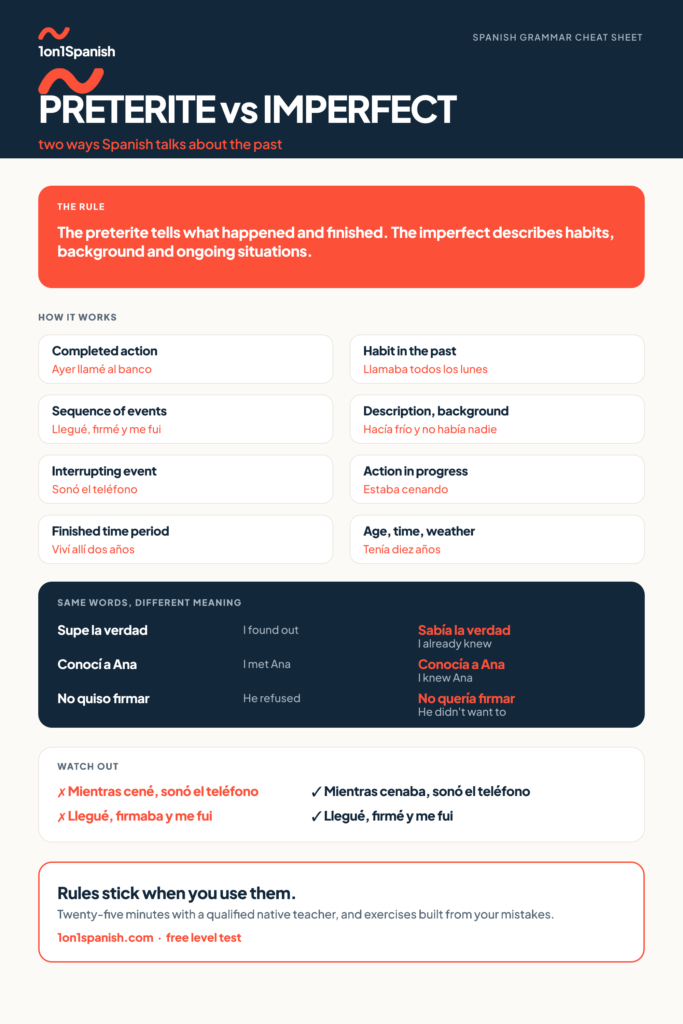
Take the chart with you
The chart is free to view and share. Drop your email and we’ll send the print-ready US Letter PDF — the version you stick on the fridge.
Practice
Practice preterite and imperfect with a real teacher
Charts get you halfway. The other half is saying it out loud to someone who corrects you on the spot. At 1on1Spanish you get 25-minute private lessons with a qualified native teacher, exercises built from the mistakes you make in class, and AI practice between lessons.
First month $1. No contracts, cancel anytime.
These guides are free. When you want someone correcting you out loud, learn Spanish online with a qualified native teacher.
Take your free level testBuilt on RingTeacher's method — 700,000+ classes delivered since 2017, teaching English to Spanish speakers. Now in the other direction.
Frequently asked questions
When do you use the preterite instead of the imperfect in Spanish?
Use the preterite when the action has a start and an end you can point to: Firmé el contrato, Viví allí tres años. Use the imperfect for habits, descriptions and actions in progress: Iba cada lunes, La casa era grande, Estaba durmiendo. If the sentence moves the story forward it’s preterite; if it sets the scene it’s imperfect.
What’s the easiest way to remember preterite vs imperfect?
Picture a timeline. The imperfect is the horizontal line — the situation running along in the background. The preterite is a vertical mark cutting across it — the thing that happened. Estaba en una reunión cuando me llamó el médico has both. Ask which half of that picture your sentence belongs to before you conjugate anything.
Does “used to” always become the imperfect in Spanish?
Yes. Whenever the English sentence says “used to” or uses “would” for a repeated past habit, Spanish uses the imperfect: Todos los veranos íbamos a Florida. The trap runs the other way too: the imperfect covers plenty of sentences where English shows no “used to” at all, like descriptions and clock time.
Is the preterite different in Latin America and Spain?
The rule is the same everywhere, but the habit differs in one spot. Spaniards often use the present perfect for today’s events — Hoy he hablado con el banco — where most of Latin America uses the preterite: Hoy hablé con el banco. Both are correct Spanish, and both are understood on either side of the Atlantic.
What’s the most common preterite vs imperfect mistake?
Using the preterite for a repeated past habit, as in cada verano fui a la playa. English speakers map “I went” to a single form and stop there. The second most common is missing the background verb in an interruption, saying leí el correo cuando entró mi jefe instead of estaba leyendo, which reverses the order of events.