
Comprar conjugation in Spanish: every tense you need, with examples
Comprar means “to buy”, and it’s a fully regular -ar verb in every tense — no stem change, no spelling change, nothing to memorize beyond the standard pattern. The real confusion with this verb isn’t grammatical, it’s the sentence le compré un regalo a mi madre, which can mean two opposite things depending on context. All nine tables are below, along with the line between comprar and pagar. 1on1Spanish teaches this in 25-minute one-on-one lessons with qualified native teachers, online across the United States.
Reviewed by María Jiménez — Licenciada en Filología Hispánica (BA in Hispanic Philology) · Updated Sep 2026
What comprar means
Comprar is “to buy” or “to purchase”: compré un carro, compramos la casa en 2019. It takes a direct object for what’s bought, and often an indirect object with a for who’s involved — and that’s exactly where the ambiguity lives, covered below.
Comprar also shows up in a few fixed expressions: comprar a plazos (to buy on installments), comprar al contado (to pay in full, cash or card, no financing), and figuratively, comprar tiempo — to buy time, same idiom as in English.
Grammatically it’s fully regular: standard -ar endings throughout. Participle comprado, gerund comprando.
Comprar conjugation: present tense
Fully regular. No irregular forms in this table.
| Form | Example | |
|---|---|---|
| yo | compro | Compro las verduras en el mercado. (I buy vegetables at the market.) |
| tú | compras | ¿Compras el pan aquí siempre? (Do you always buy bread here?) |
| él / ella / usted | compra | Mi esposo compra la gasolina los lunes. (My husband buys gas on Mondays.) |
| nosotros | compramos | Compramos los boletos con anticipación. (We buy the tickets in advance.) |
| vosotros | compráis | ¿Compráis la fruta en el mismo puesto? (Do you buy the fruit at the same stand?) |
| ellos / ellas / ustedes | compran | Mis padres compran todo en línea ahora. (My parents buy everything online now.) |
Comprar conjugation: preterite
Regular -ar endings, no spelling change.
| Form | |
|---|---|
| yo | compré |
| tú | compraste |
| él / ella / usted | compró |
| nosotros | compramos |
| vosotros | comprasteis |
| ellos / ellas / ustedes | compraron |
Compré una casa el año pasado. — I bought a house last year.
Comprar conjugation: imperfect
Fully regular.
| Form | |
|---|---|
| yo | compraba |
| tú | comprabas |
| él / ella / usted | compraba |
| nosotros | comprábamos |
| vosotros | comprabais |
| ellos / ellas / ustedes | compraban |
Cuando era niño, mi abuela me compraba dulces cada domingo. — When I was a kid, my grandma used to buy me candy every Sunday.
Comprar conjugation: future
Regular endings on the infinitive.
| Form | |
|---|---|
| yo | compraré |
| tú | comprarás |
| él / ella / usted | comprará |
| nosotros | compraremos |
| vosotros | compraréis |
| ellos / ellas / ustedes | comprarán |
Compraremos los muebles cuando nos mudemos. — We’ll buy the furniture when we move.
Comprar conjugation: conditional
| Form | |
|---|---|
| yo | compraría |
| tú | comprarías |
| él / ella / usted | compraría |
| nosotros | compraríamos |
| vosotros | compraríais |
| ellos / ellas / ustedes | comprarían |
Yo no compraría esa marca otra vez. — I wouldn’t buy that brand again.
Comprar conjugation: present subjunctive
Built on the compro stem, fully regular.
| Form | |
|---|---|
| yo | compre |
| tú | compres |
| él / ella / usted | compre |
| nosotros | compremos |
| vosotros | compréis |
| ellos / ellas / ustedes | compren |
Espero que compres algo cómodo para el viaje. — I hope you buy something comfortable for the trip.
Comprar conjugation: imperfect subjunctive
Built on the preterite stem compraron-.
| Form (-ra) | Form (-se) | |
|---|---|---|
| yo | comprara | comprase |
| tú | compraras | comprases |
| él / ella / usted | comprara | comprase |
| nosotros | compráramos | comprásemos |
| vosotros | comprarais | compraseis |
| ellos / ellas / ustedes | compraran | comprasen |
Si tuviera el dinero, compraría esa casa. — If I had the money, I’d buy that house.
Comprar commands (imperative)
| Affirmative | Negative | |
|---|---|---|
| tú | compra | no compres |
| usted | compre | no compre |
| nosotros | compremos | no compremos |
| vosotros | comprad | no compréis |
| ustedes | compren | no compren |
Compra lo que necesites, yo pago. — Buy what you need, I’ve got it. Common between friends or family at a store.
Participle, gerund and compound tenses
Participle comprado, gerund comprando. Both regular. Compounds take haber:
He comprado tres carros en mi vida (present perfect) · Ya había comprado los boletos cuando subió el precio (past perfect) · Para diciembre habré comprado todos los regalos (future perfect).
When to use comprar
Buying something outright
Compré una laptop nueva para el trabajo. The default, everyday use — this is the meaning most learners already know.
Buying for or from someone, with an indirect object
Le compré un regalo a mi madre. Below is exactly why this sentence has two possible readings.
Paying in installments or in full
Compramos el refrigerador a plazos. Common in everyday American Spanish around furniture, appliances and cars.
Figuratively, to gain time
Eso nos compra unos días más antes de decidir. Same idiom as English “buy some time”, used the same way in negotiations and deadlines.
Comprar vs pagar
Both touch money, and English speakers mix them up because “pay for” and “buy” overlap loosely. Comprar is acquiring the item; pagar is settling what’s owed for it.
| Comprar | Pagar |
|---|---|
| Compré un carro nuevo — I bought a new car | Pagué el carro en efectivo — I paid for the car in cash |
| Takes the thing acquired as the object | Takes the amount or the bill as the object |
| Compré la cena (I bought/covered dinner) | Pagué la cuenta (I paid the check) |
Le compré a mi madre un pastel para su cumpleaños can mean I bought her a cake as a gift, or I bought a cake from her — the le marks the indirect object, but only context tells you which side of the transaction your mother is on.
Common mistakes English speakers make with comprar
Pagar takes what you owe, not the object you acquired. If the object is the direct object, the verb is comprar.
The reverse mistake: an amount of money is what you pay, not what you buy.
The natural word order puts the indirect object pronoun le before the verb and the person after it with a, not para. This is standard practice with indirect object pronouns, and comprar is one of the verbs where learners meet the pattern first.
After espero que, the verb needs the subjunctive: compres, not compras.
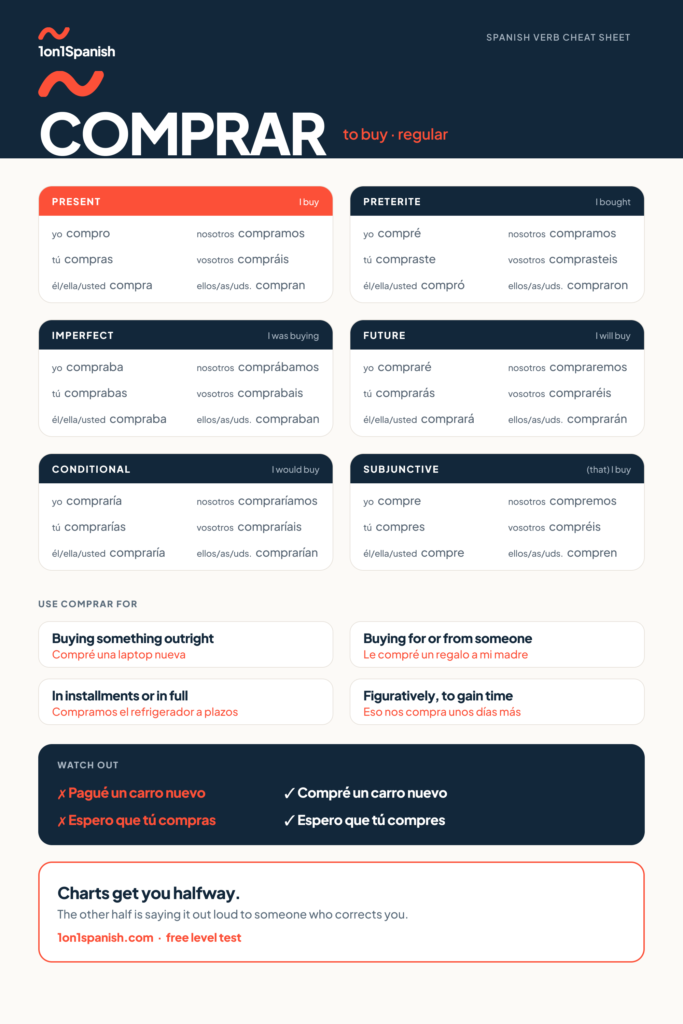
Take the chart with you
The chart is free to view and share. Drop your email and we’ll send the print-ready US Letter PDF — the version you stick on the fridge.
Practice
Practice comprar with a real teacher
Charts get you halfway. The other half is saying it out loud to someone who corrects you on the spot. At 1on1Spanish you get 25-minute private lessons with a qualified native teacher, exercises built from the mistakes you make in class, and AI practice between lessons.
First month $1. No contracts, cancel anytime.
Reading about it only gets you so far. Learn Spanish online in 25-minute conversations and use it.
Take your free level testBuilt on RingTeacher's method — 700,000+ classes delivered since 2017, teaching English to Spanish speakers. Now in the other direction.
Frequently asked questions
Is comprar regular or irregular in Spanish?
Fully regular. Comprar follows the standard -ar pattern in every tense, with no stem change and no spelling change. The nine tables above are all built directly on the endings you’d learn from hablar, so once you know one regular -ar verb, you know this one.
What’s the difference between comprar and pagar?
Comprar is acquiring something — the item is the direct object: compré un carro. Pagar is settling an amount owed — money or a bill is the object: pagué el carro, pagué la cuenta. You buy a thing; you pay an amount, or you pay for a thing with pagar por.
How do you say “I bought this for my mom” in Spanish?
Le compré esto a mi mamá is the natural phrasing, using the indirect object pronoun le even though her name or “mamá” also appears in the sentence — Spanish doubles the pronoun this way. The same sentence can technically mean you bought it from her; context almost always makes the meaning clear.
What is the past tense of comprar in Spanish?
Two forms depending on the shape of the action. The preterite — compré, compraste, compró, compramos, comprasteis, compraron — describes a single completed purchase: compré una casa. The imperfect — compraba, comprabas, compraba, comprábamos, comprabais, compraban — describes a repeated habit: mi abuela me compraba dulces cada domingo.
Do I need the subjunctive of comprar in everyday conversation?
Yes, mainly with hopes and suggestions. Compre appears after espero que (espero que compres algo bueno), after sugiero que (sugiero que compren boletos con anticipación), and after ojalá (ojalá que compren la casa). It’s common in any conversation about shopping decisions someone else is making.