
Spanish indirect object pronouns: le, les and the se lo switch
An indirect object pronoun — me, te, le, nos, os, les — marks who receives or is affected by the action, and Spanish keeps it in the sentence even when the person is already named: A mi madre le doy las gracias. English drops the pronoun the moment it names the person, so the repetition looks like a mistake until you realize it’s mandatory. 1on1Spanish teaches this in 25-minute one-on-one lessons with qualified native teachers, online across the United States.
Reviewed by María Jiménez — Licenciada en Filología Hispánica (BA in Hispanic Philology) · Updated Sep 2026
Who the pronoun points at
The indirect object answers “to whom?” or “for whom?”. In Mandé el contrato a mi abogado, the contract is what I sent and the lawyer is who I sent it to, so the lawyer becomes le.
| Receiver | Pronoun | Example |
|---|---|---|
| to/for me | me | Mi jefe me dio el día libre. |
| to/for you (informal) | te | Te mandé la factura. |
| to/for him, her, you (formal) | le | Le expliqué el problema. |
| to/for us | nos | El banco nos negó el préstamo. |
| to/for you all (Spain, informal) | os | Os guardo el sitio. |
| to/for them, you all | les | Les compré los boletos. |
Notice that le covers him, her and formal you with a single form, which is the ambiguity Spanish solves in the next section. And unlike direct object pronouns, these do not change for gender: it’s le whether you’re talking about your father or your mother.
Why the pronoun is repeated
A mi madre le doy las gracias names the mother twice. It isn’t emphasis and it isn’t optional. Dar is the verb you’ll use most with these pronouns, and the dar conjugation is irregular in exactly the forms you see on this page: doy, di.
When the indirect object appears as a noun phrase with a, the pronoun comes too. Le mandé el correo a Marta. Les pagamos a los proveedores el viernes. Drop the pronoun and you get Mandé el correo a Marta, which is understandable but sounds off. In speech it barely happens.
The a phrase is what clears up le. Since le alone could be him, her or you, the phrase does the identifying: Le di el informe a él, Le di el informe a ella, Le di el informe a usted. You add it when context doesn’t already make the person obvious, and you leave it out when it does.
That same phrase also carries emphasis: A mí me parece bien is “I, for one, think it’s fine.”
Verbs that are built around the receiver
A whole family of Spanish verbs treats the person as the receiver rather than the doer, and they all run on indirect pronouns: gustar, encantar, interesar, doler, faltar, quedar, parecer, importar.
Me gusta el trabajo. Literally, the job is pleasing to me. A mi mujer le encantan los perros. Me duele la espalda. Nos faltan dos sillas. ¿Qué te parece la oferta?
The verb agrees with the thing, not with the person: Me gusta el café, but Me gustan los cafés de aquí. This is where English speakers say Yo gusto, which means “I am pleasing”, a different sentence entirely.
That whole group has its own page, gustar and the verbs built like it, with the two-form rule and the a phrase that names the person.
Reference chart
| Situation | Pattern | Example | English |
|---|---|---|---|
| Basic indirect object | pronoun + verb | Le dije la verdad. | I told him the truth. |
| Named receiver | pronoun + verb + a + noun | Le dije la verdad a mi jefe. | I told my boss the truth. |
| Clarifying le | + a él / a ella / a usted | Le mandé el correo a ella. | I sent her the email. |
| Emphasis | a mí / a ti + pronoun | A mí me parece caro. | I think it’s expensive. |
| Gustar-type verb | pronoun + verb + subject | Nos interesa la propuesta. | We’re interested in the proposal. |
| Two pronouns | indirect + direct | Me lo explicó. | He explained it to me. |
| le/les + lo/la | se + direct | Se lo expliqué. | I explained it to him. |
| With infinitive | either position | Voy a decírselo / Se lo voy a decir. | I’m going to tell him. |
| Affirmative command | attached | Dímelo. | Tell me. |
| Negative command | before the verb | No me lo digas. | Don’t tell me. |
Two pronouns in one sentence, and where se comes from
When both pronouns appear, the indirect one goes first: me lo, te la, nos los. ¿El contrato? Me lo mandaron ayer. The second word in each pair comes from the direct object pronoun set: lo, la, los, las.
But le and les never sit next to lo, la, los, las. In that position they turn into se:
- Le di el informe + lo → Se lo di.
- Les mandé las facturas → Se las mandé.
This se has nothing to do with reflexive verbs; it’s a pronunciation fix that stuck. And because se hides who the receiver was, the clarifying phrase does more work than usual: Se lo di a él, Se lo di a ellos.
The pairs that change the sentence
| Sentence | What it means |
|---|---|
| Le compré un regalo. | I bought him a gift. |
| Lo compré. | I bought it. |
| Le pegué. | I hit him. |
| Lo pegué. | I glued it. |
| Le escribí. | I wrote to her. |
| La escribí. | I wrote it (the letter). |
| Me lo dio. | He gave it to me. |
| Se lo dio. | He gave it to him / her / them. |
| A mí me gusta. | I like it (with emphasis on me). |
| Me gusta. | I like it. |
| Les pagué. | I paid them. |
| Los pagué. | I paid them (the bills). |
Common mistakes English speakers make
Le and lo can’t stand together. This one is mechanical: whenever le or les meets a direct object pronoun, it becomes se.
The a ella phrase clarifies the pronoun; it doesn’t replace it. Both have to be there.
Gustar puts the thing in the subject slot. Yo gusto means other people find me appealing, which is rarely the intended sentence in a work call.
The pronoun agrees in number with the receiver, not with anything else in the sentence. One sister, one le.
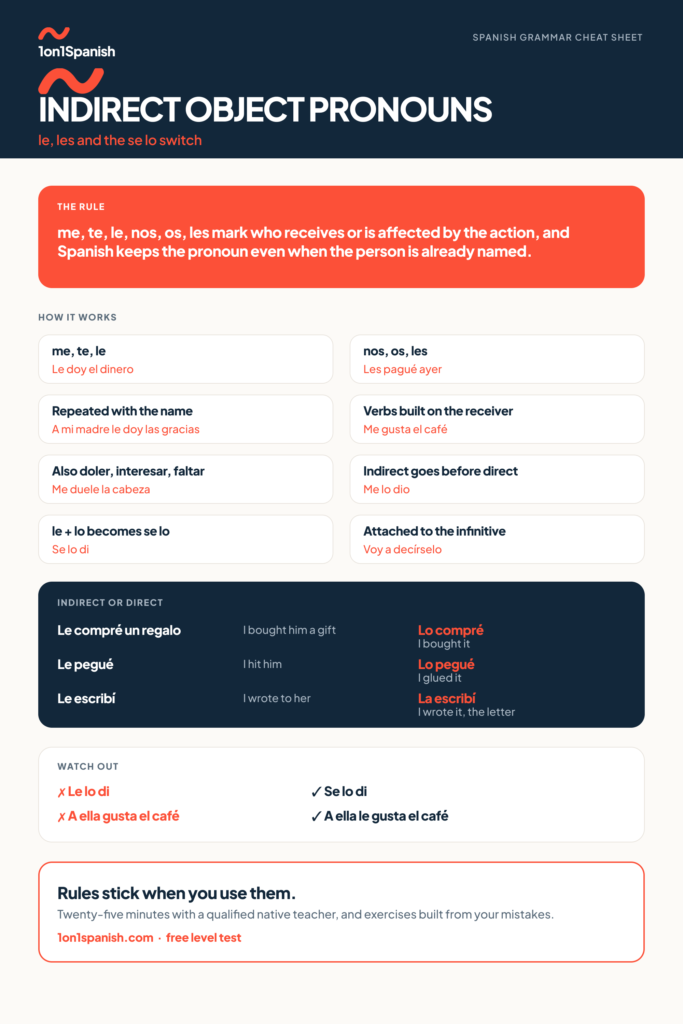
Take the chart with you
The chart is free to view and share. Drop your email and we’ll send the print-ready US Letter PDF — the version you stick on the fridge.
Practice
Practice indirect object pronouns with a real teacher
Charts get you halfway. The other half is saying it out loud to someone who corrects you on the spot. At 1on1Spanish you get 25-minute private lessons with a qualified native teacher, exercises built from the mistakes you make in class, and AI practice between lessons.
First month $1. No contracts, cancel anytime.
Guides help. A teacher hears what a guide cannot — Learn Spanish online with a real teacher.
Take your free level testBuilt on RingTeacher's method — 700,000+ classes delivered since 2017, teaching English to Spanish speakers. Now in the other direction.
Frequently asked questions
What’s the difference between direct and indirect object pronouns in Spanish?
The direct object is what receives the action; the indirect object is who receives it. In Le mandé el contrato, the contract is direct and the person is indirect. The forms only differ in the third person: direct uses lo, la, los, las, indirect uses le, les. Everything else (me, te, nos, os) is shared between both systems.
Why does Spanish repeat the pronoun when the person is already named?
Because the pronoun is part of the verb phrase, not a substitute for the noun. Le di el informe a mi jefe names the boss once as information and marks him once grammatically. English can’t do this, which is why the sentence feels redundant at first. Skipping the pronoun isn’t a serious error, but it’s not how the language is spoken.
When does le become se in Spanish?
Whenever le or les is immediately followed by lo, la, los or las. Le di el libro plus lo becomes Se lo di, never le lo di. The change is purely mechanical and has nothing to do with reflexive se. Because it erases the receiver, speakers often add a clarifier: Se lo di a ella.
Do I always need le with gustar?
Yes. Gustar and its family (encantar, interesar, doler, faltar, parecer) always take an indirect pronoun, because the person is the receiver rather than the subject. A mi jefe le interesa needs both the phrase and the pronoun. The verb agrees with the thing: me gusta el café, me gustan los postres.
What’s the most common mistake with indirect object pronouns?
Dropping the pronoun when the person is named: Mandé el correo a Marta instead of Le mandé el correo a Marta. It comes straight from English, where naming the person makes the pronoun ungrammatical. The second most frequent is le lo instead of se lo, which shows up as soon as learners start combining two pronouns in one sentence.