
Conseguir conjugation in Spanish: every tense you need, with examples
Conseguir means “to get”, “to obtain” and “to manage to do something”. It carries two changes at once: the stem vowel e becomes i when stressed, and the u of -gui- disappears before o and a, because it was only there to keep the g hard. That’s why yo is consigo and not consiguo. Every tense is below. 1on1Spanish teaches verbs like this in 25-minute one-on-one lessons with qualified native teachers, online across the United States.
Reviewed by María Jiménez — Licenciada en Filología Hispánica (BA in Hispanic Philology) · Updated Aug 2026
What conseguir means
The first sense is getting hold of something concrete: an appointment, a ticket, a table, a permit. Conseguí cita con el especialista para el jueves. No conseguimos entradas para el partido.
The second is achieving a goal: Consiguió el ascenso después de tres años.
The third has no single English word. Followed by an infinitive, conseguir means “to manage to”: Conseguí abrir la cuenta sin ir a la oficina — I managed to open the account without going in person. This use is everywhere in spoken Spanish and it’s the one worth practicing.
Two mechanics, both predictable:
- Stem change e→i. Like pedir, servir and repetir: the change hits the stressed present forms, the third person of the preterite, the whole present subjunctive and the gerund.
- Spelling change gu→g. Spanish writes gu before e and i to keep a hard g sound. Once the following vowel is o or a, the u has no job and is dropped: consigo, consiga.
Participle conseguido, gerund consiguiendo.
Conseguir conjugation: present tense
| Form | Example | |
|---|---|---|
| yo | consigo | No consigo cita con el dentista. (I can’t get a dentist appointment.) |
| tú | consigues | ¿Consigues descuento con el seguro? (Do you get a discount with your insurance?) |
| él / ella / usted | consigue | Mi hermano consigue vuelos muy baratos. (My brother gets flights at very low prices.) |
| nosotros | conseguimos | Conseguimos mesa sin reserva. (We get a table without a reservation.) |
| vosotros | conseguís | ¿Conseguís hablar con alguien? (Do you manage to talk to anyone?) |
| ellos / ellas / ustedes | consiguen | Consiguen buenos resultados. (They get good results.) |
Conseguir conjugation: preterite
Only the third persons change, and there the u stays, because the vowel that follows is i.
| Form | |
|---|---|
| yo | conseguí |
| tú | conseguiste |
| él / ella / usted | consiguió |
| nosotros | conseguimos |
| vosotros | conseguisteis |
| ellos / ellas / ustedes | consiguieron |
Consiguió el visado en dos semanas. — He got the visa in two weeks.
Conseguir conjugation: imperfect
Regular throughout.
| Form | |
|---|---|
| yo | conseguía |
| tú | conseguías |
| él / ella / usted | conseguía |
| nosotros | conseguíamos |
| vosotros | conseguíais |
| ellos / ellas / ustedes | conseguían |
Antes conseguía cita el mismo día. — I used to get an appointment the same day.
Conseguir conjugation: future
| Form | |
|---|---|
| yo | conseguiré |
| tú | conseguirás |
| él / ella / usted | conseguirá |
| nosotros | conseguiremos |
| vosotros | conseguiréis |
| ellos / ellas / ustedes | conseguirán |
Conseguir conjugation: conditional
| Form | |
|---|---|
| yo | conseguiría |
| tú | conseguirías |
| él / ella / usted | conseguiría |
| nosotros | conseguiríamos |
| vosotros | conseguiríais |
| ellos / ellas / ustedes | conseguirían |
Con ese sueldo no conseguiríamos la hipoteca. — On that salary we wouldn’t get the mortgage.
Conseguir conjugation: present subjunctive
Every form loses the u and takes the i, nosotros and vosotros included.
| Form | |
|---|---|
| yo | consiga |
| tú | consigas |
| él / ella / usted | consiga |
| nosotros | consigamos |
| vosotros | consigáis |
| ellos / ellas / ustedes | consigan |
Ojalá consigas el puesto. — I hope you get the job.
Conseguir conjugation: imperfect subjunctive
Built on the third-person preterite, so the u comes back alongside the i.
| Form (-ra) | Form (-se) | |
|---|---|---|
| yo | consiguiera | consiguiese |
| tú | consiguieras | consiguieses |
| él / ella / usted | consiguiera | consiguiese |
| nosotros | consiguiéramos | consiguiésemos |
| vosotros | consiguierais | consiguieseis |
| ellos / ellas / ustedes | consiguieran | consiguiesen |
Si consiguiera el traslado, nos mudaríamos a Denver. — If I got the transfer, we’d move to Denver.
Conseguir commands (imperative)
| Affirmative | Negative | |
|---|---|---|
| tú | consigue | no consigas |
| usted | consiga | no consiga |
| nosotros | consigamos | no consigamos |
| vosotros | conseguid | no consigáis |
| ustedes | consigan | no consigan |
Consiga usted el justificante antes de irse. — Get the receipt before you leave.
Participle, gerund and compound tenses
Participle conseguido, gerund consiguiendo. Compounds with haber:
He conseguido el presupuesto (present perfect) · Había conseguido el permiso antes de la mudanza (past perfect) · Para junio habremos conseguido la licencia (future perfect).
When to use conseguir
Getting something you had to chase
An appointment, a permit, a refund, a table, a parking spot. Conseguí que me devolvieran el dinero. Note the subjunctive after conseguir que: it’s the standard pattern, and it’s explained in Spanish subjunctive.
Achieving a goal
Consiguió terminar la carrera trabajando a la vez.
Managing to do something, against friction
Conseguir + infinitive is the everyday way to say you finally pulled something off: No consigo dormir. ¿Conseguiste hablar con el seguro?
Failing, in the negative
The negative is more common than the affirmative in conversation: No consigo entenderlo. No conseguimos contactar con nadie.
Conseguir vs lograr vs obtener
Three verbs cover English “get” and “achieve”, and they’re not stylistically equal.
| Spanish | Register and use |
|---|---|
| Conseguí una cita. | Neutral, spoken. Default choice in conversation |
| Logré terminar a tiempo. | Slightly more formal, emphasizes effort against difficulty |
| Obtuvo la nacionalidad. | Formal and written. Documents, results, official outcomes |
| No consigo abrir la puerta. | Only conseguir and lograr work with an infinitive this way |
Obtener almost never takes an infinitive, so obtuve abrir is wrong. If you’re speaking rather than writing, conseguir is the safe pick every time.
Common mistakes English speakers make with conseguir
The u exists only to protect the hard g before e and i. Before o, it’s dropped. Same logic in seguir → sigo and distinguir → distingo.
The preterite third person takes the stem change: consiguió, consiguieron. Only those two forms.
Conseguir que is always followed by the subjunctive, and a past main verb pulls the subjunctive into the past too.
The gerund takes the i like every -ir stem-changer.
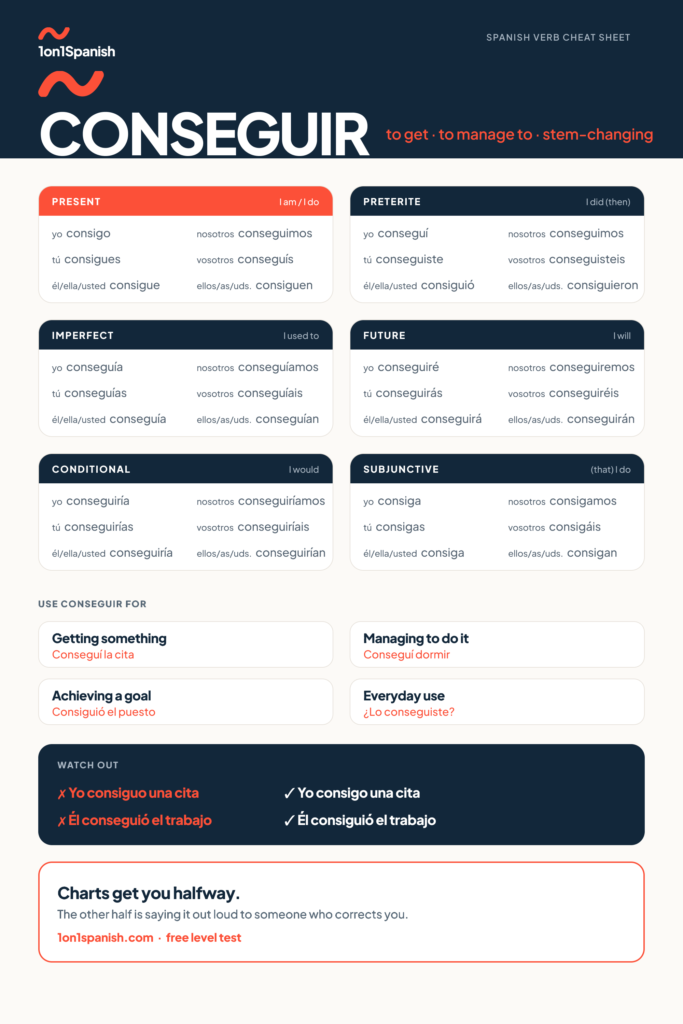
Take the chart with you
The chart is free to view and share. Drop your email and we’ll send the print-ready US Letter PDF — the version you stick on the fridge.
Practice
Practice conseguir with a real teacher
Charts get you halfway. The other half is saying it out loud to someone who corrects you on the spot. At 1on1Spanish you get 25-minute private lessons with a qualified native teacher, exercises built from the mistakes you make in class, and AI practice between lessons.
First month $1. No contracts, cancel anytime.
The rest of the tables are in our guide to Spanish verbs.
Prefer to practice with a person? Take one-on-one Spanish lessons online with a qualified native teacher.
Take your free level testBuilt on RingTeacher's method — 700,000+ classes delivered since 2017, teaching English to Spanish speakers. Now in the other direction.
Frequently asked questions
Is conseguir regular or irregular in Spanish?
Conseguir is a stem-changing verb with a spelling adjustment, not a truly irregular one. The e becomes i under stress: consigo, consigues, consigue, consiguen, plus consiguió, consiguieron, the whole present subjunctive and the gerund consiguiendo. Separately, the u of gui disappears before o and a, giving consigo and consiga.
Why does conseguir lose the u in “consigo”?
Spanish spells a hard g as gu only before e and i; before a, o and u the plain g already sounds hard. So conseguir keeps the u in conseguimos and consiguió, and drops it in consigo and consiga. The sound never changes. Only the spelling does. Seguir, distinguir and perseguir behave identically.
What’s the difference between conseguir and lograr?
They overlap, and in most sentences either works. Conseguir is the neutral, everyday choice and the one you’ll hear in conversation: Conseguí cita. Lograr leans slightly more formal and stresses that there was an obstacle: Logró terminar a pesar de todo. For official outcomes on paper, such as a degree, citizenship or a permit, Spanish prefers obtener.
How do you say “I managed to do it” in Spanish?
Conseguí hacerlo or Logré hacerlo. The pattern is conseguir plus an infinitive, and it’s how Spanish expresses “manage to” without a separate verb. In the negative it’s even more common: No consigo dormir (I can’t get to sleep), No consigo entenderlo (I can’t manage to understand it), No conseguí hablar con nadie (I couldn’t get through to anyone).
Do I need the subjunctive of conseguir in everyday conversation?
Yes, in two places. After conseguir que, the following verb is always subjunctive: Conseguí que me atendieran. And conseguir itself goes subjunctive after wishes and doubts: Ojalá consigas la cita, Espero que consigan el permiso, No creo que consigamos entradas. These are sentences a learner produces in the first months, not advanced grammar.