
Construir conjugation in Spanish: every tense you need, with examples
Construir means “to build” or “to construct”, and its one irregularity is a spelling rule, not a sound change: whenever the unstressed i of the stem would sit between two vowels, it becomes a y. That’s what turns construir into construyo, construyó and construyendo. The u never changes — only the i does, and only in specific spots. Every tense is below, marked where the y shows up and where it doesn’t. 1on1Spanish teaches this in 25-minute one-on-one lessons with qualified native teachers, online across the United States.
Reviewed by María Jiménez — Licenciada en Filología Hispánica (BA in Hispanic Philology) · Updated Sep 2026
What construir means
Construir is “to build”, for anything physical: construyen una torre nueva en el centro, construimos la cerca el verano pasado. It’s the standard verb for construction work, from a house to a highway.
It also works figuratively, for things you build over time: construir una relación, construir confianza, construir una carrera. This use is just as common as the literal one in adult conversation — relationships, trust, and careers all get “built” in Spanish the same way they do in English.
Grammatically it’s regular in meaning, with a spelling change: the stem’s i becomes y whenever it would otherwise sit unstressed between two vowels. That rule governs most of the present tense, the third person of the preterite, the whole subjunctive, and the gerund. The u of constru- is stable throughout; it never changes or disappears.
Construir conjugation: present tense
The y appears everywhere except nosotros and vosotros, where the ending starts with i instead of another vowel.
| Form | Example | |
|---|---|---|
| yo | construyo | Construyo casas desde hace diez años. (I’ve been building houses for ten years.) |
| tú | construyes | ¿Construyes tú mismo los muebles? (Do you build the furniture yourself?) |
| él / ella / usted | construye | La empresa construye un centro comercial nuevo. (The company is building a new mall.) |
| nosotros | construimos | Construimos la cerca entre los dos. (We built the fence between the two of us.) |
| vosotros | construís | ¿Construís vosotros el garaje o contratáis a alguien? (Are you building the garage yourselves or hiring someone?) |
| ellos / ellas / ustedes | construyen | Construyen puentes por toda la región. (They build bridges all over the region.) |
Construir conjugation: preterite
Only the third person takes the y — the first and second person forms keep the i with a written accent instead.
| Form | |
|---|---|
| yo | construí |
| tú | construiste |
| él / ella / usted | construyó |
| nosotros | construimos |
| vosotros | construisteis |
| ellos / ellas / ustedes | construyeron |
Construyeron el puente en menos de un año. — They built the bridge in less than a year.
Construir conjugation: imperfect
Fully regular, no spelling change.
| Form | |
|---|---|
| yo | construía |
| tú | construías |
| él / ella / usted | construía |
| nosotros | construíamos |
| vosotros | construíais |
| ellos / ellas / ustedes | construían |
De niños, construíamos fuertes con cajas de cartón. — As kids, we used to build forts out of cardboard boxes.
Construir conjugation: future
Regular endings on the infinitive.
| Form | |
|---|---|
| yo | construiré |
| tú | construirás |
| él / ella / usted | construirá |
| nosotros | construiremos |
| vosotros | construiréis |
| ellos / ellas / ustedes | construirán |
Construiremos la nueva oficina el próximo año. — We’ll build the new office next year.
Construir conjugation: conditional
| Form | |
|---|---|
| yo | construiría |
| tú | construirías |
| él / ella / usted | construiría |
| nosotros | construiríamos |
| vosotros | construiríais |
| ellos / ellas / ustedes | construirían |
Yo construiría el garaje antes que la terraza. — I’d build the garage before the deck.
Construir conjugation: present subjunctive
Built on the construy- stem throughout, including nosotros and vosotros.
| Form | |
|---|---|
| yo | construya |
| tú | construyas |
| él / ella / usted | construya |
| nosotros | construyamos |
| vosotros | construyáis |
| ellos / ellas / ustedes | construyan |
Espero que construyan el puente antes del invierno. — I hope they build the bridge before winter.
Construir conjugation: imperfect subjunctive
Built on the preterite stem construyeron-, so the y carries through every form.
| Form (-ra) | Form (-se) | |
|---|---|---|
| yo | construyera | construyese |
| tú | construyeras | construyeses |
| él / ella / usted | construyera | construyese |
| nosotros | construyéramos | construyésemos |
| vosotros | construyerais | construyeseis |
| ellos / ellas / ustedes | construyeran | construyesen |
Si construyeran el edificio más rápido, ahorrarían dinero. — If they built the building faster, they’d save money.
Construir commands (imperative)
| Affirmative | Negative | |
|---|---|---|
| tú | construye | no construyas |
| usted | construya | no construya |
| nosotros | construyamos | no construyamos |
| vosotros | construid | no construyáis |
| ustedes | construyan | no construyan |
Construyamos algo juntos este fin de semana. — Let’s build something together this weekend.
Participle, gerund and compound tenses
Participle construido, with a written accent to keep the i and the o in separate syllables — it does not take the y. Gerund construyendo, which does. Compounds take haber:
Han construido tres edificios en esta cuadra este año (present perfect) · Ya había construido la primera fase cuando llegamos (past perfect) · Para 2027 habrán construido todo el complejo (future perfect).
When to use construir
Physical construction
Construyen un puente nuevo sobre el río. The literal, most common use, covering everything from a house to a highway.
Building something over time, figuratively
Construir una relación toma tiempo. Just as natural in Spanish as in English — relationships, trust and careers all “get built”.
Talking about a company’s or a country’s projects
La ciudad construye tres escuelas nuevas este año. Common in the news and in workplace conversation.
Describing your own work or trade
Construyo casas desde hace diez años. A normal way to describe your job if you’re in construction — one of the most useful professional contexts for this verb in the United States.
Common mistakes English speakers make with construir
The yo form needs the y: without it, construo isn’t a real word.
The third-person preterite takes y, not a plain i.
The gerund always carries the y: construyendo, never construindo.
This is the overcorrection version — once learners notice the y in other forms, they add it where it doesn’t belong. Nosotros and vosotros in the present tense stay regular.
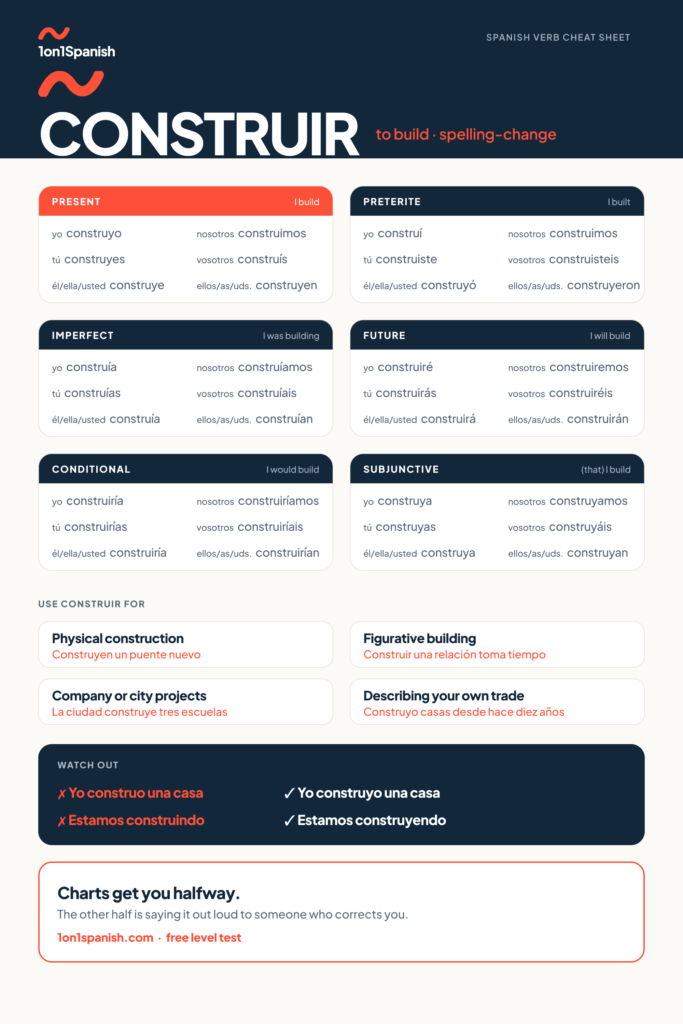
Take the chart with you
The chart is free to view and share. Drop your email and we’ll send the print-ready US Letter PDF — the version you stick on the fridge.
Practice
Practice construir with a real teacher
Charts get you halfway. The other half is saying it out loud to someone who corrects you on the spot. At 1on1Spanish you get 25-minute private lessons with a qualified native teacher, exercises built from the mistakes you make in class, and AI practice between lessons.
First month $1. No contracts, cancel anytime.
The fastest way to make this stick is to say it to someone. Learn Spanish online with a real teacher.
Take your free level testBuilt on RingTeacher's method — 700,000+ classes delivered since 2017, teaching English to Spanish speakers. Now in the other direction.
Frequently asked questions
Is construir regular or irregular in Spanish?
Regular in meaning, with a spelling change: the unstressed i of the stem becomes y whenever it would otherwise sit between two vowels. That covers most of the present tense (construyo, construyes, construye, construyen), the third-person preterite (construyó, construyeron), the whole subjunctive, and the gerund (construyendo). The u never changes.
Why does construir have a “y” in some forms but not others?
Spanish spelling doesn’t allow an unstressed i to sit alone between two other vowels — it gets written as y instead. That’s why construyo has a y but construimos doesn’t: in construimos, the i is followed by a consonant sound (the stress falls on the ending), so the spelling rule doesn’t apply.
What is the past tense of construir in Spanish?
Two forms. The preterite — construí, construiste, construyó, construimos, construisteis, construyeron — only takes the y in the third person. The imperfect — construía, construías, construía, construíamos, construíais, construían — is completely regular and describes an ongoing or repeated past action: construían casas de adobe en esa zona.
How do you say “build a relationship” in Spanish?
Construir una relación. The figurative use of construir works the same way it does in English — relationships, trust and careers all get “built” over time: construir confianza, construir una carrera. It’s just as common in everyday conversation as the literal, physical meaning.
Do I need the subjunctive of construir in everyday conversation?
Yes, mainly after hopes and doubts. Construya appears after espero que (espero que construyan el puente a tiempo) and after no creo que (no creo que construyan la torre este año). The subjunctive keeps the same y pattern as the rest of the irregular forms.